Senedd Home
Oggy Bloggy Ogwr
State of Wales
Sunday, August 9, 2026
  • About & Contact
    • About State of Wales
    • Comments Policy
    • Complaints Policy
    • Contact
    • Disclaimer
  • Elections Centre
  • The Independence Index
    • The Independence Index (Full)
    • Foreign Policy
      • Relations with the former UK & Ireland
      • Relations with Europe
      • Foreign Policy (General)
      • International Organisations & Law
      • Overseas Aid
    • Defence
      • Defence Policy
      • NATO
      • Armed Forces
      • National Security
      • Civil Defence
    • Rules & Regulations
      • Safety & Standards
      • Intellectual Property
    • Economics & Money
      • Business & Economy
      • Currency
      • Tax & Spending
      • Transport & Infrastructure
    • Society
      • Communities & Housing
      • Culture & Sport
      • Education
      • Health
      • Media & Communications
      • Science & Technology
    • The State
      • Environment & Natural Resources
      • Justice
      • Local Government
  • Support & Donate
No Result
View All Result
  • About & Contact
    • About State of Wales
    • Comments Policy
    • Complaints Policy
    • Contact
    • Disclaimer
  • Elections Centre
  • The Independence Index
    • The Independence Index (Full)
    • Foreign Policy
      • Relations with the former UK & Ireland
      • Relations with Europe
      • Foreign Policy (General)
      • International Organisations & Law
      • Overseas Aid
    • Defence
      • Defence Policy
      • NATO
      • Armed Forces
      • National Security
      • Civil Defence
    • Rules & Regulations
      • Safety & Standards
      • Intellectual Property
    • Economics & Money
      • Business & Economy
      • Currency
      • Tax & Spending
      • Transport & Infrastructure
    • Society
      • Communities & Housing
      • Culture & Sport
      • Education
      • Health
      • Media & Communications
      • Science & Technology
    • The State
      • Environment & Natural Resources
      • Justice
      • Local Government
  • Support & Donate
No Result
View All Result
State of Wales
No Result
View All Result
Home Feature Pieces

End of the Road?

As the Welsh Government announces a pause to review new road projects, is it the beginning of the end for new roads in Wales or nothing more than an empty gesture?

Owen Donovan by Owen Donovan
June 29, 2021
in Feature Pieces, Senedd
End of the Road?

Welsh Government, Crown Copyright

Share on FacebookShare on TwitterShare on RedditShare on BlueskyShare by email

Although it had been trailed in the new national transport strategy – published towards the end of the Fifth Senedd – last week, the Deputy Minister for Climate Change, Lee Waters (Lab, Llanelli), announced a pause on new road projects.

Here are the main points from his Senedd statement:

  • The Welsh Government’s target is for 45% of all journeys to be made by public transport, walking or cycling by 2045.
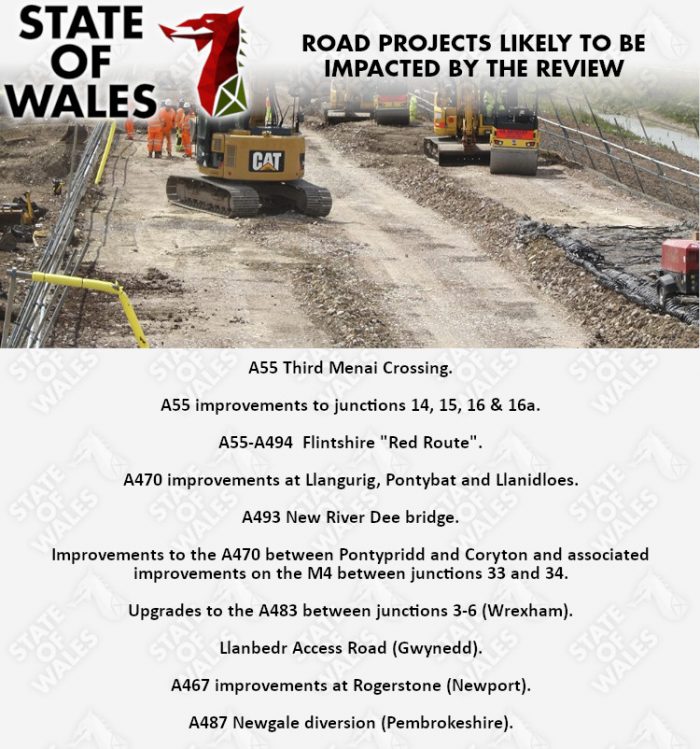
  • Proposed road projects wholly or partially funded by the Welsh Government (including road projects funded via the local government transport fund) will be paused for review. All road projects currently under construction or with work set to start imminently will continue.
  • That review – led by an expert panel – will decide whether the road projects “reduce the need to travel, allow people and goods to move more easily from door to door by sustainable forms of transport and encourage people to make the change (to sustainable transport).”
  • Funding will likely move away from building new roads to the proper maintenance of the existing road network.
  • Action will be taken to improve/increase bus priority measures, while bus fares will be reviewed as part of a reintroduced Bus Bill.

It’s already been announced that a proposed Llandeilo bypass – which has already been delayed until 2025 and formed part of a budget agreement between Labour and Plaid Cymru – won’t form part of the review.

The reaction to the announcement has been somewhat predictable. The Conservatives condemned it as being anti-trade and anti-business; Plaid Cymru agreed with the principle as long as it doesn’t come at the expense of areas that have been waiting too long for infrastructure improvements (i.e. areas that just so happen to vote Plaid Cymru).

The announcement has been greeted as a radical shift in policy. To a certain extent, it’s true. You rarely hear politicians argue against investment in new roads because they’re usually presented as primarily economic projects – they provide construction jobs and are seen as a means of opening land for development and investment. The case in point being the A465 dualling project.

Now it appears as though their value as pure transport projects – getting from A to B as efficiently as possible – will carry greater weight in the future, as will their impact on the environment.

Greenhouse gas emissions from transport are significant and will likely reduce as petrol and diesel engines are phased out. But that won’t solve congestion, improve road safety or necessarily lead to a reduction in air pollution (some of which is made up of particulates from tyres released by braking).

Modal shift – switching from private transport to public transport and walking/cycling – would still have to be the answer and an avenue the Welsh Government are pursuing. All indications are their approach isn’t having the effect they would like; the proportion of people who cycle and walk regularly remains fairly static despite increased investment in active travel.

It’s also unclear how the pandemic will affect attitudes towards public transport – possibly leading to a rush back to cars, just as the Welsh Government spends hundreds of millions of pounds on new trains and metro systems.

What makes the announcement slightly odd – lending itself more to being a gesture than genuine policy – is that the WelTAG process was designed to weigh up the impact of new transport projects before a final decision is made.

A shift to focusing on maintaining the current road network isn’t that radical either. In principle, adding extra lanes to the M4 and A55 and turning them into something you see in Los Angeles would count as improving the existing road network.

GET FACT: WelTAG (CLICK TO EXPAND/COLLAPSE)

  • WelTAG stands for Welsh Transport Appraisal Guidance.
  • WelTAG was established in 2008 to weigh up the benefits and impacts of proposed transport projects. In 2017, WelTAG was refreshed to take into account the sustainable development principles of the Wellbeing of Future Generations Act 2015.
  • WelTAG assessments have to address: the problems a proposal intends to fix, how it intends to fix those problems and the social, cultural, environmental and economic impacts (including value for money).
  • Impacts are scored on a seven-point plus/minus scale ranging from large beneficial (+++) to large adverse (- – -).
  • WelTAG is divided into five stages. Stages 1-3 cover outline proposals, the detailed business case and preferred options. Stage 4 monitors the impact of construction/implementation. Stage 5 monitors the impact after construction/implementation and lesson learning.

If WelTAG is deemed to be good enough, then surely pausing road projects is just a gesture (for the sake of a Greta Thunberg tweet and Channel 4 News interview) because they’ve already cleared at least some of the Welsh Government’s own hurdles – including an assessment of the project’s impact on the environment, model shift and the economy.

So the question now ought to be, “Has Lee Waters just ripped up WelTAG?”

If the Welsh Government have decided the only option they had was to pause road projects because their own assessment process for new transport projects isn’t rigorous enough, then the answer to the question has to be “yes”.

That raises all sorts of questions by itself, including whether the Welsh Government have been properly applying their own flagship Future Generations Act principles to road projects for the last four years – and it’s not as if climate change or air pollution are issues that have suddenly snuck up on them.

Tags: Air Quality & PollutionClimate & Climate ChangeEconomicsLabourRoad SafetyRoad TransportWelsh Government
Previous Post

Word Salad: Anthem Lessons & Party Boats

Next Post

YesCymru – Five years of progress, but facing new challenges

Owen Donovan

Owen Donovan

Archive

Categories

Copyright

Creative Commons Licence

State of Wales by Owen Donovan is licensed under a Creative Commons Attribution-NonCommercial-NoDerivatives 4.0 International License.

Subscribe by Email

Search

No Result
View All Result
No Result
View All Result
  • Go To Senedd Home
  • Go To Oggy Bloggy Ogwr
  • About & Contact
    • About State of Wales
    • Comments Policy
    • Complaints Policy
    • Contact & Subscribe by Email
    • Disclaimer
  • Features
    • After the UK
    • Chinny Reckon
    • Devil’s Advocate
    • How Wales Works
    • Road to Brexit
  • The Independence Index
    • The Independence Index (full)
    • Economics & Money
      • Business & Economy
      • Currency
      • Tax & Spending
      • Transport & Infrastructure
    • Society
      • Communities & Housing
      • Culture & Sport
      • Education
      • Health
      • Media & Communications
      • Science & Technology
    • The State
      • Environment & Natural Resources
      • Justice
      • Local Government
  • Elections Centre
  • Wales FAQ
    • How is Wales funded?
    • How are laws in Wales made?
  • Support & Donate