


The final four posts on local government and independence start with a look at money.
Firstly, a word of warning.
Due to the current perilous state of the UK’s public finances – and the incompetence of the last several UK governments – it would be difficult for anybody, let alone me ( without a university economics department or privately-funded think tank at hand) to make any projections on Welsh local government finances for the foreseeable future other than to say “things are looking a bit shit”.
I know full well when to cede to others’ knowledge of public sector economics.
So this post is more about policy options than spreadsheets and graphs. So it all comes with a healthy pinch of salt.

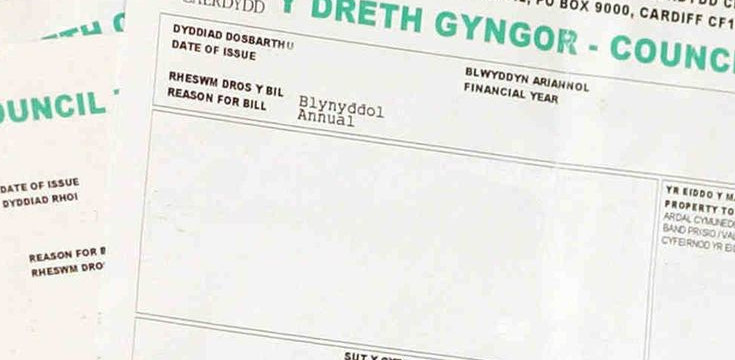
Council tax is perhaps the least popular tax levied in Wales. As you know, it’s based on property value. All domestic properties are placed into a band ranked A-I, with A being the least-valuable properties and I the highest. Band D is generally considered to be the benchmark “average”.
While there are discounts and concessions available, as council tax doesn’t take a household’s ability to pay into account it’s considered to be a regressive tax – meaning the least wealthy can sometimes end up with a higher tax burden than the wealthy. Although you would expect the wealthiest people to live in more expensive properties anyway, that’s not always the case.
Reform of council tax in Wales is on the agenda (a bit more on that in a moment), but it’s a topic that politicians have discussed at length yet not made moves to address – because council tax is so embedded in the local government funding system that replacing it would be very difficult and time-consuming. Some groups would lose out regardless.
The broad options are:
Maintain council tax as is – Council tax stays near enough the same, with the same number of bands. Maybe the furthest we would go is a property revaluation (the last one taking place in 2003). The main advantage is that we know roughly how much it raises each year (around £1.8billion).
Reform council tax – This is the road the Welsh Government, as part of the Labour-Plaid Cymru agreement, are going down. It sounds as though this will consist of a property revaluation and the creation of additional council tax bands. It’s unclear what effect this would have yet, but you assume it would be done to ensure roughly the same amount of money is raised each year while spreading the tax burden a bit more fairly.
Replace with a poll tax – Under a poll tax, each member of a household would be charged a flat annual fee with discounts and concessions available. As you know, the Conservatives attempted to introduce a poll tax in the late 1980s resulting in a backlash that helped bring down Thatcher. Council tax replaced it, but they’re both regressive taxes that don’t take ability to pay into account.
A return to domestic rates – Rates pre-date the council tax system and charged based on the rental value of a property rather than the property value itself. Northern Ireland maintains a system similar to this, with rates set by the Northern Irish Assembly and the unitary authorities based on the capital value of a property (capped at a maximum of £400,000). The formula used is:
The capital value of property x (regional/Northern Irish rate + local council rate)
So if you lived in a property valued at £200,000, the Northern Irish rate was set at 0.004574 and the council rate was set at 0.003394, the total amount payable that year would be:
200,000 x (0.004574 + 0.003394) = £1,593.60
A similar system is used for business rates.
Replace with precept-based system – Under this system, used to fund town & community councils, local government could only charge for the actual cost of providing services. So if a municipality’s planning department costs £150,000 a year to run, and there are 7,500 taxable domestic households in the municipality, the planning precept charged to each household would average £20. Say they decide one year to hire another planning officer – cost £35,000 – the departmental cost rises to £185,000 and the precept to £24.67.
The same would then apply to other council departments – waste collection, schools, social services etc. – net of any revenue funding and capital funding they receive from the Welsh Government or money raised through fees, commercial charges or fines.
Of course, the precept could be set to vary based on property value using bands similar to council tax. Councils would be allowed a reasonable contingency/reserves too, which can roll over if unspent.
Replace with a land value tax (LVT) – A land value tax has been mentioned as a council tax replacement in Wales. Instead of being charged based on the value of the property built on the land, it would be charged based on the value of the land itself.
A technical analysis commissioned for the Welsh Government, published in 20204, concluded:
- A land value tax should minimise exceptions and disincentivise landowners from deliberately degrading land (a separate vacant land tax has been mooted to deal with this).
- Consideration should be given to charging the landowner (i.e. landlord) rather than the occupier.
- There are major obstacles around “asset-rich, cash-poor” households (i.e. a retired widow living in an expensive house) and the impact a land value tax would have on them.
- It could replace land transaction tax (aka. stamp duty).
- It would require a complete register of land ownership in Wales (around 18.6% of land in Wales is unregistered – see also IndyWales & The Land Registry).
- A uniform national rate of 1.14% on domestic property land would average out at a £1,113 annual bill – raising nearly the same money as council tax in 2018-19 – with up to 59% of households paying less than £1,000.
This does suggest a land value tax would have to be set and collected nationally, then redistributed back to local authorities (similarly to what happens with business rates) otherwise it would be distorted by different land values. Cardiff, for example, would be able to charge a far lower rate than somewhere like Blaenau Gwent or Powys and raise as much, if not more, money.
Replace with a local income tax (LIT) – This is the other big proposal for replacing council tax.
The closest this has come to being implemented in the UK was in Scotland when a previous SNP-led Scottish Government (backed by the Liberal Democrats) drafted proposals to introduce a local income tax. When they were told by the UK Government (then controlled by Labour) that council tax benefit worth £380million would be withheld – and additionally later on discovered LIT it would leave £750million budget shortfall – the plans were dropped.
Some research has been undertaken on a local income tax for Wales5. The conclusions were:
- Local income taxes – such as those used in Denmark and Sweden – are usually set and collected nationally (ironically) and the idea that councils could set the local income tax rate was unpopular when proposed in Scotland (even if the idea of a local income tax was supported).
- An assessment of “ability to pay” could be complicated if things such as welfare payments & pensions, savings, dividends and income from self-employment were included as taxable income.
- There’s a debate over whether a local income tax should be charged based on whole household income, or charged to individuals (meaning different people living in the same household would receive different bills).
- Some discounts – such as for single-person households – could be removed under a local income tax.
- Transitioning from council tax to a local income tax “would need to be carefully planned” with some form of relief scheme in the short term for people who face sudden higher tax bills.
- There were no figures provided on how much a local income tax could raise in Wales, though a flat rate of 3% was proposed in Scotland.
4. ap Gwilym, Jones and Rogers (2019). “A technical assessment of the potential for a local land value tax in Wales.” Available at: https://gov.wales/sites/default/files/statistics-and-research/2020-03/technical-assessment-of-the-potential-for-a-local-land-value-tax-in-wales.pdf
5. Bunt, J (2020). “An assessment of the feasibility of a local income tax to replace council tax in Wales .” Available at: https://gov.wales/sites/default/files/statistics-and-research/2020-11/an-assessment-of-the-feasibility-of-a-local-income-tax-to-replace-council-tax-in-wales.pdf

