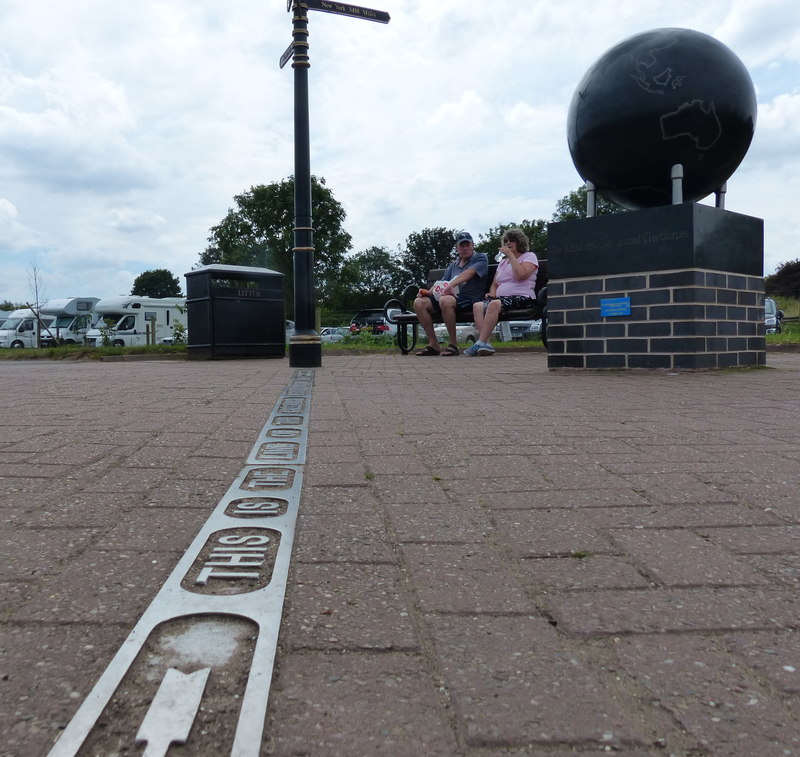
Image Source: © Copyright Mat Fascione and licensed for reuse under Creative Commons Licence BY-SA-2.0
Donations keep this site going. If you like what I’m doing here and think this work is important to the independence movement, consider a donation. One-off or monthly; as little or as much as you want. Click the links below, or full details are available here.
What Happens Now?
Wales currently lies within the UTC +00:00 time zone (the official global title). It’s also called Greenwich Mean Time (GMT) or British Summer Time (BST).
While the focal point is Great Britain and Ireland, it’s the same time zone used in Portugal (and Madeira), the Canary Islands, the Faroe Islands and Ireland.
It’s also partially shared with some West African countries, Iceland and Greenland – but they don’t use daylight savings time (“put clocks back/forward”).
Does This Work for Wales?
Yes.
This issue is discussed more often in Scotland. As Great Britain is a long, thin island, Scotland is somewhat disadvantaged by the current system, as winter mornings are often darker than elsewhere in the UK because Scotland is far further north.
More generally, the debate has focused on whether we should continue “putting the clocks back/forward” in the spring and autumn.
Independence & Time: Pros & Cons
We could set a time zone that suits us (yes, really). If we think that scrapping daylight savings or switching to a different time zone would be better we could do it.
There is some support for scrapping daylight savings time and switching to year-round summertime1. This would mean darker mornings but lighter evenings in autumn/winter.
There is some evidence that changing the clocks has negative health and economic impacts, supporting a fixed time all year round2.
It would be odd to be an hour or half-hour ahead or behind both Ireland and England (if we did decide to switch time zones).
Having a different time zone from England would cause serious problems for regular cross-border commuters.
Changing the time zone or scrapping daylight savings would present problems to early morning workers, particularly farmers. It could also make roads less safe for pedestrians and cyclists (if there were darker mornings), undermining the push to encourage people to walk or cycle more.
What Do Other Countries Do?
![]()
Iceland shares the same time zone as the UK and Ireland (UTC +00:00) but it doesn’t use daylight savings time. So in the summer, Iceland is an hour behind the UK.
![]()
India has a half-hourly difference from the time zones to the east and west (UTC +5:30), instead of the more common hourly difference.
![]()
There is a 45-minute difference (UTC +5.45) from the time zone to the west and a 15-minute difference from the time zone to the east.
What Options Does Wales Have?
The default option and the most practical and realistic one overall.
If an English Government decided to scrap daylight savings, then we would probably want to follow suit. This would make some sense, but we wouldn’t have to do it.
Wales would switch to British Summer Time (BST) all year round. Wales would be an hour ahead of England and Ireland between October-March if they didn’t follow suit.
Wales would be permanently an hour ahead of England and Ireland but would be within the same time zone as most of mainland Western Europe.
What's at Stake?
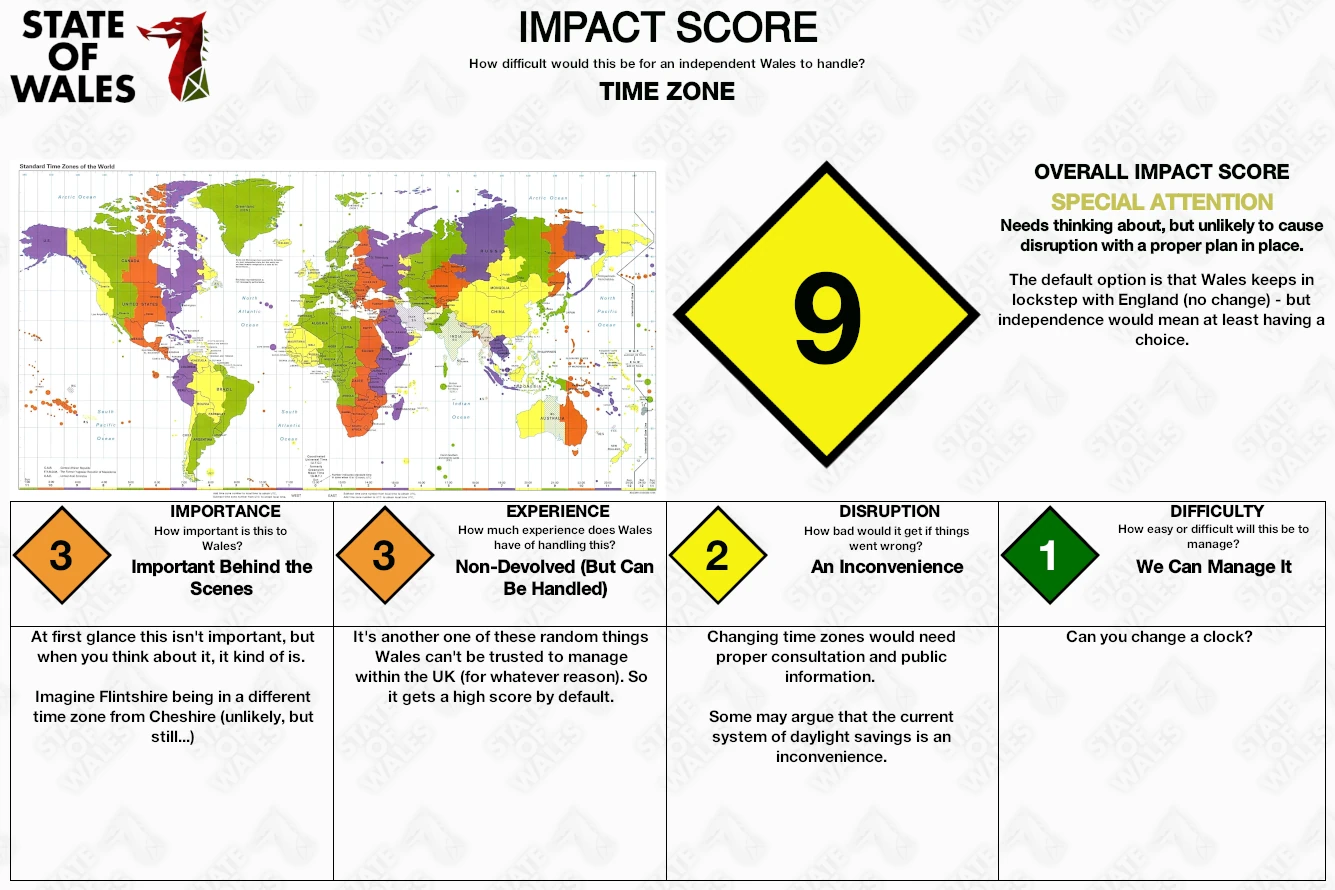
The overall score (out of 20) is the total of the scores for the four mini-categories (out of 5 each).
How Would This Be Run?
This isn’t something that’s managed. It’s just “done”. After independence, the Welsh Government would either change the timezone/scrap daylight savings through regulations or a very short law.
How Much Will This Cost?
Headline: No change; no costs.
No costs. This is what happens now.
No direct costs. It would need a public information campaign in the lead-up, but the indirect costs are hard to estimate.
Would any new taxes need to be introduced?
No.
Who will pay for this?
In the event of a timezone change or scrapping daylight savings, a public information campaign would be funded from general taxation (all taxpayers).
How Long Would This Take?
Changing the time zone or scrapping daylight savings would probably need the Senedd’s approval after independence – either as regulations or as a law.
Regulations may be approved within weeks of being drafted, though a law would take longer – probably the best part of a year.
People & Work
Everyone resident in Wales.
Though changing time zone would directly affect the estimated 117,000 cross-border commuters between Wales and England (both directions)3.
No, though having a different timezone or daylight savings policy from England may discourage employers from hiring people who have to cross the border to work for them.
YouGov (22nd October 2024). “Should we stop setting the clocks back?” 42% support scrapping daylight savings time, with a preference for keeping British Summer Time all year round if it was scrapped.
Prof. Joan Costa-i-Font, London School of Economics (19th March 2024). “Are we underestimating the costs of daylight saving time?”
StatsWales (2024). “Detailed commuting patterns in Wales by Welsh local authority”.
No AI tools were used to draft this post.