


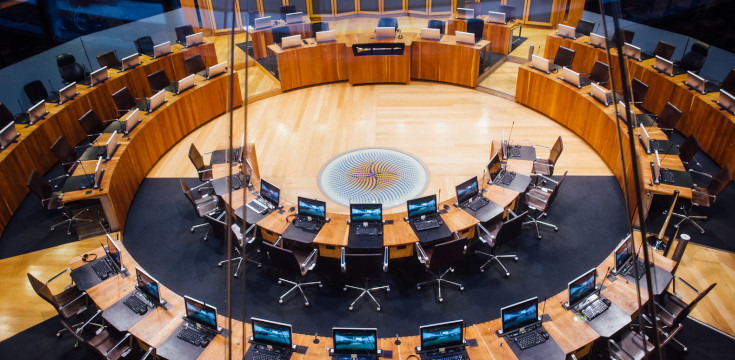
As you’ll probably know by now, in the last few weeks the (at least) second Senedd committee set up to consider electoral reform reported back (pdf).
The headline recommendations were:
- The number of Senedd Members should be increased from 60 to 96.
- All MSs should be elected using closed list proportional representation via the D’Hondt method (at the moment only the 20 regional list members are).
- The Senedd should have 16 constituencies based (initially) on pairing together the proposed 32 new UK Parliament seats. Each new Senedd constituency would elect 6 MSs. The constituency boundaries will be reviewed again by 2031.
- There should be a statutory gender quota, which would likely mean minimum numbers of male and female candidates in each constituency. It’s also recommended that candidate diversity monitoring is improved.
- More work should be undertaken to pave the way for future job-sharing and quotas for defining characteristics other than gender (i.e. race, disability).
On Wednesday, the Senedd backed the principles of the committee’s report by 40 votes to 14 meaning work can start on the necessary law changes.
With Labour and Plaid Cymru having a supermajority (two-thirds of MSs) between them – and a political mandate from the 2021 election to make changes to the Senedd – as long as there are no hitches, reforms ought to be in place by the next scheduled election in 2026.
The issue now is whether some of these recommendations, if enacted, could end up causing more problems than they aim to solve.
“By taking power away from us to vote for individual candidates it hands a hell of a lot of power to political parties that they don’t deserve.”
The following is the worst aspect of the proposals to the point where even I’d consider whether voting in Senedd elections would be worth the effort.
The committee recommends a closed list system to elect members. So as well as only having one vote (for a party), you won’t be able to vote for a particular candidate.
This doesn’t matter as much with the mixed-member system we have now. We at least have some decision-making power over our constituency representatives and the list members are there as a top-up to ensure a more proportional result overall.
The committee justifies their recommendation by suggesting we’re too thick to understand how STV works – basically saying we can’t count from 1-6 – and that MSs in STV constituencies could become too focused on constituency work (as though that’s a bad thing). If that’s a problem, why have constituencies at all?
By taking power away from us to vote for individual candidates it hands a hell of a lot of power to political parties that they don’t deserve. A closed list is deemed to be the only practical means to introduce a gender quota for candidates because there’s a risk that we might not agree with whoever the party chooses for us.
As long as a candidate can secure enough support within a party or a party branch – perhaps only a few hundred members or less – they would effectively be guaranteed a seat for as long as they want if they get consistently placed towards the top of a list.
Once you win a seat under D’Hondt it’s much harder to lose it than under the mixed-member system we use now because the party vote shares are often fairly consistent from one election to the next and first-past-the-post results would no longer be counted.
With “zipping” – where parties alternate between genders on their list (so a female may be elected first, the next seat they win would go to a male and so on) – some candidates may not even have to go through a selection process if they’re the right gender or there are too few candidates running.
There wouldn’t be any by-elections when vacancies arise; the vacancy will simply pass to the next person on the list. We had problems with that and defections during the last Senedd and everyone was demanding “something be done”, yet here we are set to entrench it.
There’s a need to carefully balance voter choice and proportionality with the need to improve the representation of under-represented groups. I get that and gender quotas aren’t the issue – even if it appears as though gender quotas may scupper the plans because the Senedd may lack certain powers in the area of equalities.
You can still have gender quotas under STV. The Republic of Ireland has a floor of 30%-per-gender (in candidate terms) and set to rise to 40%, though they have unquestioned power to do so as an independent country.
There are always solutions.
If MSs are determined to go with D’Hondt as a compromise between the current system and STV, then at least have an open list where voters have some influence over the order of candidates.
That could work by being able to overturn a party-list selection if a candidate receives a certain percentage of votes – and this was looked at in the committee report and rejected.
Or, two elections could effectively be run at the same time where we would have two ballot papers – the first to vote for (up to six) individual candidates to decide the order they run in each party list, and a second to vote for a party to determine the seat allocation.
There’s also the option of panachage, where you vote for up to six individual candidates. These votes are totalled to give votes for each party, which is then used to allocate seats proportionally – Labour would probably love that, the other parties not so much.
Another option – borrowing from America – is to run primary elections in the year before a general election to determine the order of candidates on the party lists.

