


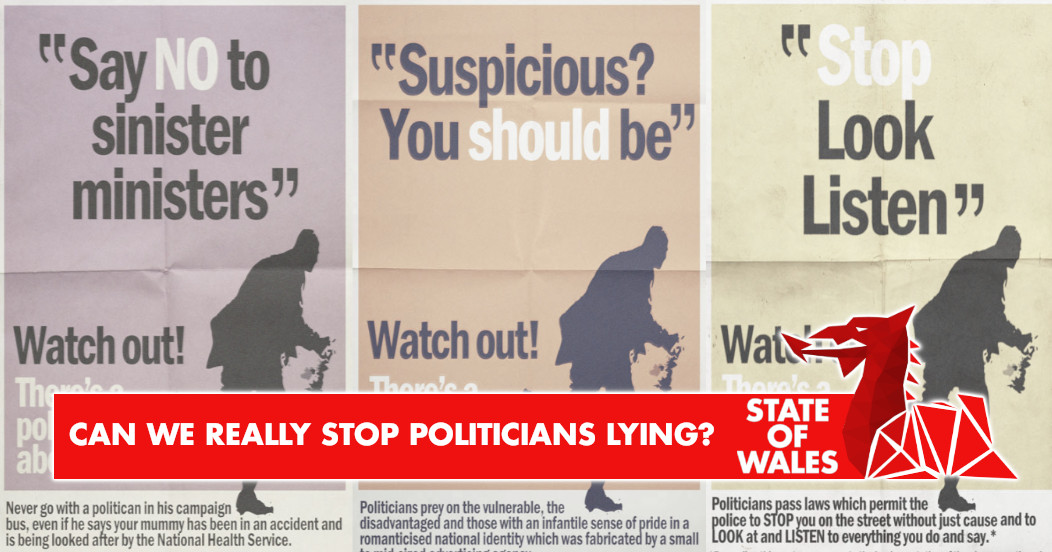
If you were unkind or cynical, you could describe politics as a marriage of convenience between the science of government and the art of lying.
Politicians – as a group – are considered to be dishonest. “No shit, Sherlock”. Polling from 2020 found that most 79% of those who responded thought politicians were only truthful up to half of the time, with 42% believing that politicians were only truthful for a fifth of the time1.
In the same poll, 68% agreed that any politician who lied during the 2019 UK General Election campaign should be treated as having committed a criminal offence.
That’s not to single out politicians. Other professions considered to be equally untrustworthy include journalists, people who work in finance, advertisers and the civil service2.
But it’s one thing to complain about something and another to attempt to do something about it. Step forward Plaid Cymru’s Adam Price MS.
1. Compassion in Politics (2020). “Public agrees: politicians who deliberately lie should be treated as criminals”. Available at: https://www.compassioninpolitics.com/lying_politicians_criminals
2. Ipsos (23th October 2023). “Politicians the least trusted profession, while doctors the most trustworthy.” Available at: https://www.ipsos.com/en-uk/politicians-least-trusted-profession-while-doctors-most-trustworthy

That’s the question we all ask – but they still do it. There may even be some situations where politicians are right to lie to us.
To change your mind (manipulation) – The whole point of politics (in a democracy) is to convince you that a particular politician or party is the right person to vote for. They don’t have to lie to do this, but some of the techniques covered in the previous section – oversimplification, half-truths, spin – are in the politicians’ toolbox.
There are different types of manipulation. Some politicians appeal to your heart, some to your head, some use their authority, and some use your sense of anger, injustice or danger.
To strengthen a weak position – If a policy isn’t quite cutting through, or inspiring enough people to react, then telling a quick fib on how important/vital or “bad” it is can go some way to turn people for or against it (depending on what the politician wants to achieve). This isn’t always a bad thing as it can bring issues to the forefront that would otherwise be completely glossed over.
Political marketing: performance and rhetoric – Politicians love the sound of their voices. They have to be slightly narcissistic to think they should make decisions for everyone else in the first place. Saying things that get a rise out of other politicians, the terminally online or unfriendly media is one way for politicians to promote themselves to the public and, much like strengthening a weak position, shine a spotlight on a particular cause.
Public relations and expectation management – Politicians usually have to be polite, unless being “a bad boy/girl” is part of their “shtick” (and there have been a few Senedd members like that). That means feigning interest and passion for subjects, organisations, events and people that they wouldn’t give the time of day to if they had a choice. It’s part of the “soft skills” needed to be a public representative.
Their public image has to be carefully curated to present themselves a certain way: “I really like that popular music artist, fellow kids. Now, how about that local sports team”. It also means letting people and organisations down gently, as well as being deliberately vague on occasion so they don’t over-promise or threaten to under-deliver. All lying, but not necessarily evil – just part of the job.
A “noble lie”: lying to achieve a good outcome – Related to the above. This could include being vague with details to protect a vulnerable person, or exaggerating a heartstring-tugging story to prod a government into action. It could also include over-promising or presenting the best possible picture to attract extra investment. There are plenty of examples at all levels.
To avoid the consequences of their own decisions, words and/or actions (aka. “digging a hole”, cover-ups) – This is a risky thing to do, but it works for a time – especially for populists. A strategic lie can deflect, distract and confuse.
A hole-digging politician hopes the media and public jump from controversy to controversy without giving themselves enough time to focus on one specific thing. The politician and/or their party will always “want to move on”. When they reach the point that they can’t move on – and the mud starts to stick – their political career is usually (but not always) fatally damaged.

