Senedd Home
Oggy Bloggy Ogwr
State of Wales
Sunday, August 9, 2026
  • About & Contact
    • About State of Wales
    • Comments Policy
    • Complaints Policy
    • Contact
    • Disclaimer
  • Elections Centre
  • The Independence Index
    • The Independence Index (Full)
    • Foreign Policy
      • Relations with the former UK & Ireland
      • Relations with Europe
      • Foreign Policy (General)
      • International Organisations & Law
      • Overseas Aid
    • Defence
      • Defence Policy
      • NATO
      • Armed Forces
      • National Security
      • Civil Defence
    • Rules & Regulations
      • Safety & Standards
      • Intellectual Property
    • Economics & Money
      • Business & Economy
      • Currency
      • Tax & Spending
      • Transport & Infrastructure
    • Society
      • Communities & Housing
      • Culture & Sport
      • Education
      • Health
      • Media & Communications
      • Science & Technology
    • The State
      • Environment & Natural Resources
      • Justice
      • Local Government
  • Support & Donate
No Result
View All Result
  • About & Contact
    • About State of Wales
    • Comments Policy
    • Complaints Policy
    • Contact
    • Disclaimer
  • Elections Centre
  • The Independence Index
    • The Independence Index (Full)
    • Foreign Policy
      • Relations with the former UK & Ireland
      • Relations with Europe
      • Foreign Policy (General)
      • International Organisations & Law
      • Overseas Aid
    • Defence
      • Defence Policy
      • NATO
      • Armed Forces
      • National Security
      • Civil Defence
    • Rules & Regulations
      • Safety & Standards
      • Intellectual Property
    • Economics & Money
      • Business & Economy
      • Currency
      • Tax & Spending
      • Transport & Infrastructure
    • Society
      • Communities & Housing
      • Culture & Sport
      • Education
      • Health
      • Media & Communications
      • Science & Technology
    • The State
      • Environment & Natural Resources
      • Justice
      • Local Government
  • Support & Donate
No Result
View All Result
State of Wales
No Result
View All Result
Home Constitution

Radical Wales: Democracy by Lottery

Should our political decision-makers be chosen at random?

Owen Donovan by Owen Donovan
November 4, 2024
in Constitution, Senedd & Elections
Radical Wales: Democracy by Lottery
Share on FacebookShare on TwitterShare on RedditShare on BlueskyShare by email
This site is best viewed in landscape mode on smartphones.
Support IndyWales? Support State of Wales!

Donations keep this site going. If you like what I’m doing here and think this work is important to the independence movement, consider a donation. One-off or monthly; as little or as much as you want. Click the links below, or full details are available here.

What is a "Democratic Lottery" (Sortition)?

It’s where the people who take part in political decision-making are chosen by lottery instead of being elected.

This could be a completely random selection. Or, it could be a selection where specific groups are picked to ensure fair and accurate representation of the public.

It’s very different from representative democracy (we elect people to make decisions on our behalf). It’s also different from direct democracy (because a select group of people will make decisions).

Sortition: Case Studies

Ancient Athens
The Jury System
Canada (proposed Senate reform)
Ancient Athens

Some bodies of the Athens government were made up of people chosen by lot using a primitive computer.

You couldn’t call it a “true” democratic lottery because the only people eligible to be drawn in the lots were adult men. The goal was to prevent power from being concentrated in too few hands. Those men selected this way were involved in drafting and voting on laws, ran the day-to-day services in Athens and administered the courts.

Other historical states which have used sortition (at least partly) in government include the Republic of Venice, while the concept of a “citizens’ assembly” is similar to sortition (more on that later).

The Jury System


The principle is the same as sortition; a random cross-section of the public (though this hasn’t always been the case as eligibility to serve on a jury used to be restricted to certain groups) make important decisions.

It grew out of the principle in certain legal cultures – that lacked a professional legal class – in which evidence in criminal cases should be heard and interpreted by the accused’s peers without bias.

Canada (proposed Senate reform)


While there has been a lot of debate (and little action) on reforming the UK’s House of Lords, similar debates have taken place (primarily in academic circles) on reforming the Canadian Parliament’s Senate – which is made up of appointees in a similar way to the House of Lords.

Sortition has been raised as a potential option, as has the prospect of a citizen’s assembly to consider constitutional reforms as a whole.

Sortition: Arguments For & Against

Arguments For
Arguments Against
Arguments For

Genuine representation – If legislators were selected by lottery instead of political parties then the odds increase that the body would be far more representative of the population as a whole. Even in the supposedly “more down to earth” Senedd, certain groups are over-represented. Sortition would give everyone an equal chance of becoming a legislator and, if needed, the lottery could be arranged in such a way as to ensure the appointed body accurately reflects the population.

A new kind of politics? – One of the biggest positives is the prospect that a legislative or decision-making body chosen at random would focus more on specific issues rather than power politics. Yes, people will still have strong opinions and personal relationships and power dynamics will continue to exist, but the “tug-of-war” stuff would likely be over things that matter to all of us rather than political obsessives.

Incorruptible? – In principle, it would be more difficult for vested interests and lobbyists to try and influence a decision-making body chosen at random. They could try, of course, but there’s always the chance that the people they’re trying to influence could be gone at the next lottery. There would be no career politicians. There would be fewer opportunities for those taking part to develop the kind of close relationships and networks which may lead to quid pro quo arrangements, or outright corruption…in theory.

Arguments Against

Loss of government effectiveness – Naturally, there would be questions over whether the average person selected at random could make better decisions than a full-time elected politician.

Sortition could make it more difficult to put together a serious long-term plan for governance or the economy, with the group jumping from issue to issue.

No political mandate – Winning an election gives a political party, or parties, a legitimacy or “right” to enact their policies (what you would normally call a “mandate”). Under a parliament or body chosen by lottery, no such mandate would exist.

As noted, there would be no manifesto, no strategy, no programme of law-making. So it would be impossible to tell what the group selected by lot would or wouldn’t do beforehand. While this would certainly give them more freedom and flexibility to react to events as they happen, policies would likely be guided even more so by the civil service (if they still exist in the same way).

Would it be more trustworthy? – A political body chosen at random would have little to no relationship with a constituency, local organisations or public services. How civically active its members were beforehand would be entirely down to chance.

Maybe that’s being unkind; we certainly place a lot of trust and responsibility on juries and they’re chosen at random. The problem is that we wouldn’t have any idea of the group dynamics (i.e. whether a few members of the body would come to dominate or lead others to go a certain way). There’s also a risk that the popular decision is chosen, rather than the “right” decision.

We would have no idea of the biases and prejudices of the members beforehand when we probably get a good idea of what a political candidate’s values are based on their party (or independent) allegiance when they stand for elections. Imagine the county being run by pub bores.

What Are The Alternatives?

If a political body chosen at random is a bit too far, then there are other valid alternatives:

Citizens' Assemblies
Deliberative Opinion Polls
Direct Democracy
Liquid/Delegated Democracy
Citizens' Assemblies

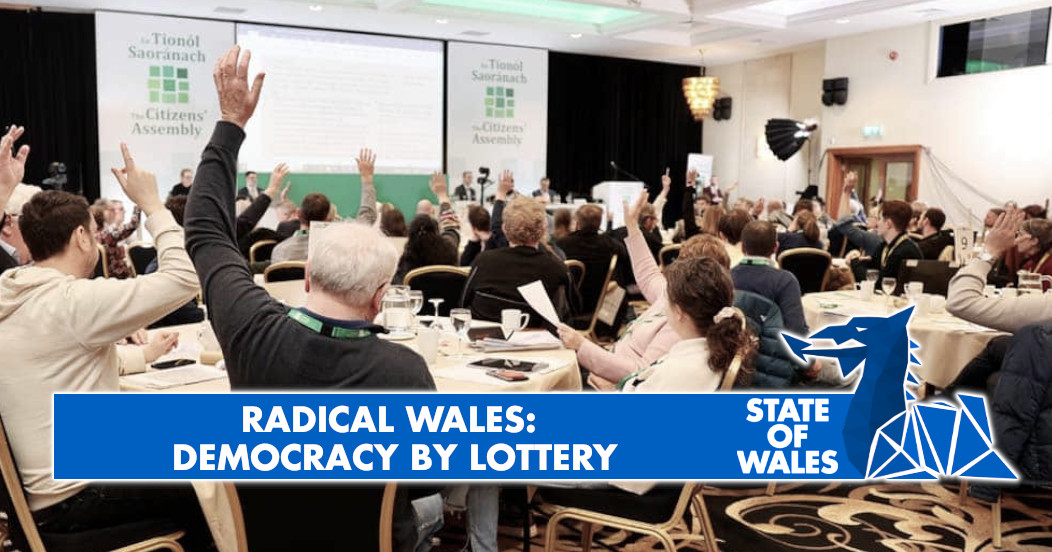
A body chosen largely at random to discuss specific issues and make recommendations on the way forward. In many ways, it’s sortition without any real “teeth” or a “focus group on steroids” but it has been trialled (to mixed success) in Wales before.

“Citizens panels” informed the McAllister-Williams Commission report on the future of democracy in Wales (The Constitutional Commission: A Soft Reboot), and one of the core recommendations was “for the public to become more actively involved in decision-making”.

Deliberative Opinion Polls

Similar to a citizens’ panel or citizens’ assembly. A cross-section of society is chosen at random to consider a specific matter or issue in depth. They’re polled at regular points after discussing the issue with politicians, experts and each other.

It would give politicians and decision-makers a better idea of how the public would react to a new policy or issue. It’s similar to the concept of “deep canvassing”.

Direct Democracy

Pretty straightforward. The electorate would get to vote directly on issues in referendums or trigger such a referendum. This was covered in more detail in Radical Wales: Direct Democracy.

Liquid/Delegated Democracy

A mix of proxy voting and direct democracy, where individual electors have a choice on how they vote, delegating their vote to someone else if they trust that delegate. It hasn’t been tried or tested on any great scale to date. This will be explored in more detail next week (Radical Wales: Liquid Democracy).


How Could Wales Introduce Sortition?

I don’t think we would ever see the introduction of Athenian democracy in Wales; it might’ve been fine for them at the time, but the demands of government are such that it would be impractical now.

There are avenues for some form of sortition to be introduced though. These are just a few examples. I’m sure there are others.

A Top-Up to Elected Senedd Members
A Second Chamber to the Senedd
A Permanent Citizens' Assembly of Wales
Use Sorition to Replace Local Councillors
A Top-Up to Elected Senedd Members

A certain proportion of the Senedd (for argument’s sake 20% of sitting members; 19 MSs in a 96-member chamber) could be chosen by lottery as a form of “democratic jury duty” (with pay, of course). The shortlisting could be done in such as way as to ensure a proper cross-section of Welsh society.

We already use something similar to this in the form of “partner members” of the Welsh Youth Parliament, who are selected by partner organisations “to ensure the representation of diverse groups of young people”.

A Second Chamber to the Senedd

Going one step further, if we ever decided to create a second chamber to the Senedd (see more at A Welsh Constitution: Size & Shape of the Senedd) then it could be selected wholly or partially by lottery. As mentioned earlier, there have been calls for the UK House of Lords and Canadian Senate to be reformed similarly (though it hasn’t caught on yet).

A Permanent Citizens' Assembly of Wales

This is perhaps the most realistic and deliverable option. A standing Citizens’ Assembly – reflecting the broadest cross-section of Welsh society – would become a permanent feature, with its own secretariat and formal role (similar to the Welsh Youth Parliament). The members of the Assembly can be rotated at set intervals, whether yearly or biennially. The selection process could be similar to jury duty (as in people selected from the electoral roll).

The Citizens Assembly might formally sit on a set regular basis (i.e. once every 2-3 months) to discuss issues referred to them by the Senedd as a whole, Senedd scrutiny committees, Welsh or local government.

Use Sorition to Replace Local Councillors

Given the problems political parties have had in drumming up enough interest to stand for local government (particularly town & community council level), could elected local councils be replaced by members of the community selected at random? Where there are uncontested elections this isn’t far off what happens anyway.

Perhaps the only people standing for election in each local authority would be the executive members. That could be as an elected multi-member Cabinet/Executive Committee or a directly-elected Mayor.

You Might Also Like....

Radical Wales: No Military
Armed Forces

Radical Wales: No Military

by Owen Donovan
December 10, 2025
0

...

Read moreDetails
Radical Wales: Conscription/National Service

Radical Wales: Conscription/National Service

December 10, 2025
Radical Wales: Open Source Nation

Radical Wales: Open Source Nation

January 20, 2025
Radical Wales: Liquid Democracy

Radical Wales: Liquid Democracy

November 11, 2024
Radical Wales: Legalise Drugs

Radical Wales: Legalise Drugs

July 15, 2024
Radical Wales: Direct Democracy

Radical Wales: Direct Democracy

May 13, 2024
Radical Wales: Transport Megaprojects

Radical Wales: Transport Megaprojects

February 26, 2024
Load More
Use of AI

No AI tools were used to draft this post.

Donations Welcome
Tags: ConstitutionElectoral Reform & SystemsPolitical EducationPolitical HistoryPolitical TheoryRadical WalesSeneddWelsh Government
Previous Post

Can we really stop politicians lying?

Next Post

Radical Wales: Liquid Democracy

Owen Donovan

Owen Donovan

Archive

Categories

Copyright

Creative Commons Licence

State of Wales by Owen Donovan is licensed under a Creative Commons Attribution-NonCommercial-NoDerivatives 4.0 International License.

Subscribe by Email

Search

No Result
View All Result
No Result
View All Result
  • Go To Senedd Home
  • Go To Oggy Bloggy Ogwr
  • About & Contact
    • About State of Wales
    • Comments Policy
    • Complaints Policy
    • Contact & Subscribe by Email
    • Disclaimer
  • Features
    • After the UK
    • Chinny Reckon
    • Devil’s Advocate
    • How Wales Works
    • Road to Brexit
  • The Independence Index
    • The Independence Index (full)
    • Economics & Money
      • Business & Economy
      • Currency
      • Tax & Spending
      • Transport & Infrastructure
    • Society
      • Communities & Housing
      • Culture & Sport
      • Education
      • Health
      • Media & Communications
      • Science & Technology
    • The State
      • Environment & Natural Resources
      • Justice
      • Local Government
  • Elections Centre
  • Wales FAQ
    • How is Wales funded?
    • How are laws in Wales made?
  • Support & Donate