Donations keep this site going. If you like what I’m doing here and think this work is important to the independence movement, consider a donation. One-off or monthly; as little or as much as you want. Click the links below, or full details are available here.
What is Direct Democracy?
The Political Machine
As mentioned in IndyWales & Democracy, at present most democracies – including Wales – are representative democracies.
That means we elect people to make decisions on our behalf. If a political party or group secures enough seats in a council or the Senedd, they have the mandate to fulfil their election promises as stated in their manifesto or equivalent.
Under a direct democracy – or “full democracy” (or whatever you want to call it) – political power is retained by voters. While elected representatives may still exist – to ensure someone is accountable for running things – many policy decisions are made by voters through referendums.
Direct Democracy: Case Studies
While who could play an active part in Athenian democracy was strictly limited (and wouldn’t be something we would consider particularly democratic or equal now), it was set up so that a sizable proportion of citizens were involved in one of the arms of the state in some way.
Certain assemblies were chosen by a type of lottery, while any citizen could propose a change to the law.
![]()
Probably the closest thing we have to a “direct democracy” at a national level (though it’s not a pure direct democracy).
The Swiss still have elected representatives and parliaments/councils at national, cantonal and local levels. The public can trigger a referendum on pretty much any issue they want, and the referendum is binding on the relative tier of government.
Proposed amendments to the constitution, membership of certain international organisations and urgent law changes automatically trigger a referendum (called mandatory referendums).
Other referendums – called popular initiatives – are triggered if a petition calling for one exceeds 100,000 signatures within 18 months. One is also called if a law receives 50,000 signatures opposing it within 100 days of being passed. The thresholds are lower at the cantonal and local level.
For the referendum question to be approved, there needs to be a majority vote nationally, as well as a majority vote in a majority of cantons.
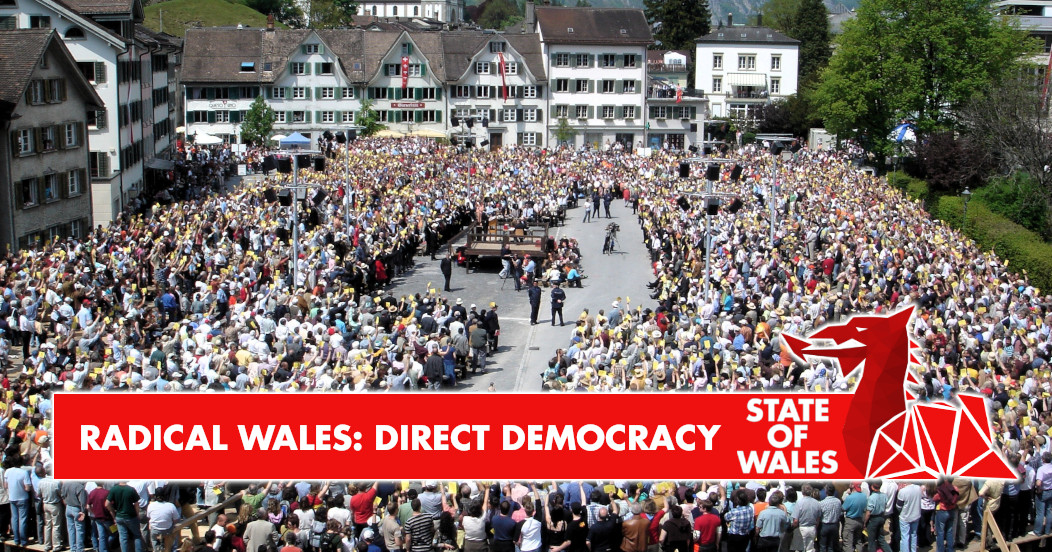
Switzerland averages around 4-5 national referendums a year; the number will be higher once you include canton and local referendums. Two Swiss cantons still hold mass public meetings to vote on local matters (landsgemeinde; pictured at the top).
![]()
A smaller scale version of direct democracy – described in more detail in Local Government: The Community – some parts of the United States use public meetings to make decisions for their equivalent of the town/community council tier of government.
Involving everyone in a community in decision-making empowers them, but there are drawbacks such as poor attendance and the possible dominance of meetings by the most vocal (though I’ll get into all this later).
Direct Democracy: Arguments For & Against
“Power to the people” – “Popular sovereignty” gives people the right to make decisions for themselves on important matters. We would be able to tell politicians: “We know you won the election, but we don’t like this policy you put in your manifesto”. Or, equally: “You should do this”.
As the purest form of democracy, it takes power back from elected politicians and gives it to everyone eligible to take part. Every vote has equal weight and the results won’t be skewed by the number of elected representatives from a given region.
Elected representatives may also be more easily swayed by lobbyists or other vested interests in a way that a member of the public wouldn’t be (or at least not in the same way – there’s always the media to do that).
Decisions have greater legitimacy – In a representative democracy, election results will determine what gets done, which party gets to do it and which individuals will be in charge of doing it.
As mentioned, a party/parties that win an election may have a manifesto which has a few controversial or radical proposals that would otherwise be unpopular. Asking the electorate to make decisions on controversial or “high impact” policy proposals outside of an election would, therefore, give those decisions greater legitimacy.
The public would act like an additional chamber of a legislature (of sorts). It would force politicians and other public officials to consider the full impact of certain issues, not hide away from them (an obvious example at a Welsh level would be the 20mph speed limit issue). Direct democracy can, therefore, be a means of settling controversial issues.
The public would need to better inform themselves – This is easier said than done, but direct democracy would, at least, require anyone wanting to vote or speak to properly research a topic beforehand.
The government, election bodies, elected politicians and the media would all need to up their game and properly explain the pros and cons of whatever is being discussed and the reasoning behind it. It’s not something we get with representative democracy as most of these discussions take place (if not quite behind closed doors) in a bubble.
Tyranny of the majority – Asking the largest number of people to make a decision doesn’t mean the decision made will be the right one. On pretty much all measures it’s clear that leaving the EU has been the “wrong decision”, but it has to be followed through because “the people have spoken”.
It can be quite easy for a less informed electorate to be manipulated by disinformation and other tactics. There would be a risk that minority groups would find themselves on the wrong side of a popular referendum and face oppression or persecution too.
Some issues are better left to experts (and I’m not necessarily including elected politicians in that, because they’re often not experts). That’s especially true for highly technical and ethical issues where many different factors cross over each other and require a careful approach. Obvious ones would include euthanasia/assisted suicide, abortion and equality issues.
It takes more time and effort – Can you imagine having up to a dozen separate votes a year? It’s hard enough trying to get people to vote once a year.
Even in Switzerland, turnout in referendums is low – usually in the 40-50% range, which isn’t that dissimilar to turnout for Senedd elections. There could be cultural issues as well, as it’s probably far easier for direct democracy to work in “popular sovereignty” societies that have been built with it in mind from the very start.
In Wales, what we’re used to is a select group of people making decisions on behalf of all of us – if not always to our benefit. Trying to get out of that mindset and taking more responsibility for ourselves will prove an uphill struggle.
It’s easier to buy opinions – While strict rules can be put in place on how referendums (or other forms of direct democracy) are conducted, there’s always a risk that vested interests could bankroll a campaign.
There would be a risk that the issue itself wouldn’t be in the minds of voters, but the quality and impact of the associated advertising, “entertainment value” and sloganeering. The phrasing of the question can also manipulate an outcome.
Referendums and alike are often pretty blunt tools – a simple yes or no. They might not reflect the nuances or details. This suits populists (IndyWales & Political Parties) and it also undermines any representative democracy (in our case, the Senedd and local councils) that sit alongside the direct democracy.
What Are The Alternatives?
Starting with the least radical and going on to the most radical:
One of the quirks of the UK’s current unwritten constitution is that referendums are not legally binding because only the UK Parliament has the power/sovereignty to make policy. While it’s politically difficult for the UK Parliament to overturn a referendum result, constitutionally it’s still possible.
Â
A bit of a political buzzword, but co-production essentially means service users having a say in how those services are delivered alongside public officials. Participatory democracy – something that was recommended as part of the McAllister-Williams Commission (The Constitutional Commission: A Soft Reboot)– would involve the public in decision-making (such as setting budgets) without necessarily giving them a final say; a sort of public consultation on steroids.
Â
 Members of the public, representative of the population, are brought together to discuss a particular issue in-depth and present those findings and views to elected representatives. While to date they’ve acted more like glorified focus groups, they could be given a constitutional role. The government and councils could be legally obligated to set up (and consider the views of) citizens assemblies in certain circumstances (i.e. changes to the constitution, controversial law proposals).
Â
Based on the Swiss model, this would mean triggering a referendum on any issue if that issue receives a minimum number of petition signatures. It would enable the public to decide on controversial or high-impact policy issues instead of leaving it to politicians.
Â
This might be worth looking at in its own right as a follow-up to this post (Radical Wales: Democracy by Lottery).
Instead of holding elections to choose politicians, politicians are chosen from the public by a lottery. This might make it easier to form a representative body (like a council) that’s properly representative of the community (i.e. gender balance).
Though like any “civic obligation” it has its obvious drawbacks; not many people look forward to jury duty and you can’t be guaranteed that a body chosen by lottery will have the right levels of expertise.
Â
Another concept worth looking at in more detail in its own right (Radical Wales: Liquid Democracy)
People would be able to either vote on issues themselves or delegate their vote to someone else. It means that people can be as involved or uninvolved in politics as they like. They might decide to act as a delegate for issues that they have a certain level of expertise or passion about, then delegate their vote to someone else for issues they have no strong opinions on.
How Could Wales Introduce Direct Democracy?
If direct democracy was introduced in Wales, it would likely be along similar lines to Switzerland.
So we would still have elected representatives in the Senedd and local councils proposing laws and policies, but they would be required to hold referendums on certain issues.
There could be several circumstances where a referendum is mandatory:
- Material changes to the constitution. This could include electoral reform, reorganisation of local government, membership of international organisations or anything relating to human rights or civil liberties.
- Any new law that projects an increase in revenue spending above a certain threshold (for argument’s sake, £50million in a single financial year at Senedd level). Or, any law that receives a certain number of petition signatures opposing it within a certain amount of time of it being passed by the Senedd.
- The introduction of completely new taxes or the abolition of existing taxes.
- Any proposed change to state assistance that is assessed would leave those affected (for argument’s sake) £1,000-a-year better or worse off (i.e. retirement age, welfare reforms, withdrawal or establishment of universal benefits).
- Criminalising/decriminalising previously legal/illegal behaviours that have a significant social impact (i.e. drug decriminalisation).
- Any issue where a petition calling for a referendum exceeds a set threshold of signatures from people registered to vote in Wales.
The Swiss threshold of 100,000 signatures to trigger a referendum is the equivalent of 1.8% of registered voters. A Welsh-equivalent figure would be around 40,000. At present, a petition to the Senedd that received 10,000 or more signatures triggers a debate.
If the threshold was set at 30,000 signatures, based on petitions submitted to the Sixth Senedd so far this would potentially mean that referendums would be held on:
- A ban on greyhound racing.
- Reversing the 20mph default speed limit in built-up areas.
- Compulsory teaching of the histories of people of colour in the Welsh curriculum.
- Reinstating cervical cancer screening to three-year intervals.
Historic/archived petitions that would have crossed the threshold include:
- Allowing supermarkets to sell non-essential items during Covid-19 lockdowns (it might not have been practical to hold a referendum on this).
- Overturning a decision to close A&E services at Withybush Hospital.
Including the other criteria, it would potentially mean referendums during the Sixth Senedd on:
- The Senedd (Elections & Members) Bill – increasing the number of MSs, changing the voting system etc.
- The Electoral Candidates Bill – proposing gender quotas for Senedd constituency lists.
- The Agriculture Bill – which partly prompted protests from farmers earlier in 2024.
- Local Government Finance Bill – proposing reforms to council tax.
So the Senedd would still be responsible for drafting laws, but in certain circumstances, it would be for the public to approve them.
Also as in Switzerland, if the Senedd disagrees with a petition they could propose a compromise “third/alternative” option on referendum ballots.
Â
You Might Also Like....
No AI tools were used to draft this post.