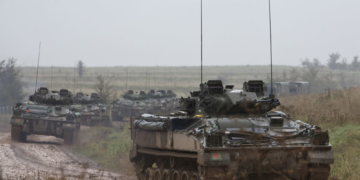
Image Source: Finnish Defence Forces/Puolustusvoimat via YLE
Donations keep this site going. If you like what I’m doing here and think this work is important to the independence movement, consider a donation. One-off or monthly; as little or as much as you want. Click the links below, or full details are available here.
What Is Conscription?
Conscription is compulsory service to the state. This usually, but not always, means spending a set period of time in the country’s armed forces (even during peacetime).
For those who cannot take part in military service (for religious, physical fitness or moral reasons), there are usually civilian or public service alternatives offered.
In most cases, this applies only to males. Though some countries either conscript/draft females on the same basis as men (Sweden, Norway), or allow females to take part in national service voluntarily (Denmark, Finland, Switzerland).
The UK had peacetime conscription between 1949 and 1960 (National Service).
In light of the increased threat posed by Russia (and other factors), some countries bordering Russia have either extended conscription (i.e. to women), have reintroduced some form of conscription, or are actively considering it.
“Bring back National Service” – usually not for defence reasons but “to build character” – has been a long-running right-wing trope in UK politics, and this has probably gone a long way towards damaging the idea. A watered-down version made it into the Conservative manifesto for the 2024 UK General Election1.
Case Studies
Finland, Switzerland and Denmark – each of which has conscription – have all featured in the defence and independence Q&A section in one way or another already.
![]()
- Both males and females are conscripted. It’s considered a “weak” form of mandatory military service. This is because while responding to a conscription notice is mandatory, taking part is mostly voluntary.
- Only around 1/6th of the eligible age group (19-year-olds) reach the point of being called in for an assessment, and conscription can be turned down at that point. Around 7,500 conscripts serve in the Norwegian Armed Forces each year2.
- Military service lasts for between 12 and 18 months and is unpaid, though conscripts are provided with what they need.
- There’s no alternative form of national service, though conscription can be turned down because of a person’s beliefs/conscientious objection.
![]()
- Latvia reintroduced conscription (“National Defence Service”) in 2023 in response to the military threat posed by Russia; it was previously active between 1991 (independence) and 20073.
- Conscription is compulsory for males born after January 2004 (19 years old at the time of reintroduction) and voluntary for females and older males. People who apply voluntarily have some control over which unit they serve in.
- The reintroduction has been delivered at a deliberately slow pace. The expectation is for 4,000 conscripts to be drafted each year, but the first intake numbered in the low hundreds.
- Military service lasts for 11 months, with 5 years on active reserve. Conscripts can join the military full-time after 6 months.
- There’s an alternative civil service available within the Ministry of Defence.
![]()
- Austria has mandatory conscription for males; females can apply voluntarily.
- This normally occurs between the ages of 18 and 35.
- Military training lasts for 6 months. After this, the conscript has the option of joining the military full-time (requiring a further 12 months of training) or joining the Austrian militia/reservists (who are paid a monthly fee and additional top-up pay).
- There is an alternative national community service available for conscientious objectors. This includes working in the emergency services or in health & social care.
![]()
- Singapore has mandatory conscription (National Service) for male citizens. Women can take part voluntarily.
- By law, this happens between the ages of 16 years, 6 months and 40, but normally occurs at age 18.
- Conscription isn’t limited to the military; conscripts can be drafted into the Singaporean Police and Civil Defence Force in addition to the Armed Forces.4
- People who join the Singaporean uniformed services full-time/as a career don’t take part in National Service.
- Conscription can only be delayed in most cases. While there are exemptions on medical grounds, there is no alternative service for conscientious objectors. Evading conscription is a criminal offence.
- National Service lasts for 2 years, with a further 10 years on active reserve and an obligation either until the age of 40 or 50 if the conscript is a senior NCO, technical specialist or commissioned officer.
Conscription: Arguments For & Against
Defence becomes everyone’s responsibility – Many things are described as “civic responsibilities” or obligations, argued to include voting in the case of Wales. By extension, you could include defending the country and civil resilience.
As well as increasing the awareness of government policies, it may help create a shared sense of purpose.
It’s highly unlikely that conscripts would ever be deployed overseas, but military training and skills could improve the local response to natural disasters like flooding by increasing the availability of trained people in the community. Conscription may also pass on leadership, teamwork, organisation, decision-making skills under pressure and hands-on practical/problem-solving skills to a wider range of people.
Fewer personnel worries – Conscription is, for the most part, cost-effective. Personnel costs are reduced (conscripts usually aren’t paid), but personnel numbers remain steady. We wouldn’t need to worry as much about missing recruitment targets, and we can increase or decrease the number of people conscripted based on military requirements at any given time.
There’s a fairness angle to it – Poorer communities have, historically, been targeted for military recruitment (for enlisted ranks at least), and we have experience of this in Wales5. While the military can provide a career and grounding for many people, the negative fallout from that ends up being carried by the people and communities who can cope with it the least.
Barring medical reasons, if everyone had to (in principle) serve time in the military (or some form of alternative service), it would spread that social burden out a bit more. It wouldn’t prevent anyone from joining the military full-time if they wanted to, and most countries that have conscription allow a delay for students.
Additionally, it would be a certainty that if conscription were reintroduced now, women would be called up on the same terms as men (as routinely happens in the Nordic countries), and there would also be an element of randomness to it in terms of assignments.
Professional militaries are better (for the most part) – There are good reasons why peacetime conscription in the UK didn’t last very long. It’s far easier to train people to the necessary standards needed for military service if they want to be there rather than being forced to.
There’s also a generational fairness issue. While nobody can control events, even if there were good reasons to bring back peacetime conscription, there would be pushback from younger generations for having to do something that older generations didn’t have to. Nobody under the age of 80 or so will have faced conscription in the UK.
It would make some sense to focus on making a military career something young people want to do, so they put some effort into it, rather than a period of involuntary work that some of them may end up resenting.
A waste of time for Wales? – Conscription is a good idea (if not necessary) in cases where a small(ish) country is surrounded by hostile neighbours. Or, when a country’s professional military is likely to be stretched too thinly to be effective (i.e. during a major war or frozen conflict).
Like it or not, this isn’t the 1400s anymore, so England and France can be discounted as hostile neighbours. The biggest geopolitical threats to Wales as of 2025 are climate change inaction, Russia (like the rest of democratic Europe) and America’s democratic backsliding.
For all of the skills conscripts may or may not learn, it’s also taking a sizable number of young people out of the economy, possibly for up to a year or more.
Moral and ethical arguments – There are practical and economic arguments against conscription, but fairly solid moral ones too. Firstly, the idea that the state forcing someone to do something against their will is wrong, even if conscription often falls outside the definition of “involuntary labour/slavery” in human rights laws.
A form of alternative service is usually offered by countries that retain national service, but not all of them do so. If we didn’t, it would lead to pacifists and other conscientious objectors facing punishment or being publicly shamed for their beliefs.
What Are The Alternatives?
Wales maintains a full-time/professional military made up of volunteers and people who want to join the military as a career. Simple.
The questions around what that might look like have been explored elsewhere on the site.
How Could Wales Introduce National Service?
There would likely be some underlying principles applying to all possible models of conscription.
- It would happen between the ages of 18 and 24 for both men and women, physically and mentally able to take part, with a delay available for full-time students.
- There would be an alternative form of public service for those who don’t want to take part in military training (i.e. community voluntary work, health & social care, emergency services), and this would be offered on an equal basis.
- Conscripts wouldn’t be paid, but would be provided with everything they need.
- The military element would cover the equivalent of Phase 1 (basic) and Phase 2 (technical/role) training and would probably last for up to a year, with a period on non-active reserve (i.e. voluntary paid refresher training for 5-10 years).
- The alternative service may last longer to compensate for the lack of a reserve element (18 months to 2 years).
Based on 2023’s population estimates6, the potential total pool of people eligible to be conscripted each year (18-24 year olds) would be around 266,000. If up to 40% of them were deemed unfit or unsuited in some way, this would fall to around 159,000.
In practice, it would mainly be 18-19-year-olds and recent graduates (21-22-year-olds) taking part. That works out at around 91,000 potential conscripts (after the 40% reduction).
As for the delivery model itself:
This would be similar to Norway. While it would be compulsory for anyone eligible to take part in conscription to register and go through the screening process, they would have a choice as to whether to take part or not (without penalty).
This would be similar to Denmark. The number of places for conscripts each year would be limited. So while everyone would need to register and go through screening, only a select number of those eligible would actually start their national service.
This would be similar to Latvia. The age for mandatory conscription may be lowered to 18-19, but those who volunteer after this age (such as those completing full-time education) would get a choice and more control over their posting or training.
Everyone eligible takes part, with very few exceptions.
There would be a penalty for not taking part or seeking an exemption (whether in military service or alternative service). That could be in the form of a criminal penalty (such as a heavy fine or, ironically, community service) or a social penalty.
A social penalty could include paying a higher rate of tax (as happens in Switzerland even for those exempted from national service, though this could be considered a means of “buying your way out” of it), having access to certain forms of welfare restricted, or being barred from applying for public sector jobs (“if you’re unwilling to undertake your obligations to the country as a citizen, the country has no obligations towards you”).
You Might Also Like....

Sean Seddon, BBC News (26th May 2024). “What is the Tory national service scheme and how might it work?“
The Norway Guide (July 28th 2022). “What The Military Conscription In Norway Is Like (Is It Really Optional?)“
Prof. Maris Andzans, Foreign Policy Research Institute (May 20th 2024). “The First Year of Conscription in Latvia“
Government of Singapore, Central Manpower Base. “About Us“
Senedd Cymru Research Service (29th September 2015). “Armed forces recruiting in schools?“
StatsWales. “Population estimates by local authority and year (mid-year 2023)“. 16 and 17-year-olds have been discounted from the totals for Wales in the 16-24 age group.
No AI tools were used to draft this post.