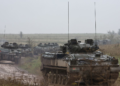
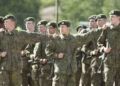
Image Source: Crash71100 via Flickr, Public Domain
Donations keep this site going. If you like what I’m doing here and think this work is important to the independence movement, consider a donation. One-off or monthly; as little or as much as you want. Click the links below, or full details are available here.
What Would Not Having A Conventional Military Mean?
You might think this is self-explanatory, but it isn’t.
At a basic level, it means Wales would not have traditional armed forces (an army, navy, air force or a combination of them).
That means not having a state-funded and state-trained uniform service authorised to use force to support the country’s foreign and defence policies.
As will be touched on later, this wouldn’t mean that Wales can’t have a military-style service with a tweaked role.
Case Studies
There are plenty of examples of independent countries that don’t have militaries because they’re too small to maintain or need one (i.e. European microstates like Liechtenstein and Monaco, as well as isolated island states like Samoa, Vanuatu and Kiribati). These aren’t useful case studies.
![]()
Iceland has already featured in parts of the independence and defence Q&A section.
- Despite not having a conventional military, Iceland is a NATO member.
- Iceland has largely outsourced its defence requirements to NATO and/or through agreements with different countries. So, despite having no military, Iceland has air defence capabilities and air bases in Iceland that NATO members use (particularly the United States).
- Iceland maintains a Coast Guard for maritime patrols, as well as search & rescue. There’s also a Crisis Response Unit, which can be deployed overseas on peacekeeping operations. About 400 people serve in both uniform services.
- National security duties are the responsibility of Iceland’s national police force.
![]()
- Costa Rica has a constitutional ban on having a permanent standing army following a civil war, but does allow a military to be established for national defence1.
- Most defence and national security tasks are undertaken by the Fuerza Publica (Public Force). This is a paramilitary national police force/gendarmerie.
- The Fuerza Publica has land, sea (National Coast Guard Service) and air (Air Vigilance Service) capabilities2.
- There’s also an elite special forces unit for more risky operations (Special Intervention Unit).
Â
![]()
- Panama abolished its standing armed forces in 1990 after a successful US invasion and subsequent overthrow of the then dictator, Manuel Noriega.
- The Panamanian military became the Panamanian Public Force – a paramilitary police force/gendarmerie.
- It includes a land element (including a dedicated border security unit) and a merged air and maritime force.
Â
![]()
- Mauritius doesn’t have a conventional military.
- Defence and national security tasks are undertaken by the national police force (Mauritian Police Force), which has around 12,500 officers.
- The Mauritius Police Force includes a Coast Guard for maritime and air operations.
- Around 1,500 members of the police force form a Special Mobile Force, which acts as a paramilitary unit and uses military tactics3.
No Military: Arguments For & Against
In practical terms, Wales doesn’t need a military – If we were to focus purely on Wales’ domestic defence and national security needs (and we didn’t want a force capable of deploying overseas) then most of that could be undertaken either by the police (in tandem with the other uniform emergency services), or a small, standalone, highly-trained paramilitary unit.
Geography screws Wales over in many ways, but in terms of defence, we’re in one of the safest parts of the world: tiny airspace, tiny maritime zone, two friendly maritime powers nearby (England and France). Even on issues like counter-terrorism, the police are more useful.
While we would need a way to address threats, Wales having a full-blown military would be a decision led more by foreign policy – and wanting to play a full part in organisations like NATO and the UN – than any practical need at home.
It would save a lot of time and money – Whilst defence isn’t the biggest contributor to Wales’ “national deficit”, within the UK, Wales proportionally contributes a large sum of money towards UK defence spending (between £2.5-2.9 billion a year as of 2023-244). It’s an easy target/”low-hanging fruit” to cut back on in terms of independence.
Also, establishing a military from scratch would be a lot of work. It would probably take up to a decade for Wales to be in a position to deploy a military overseas (i.e. on a peacekeeping mission). Scaling that back and focusing on an alternative model – or making the most of what’s already there (i.e. police, reservists, emergency services) – may make more sense practically and financially.
The moral/pacifist argument – Of course, this will divide opinion. I don’t agree, but there will be a sizable proportion of people in Wales, particularly from the non-conformist tradition and peace movements, who would be happy if Wales didn’t have “an ability to wage war”.
Warfare, spending money on arms, and maintaining armed forces, are likely to be incompatible with the Wellbeing of Future Generations Act, for one5 – unless specifically exempted.
Maybe there are better ways of guaranteeing security and defence. Sometimes the most effective means of defence are actions every single one of us can take: non-violent protest, non-cooperation, general strikes, passive resistance, direct intervention that falls short of lethal force (i.e. martial arts). Taken together, this has been called civilian-based defence6.
It could hamstring our foreign policy – As noted, foreign policy is a big driver of defence policy. This can be in both soft power (disaster relief, peackeeping, humanitarianism, state “pomp”) and hard power (obvious) terms.
The examples from earlier prove that countries don’t cut themselves off from the rest of the world if they don’t have a military. They aren’t automatic targets for invasions or attacks either. Some, like Iceland, are even members of NATO.
However, not having a military capability would take some soft and hard power options off the table and may limit what Wales can or can’t do to support our foreign policy goals (i.e. taking full part in UN peacekeeping missions).
There are certain tasks that can only be carried out by a trained military – Diplomacy should always be the first option to resolve conflicts, with force being the last resort.
Though putting it bluntly, there are plenty of bad actors out there who only understand violence and, like it or not, act in a way that should lead to them finding themselves on the wrong end of a bullet or missile. That would include protecting, for argument’s sake, a Welsh peacekeeping force working under a UN mandate.
Even those countries listed earlier as examples of “not having a military” still have some government or law enforcement agency capable of using military-like force when needed.
Defence freeloading – In a scenario where Wales doesn’t have a conventional military, we would probably expect England (and/or NATO) to do our defending for us if we were (for whatever reason) attacked or threatened.
Russia is already sniffing around undersea infrastructure in (or just outside) what would be Welsh territorial waters. Due to Ireland’s lack of fast-jet capability, the RAF effectively has to patrol Ireland’s airspace for them too.
Sometimes being a responsible independent country means doing things you don’t like, choosing options that are hard work and take a long time to realise. Getting high on our own farts for the sake of occupying the moral high ground would do more damage to Wales’ global reputation than pulling our weight when our allies and neighbours expect us to.
No Conventional Military: What are the options?
Wales outsources defence responsibilities to another country or alliance through a treaty. This would mean that the partner country (or countries) would use Wales’ defence facilities. Wales may still have a military of its own, but it would be a civil force or law enforcement agency (similar to Iceland’s Coast Guard, or a gendarmerie).
Not having a military of its own hasn’t impacted Iceland’s independence. However, it may be tolerated more because of Iceland’s strategic location in the North Atlantic and small population (meaning that even if Iceland did have a military, it wouldn’t be very big anyway). So this might not be as practical an option for Wales as it has been for Iceland.
Under this option, Wales would establish a civilian uniform agency that would concentrate on (armed) law enforcement and civil protection duties, peacekeeping, emergency management and humanitarian tasks.
It would effectively be a military without a combat role – though they would probably still be trained to use weapons and would have air, sea and land capabilities. While such an agency would take on specialist tasks at home (search and rescue, counter-terrorism, civil defence, border controls, anti-smuggling), it could also be deployable overseas at short notice to take part in peacekeeping and humanitarian missions.
This is the most balanced option for Wales if we decide not to have a military.
A gendarmerie is a national police force organised and trained along military lines. Some famous international examples include the Gendarmerie Nationale (France), Carabinieri (Italy), the Royal Canadian Mounted Police (Canada) and the Guardia Civil (Spain). Most of these countries still maintain a military, though.
You would expect funding to be similar to a large police force (3,000-4,000 officers and staff), and they would also be trained to use military-style equipment and be routinely armed.
In Wales’ case, that would probably mean an annual budget of between £450-500 million; a good £2 billion or so less than our current contribution to UK defence spending.
The downside is that having an armed, military-trained national police force “looking inward” may feel oppressive. They are also less likely to be deployable overseas except for law enforcement or national security-related missions.
Wales would still have a military, but it would consist entirely of civilian volunteers formed into local units. There would be no full-time military. However, there would still be a command structure (and rank progression based on experience), with the Welsh Government responsible for securing equipment, supplies and regulating training.
The most positive spin you can put on this is that it would make defence everyone’s responsibility without introducing conscription. It would also be very much focused on home defence and resilience, so it may meet the pacifist definition of “not waging war”.
There are some big downsides, too. For one, it would probably increase gun ownership massively. The UK also has recent experience of “militia-based defence”….in Northern Ireland. Safe to say, only the most deranged of us would want a repeat of that.
You Might Also Like....
Constitution of Costa Rica, Title I, Article 12.
Government of Costa Rica, Ministry of Public Safety. “Specialised Police Units (translated from Spanish)”
Mauritius Police Force. “Special Mobile Force“.
UK Government, HM Treasury (20th November 2024). “Country and regional analysis: 2024. Table A.6, Identifiable expenditure on defence 2019-20 to 2023-24″ A proportional “Barnett Formula style” 5% of total identifiable expenditure (£56,763 million) works out at £2.84 billion.
Wellbeing of Future Generations Act, Part 2, Section 4. Armed forces would likely be classed as a “public body” under the Act. Maintaining a conventional armed forces that can use lethal force on behalf of the state could be interpreted as not complying with the well-being goal of “a globally responsible Wales”.
Newsroom New Zealand (1st January 2024). “Is it time to abolish the military?“
No AI tools were used to draft this post.