Image Source: pxhere.com, public domain
Donations keep this site going. If you like what I’m doing here and think this work is important to the independence movement, consider a donation. One-off or monthly; as little or as much as you want. Click the links below, or full details are available here.
What Happens Now?
Defence isn’t devolved. Defence policy is decided and set by the UK Government. As the UK is also a NATO member state, certain aspects of defence policy and strategy are decided at the NATO level.
Political responsibility for defence lies with the UK’s Secretary of State for Defence, who heads the UK’s Ministry of Defence (MoD).
Political responsibility for national security – which includes things like intelligence gathering and counter-terrorism – is divided between a mix of the MoD, the UK’s Foreign Office, the UK’s Home Office and a special UK Cabinet committee (National Security Council).
As foreign affairs and defence are closely tied, there’s close working between the UK’s Foreign Office, Ministry of Defence and the UK’s intelligence services.
A ten-year strategy1 sets out the UK’s foreign policy and defence priorities until 2030. The foreign policy priorities were looked at separately. In terms of defence, it includes (amongst other things):
- Improving cyberwarfare capabilities and the ability to protect undersea infrastructure near Britain (i.e. maritime patrols and quick reaction aircraft).
- Commitment to information sharing with allies to “counter state threats at home and overseas”.
- Russia, North Korea and Iran are specifically named as potential “opportunistic state threats”, but there was also a commitment to the UK taking a bigger role in the “Indo-Pacific region” (which indirectly means China).
- Commitment to NATO membership, including increased defence spending.
- A general commitment to “modernise the armed forces”.
- A commitment to maintaining the UK’s nuclear weapons programme.
It’s worth noting that the strategy was written and published before the Russian invasion of Ukraine. Since then, defence has become a more important political priority across Europe. In February 2025, the UK Government announced its intention to spend the equivalent of 3% of GDP on defence before the end of the parliament (2029)2.
The UK’s latest Strategic Defence Review covered a lot of the same ground3.
The Welsh Government’s only involvement in defence policy is to provide certain services to veterans living in Wales (i.e. physical & mental health, housing, social care).
Does This Work for Wales?
You wouldn’t expect Wales to feature very much (even indirectly) in a UK defence strategy. Most of the mentions are in relation to energy infrastructure and the defence supply chain.
If the UK can defend itself properly, then Wales would be defended by default – but the UK’s defence needs won’t always be in line with what Wales realistically needs.
The core issue at the heart of this question is whether there’s too much emphasis on UK power projection abroad (particularly in the Middle East) and not enough on what could be called “home defence” – which could extend to include Western and Northern Europe more generally.
Independence & Defence Strategy: Pros & Cons
The defence strategy would be tailored to our specific foreign policy goals and defence/national security requirements. This includes the options of neutrality or full NATO membership.
Wales would decide if/when to deploy Welsh military personnel into harms way, instead of having that decision made for us.
Similarly, Wales doesn’t realistically need the same full-spectrum “power projection” military capability as the UK. There could even be a strong argument for Wales not having a traditional military at all if we were to focus solely on domestic defence needs (though that’s not a position I would agree with).
Wales would have control over immovable military assets in Wales. Some of these are significant, including training grounds and military bases.
It should be relatively easy to develop a Welsh/national risk register out of existing community risk registers4.
There’s an opportunity for Wales to gradually build a “21st century military capability” from the ground up, with heavy emphasis on cyberwarfare, automation and using so-called “big data” to predict or identify major domestic security or defence vulnerabilities and deal with them early.
The Welsh Government has no experience of defence and very limited experience of foreign policy. The number of options may be overwhelming, and there’s a risk we end up making the wrong choices.
It’s likely that the development of a full Welsh military – capable of deployment overseas, if necessary – may take the best part of a decade. There would need to be an “interim/bare bones” Welsh military to cover the gap.
Additionally, we would have no national security/intelligence capability from the start (other than the police); this would have to be built up from scratch.
If Wales significantly scales back its defence capabilities, we may be accused of “freeloading” as Ireland often has been (i.e. RAF patrols in Irish airspace due to a lack of Irish air capability).
You can “fight smart” using new and emerging technology all you want, but that presents as many risks as it does opportunities.
What Do Other Countries Do?
![]()
As of 20245:
- Ireland is officially neutral, but takes part in the EU’s Common Defence & Security Policy (CDSP) and NATO’s Partnership for Peace.
- Has set a goal to reach an “enhanced capability”, whereby Ireland can address gaps in its defences and still play a full part in peacekeeping missions by 2028. This is step 2 of a three-step “level of ambition” (LoA) whereby step 3 is full-spectrum capability similar to countries similar in size to Ireland (i.e. Denmark, Norway).
- There’s an acceptance that Ireland can’t rely on its neutral status to protect it from threats to its sovereignty, as Ireland is as vulnerable to “hybrid warfare” as any other European country.
- Developing Ireland’s naval and air surveillance capabilities is a high priority due to its large territorial waters/economic zone.
- The Irish Defence Forces are set to cut back a number of civil defence/”military aid to the civil power” roles they currently perform, as they are no longer relevant.
- Ireland reviews its defence policy roughly every four years.
![]()
- Iceland doesn’t have a conventional armed forces, but is still a member of NATO6.
- Iceland has largely outsourced its defence requirements to NATO or through agreements with different countries. So, despite having no military of its own, there are air defence capabilities and air bases in Iceland that NATO members use (particularly the United States).
- Iceland maintains a Coast Guard for maritime patrols and search & rescue.
- Iceland’s national security policy is focused on maintaining sovereignty, cooperation with other countries on Arctic security and climate change, protecting infrastructure and addressing specific security threats such as cybercrime, organised crime and terrorism.
![]()
As of 20247:
- Finland considers their location “significant” in terms of European military strategy.
- Finland had a policy of armed neutrality from 1949 to 2023, at which point it joined NATO in response to Russian aggression.
- They consider maintaining “full spectrum” capability – and the ability to fight multi-year wars – vital to their national security.
- Has universal male conscription for 18-29-year-olds as part of a constitutional duty to national defence (which can be deferred or changed to civilian service). Females can apply voluntarily.
![]()
As of 20248:
- Defence policy is focused almost entirely on home defence and making a hypothetical invasion as difficult and costly as possible, as well as protecting critical national infrastructure.
- Switzerland has a policy of armed neutrality and maintains strong land and air forces (as a landlocked country, its naval forces are much smaller). While neutral, Switzerland does take part in international peacekeeping missions and has a policy of working with the adversaries of any country that attacks Switzerland.
- The Swiss take part in NATO’s Partnership for Peace Programme.
- There’s a strong focus on civil defence and preparedness. There’s an expectation that Swiss citizens perform voluntary (including military) duties. Laws require infrastructure and housing to be built with defence in mind.
- Has universal male conscription (which can be deferred or changed to civilian service). Females can apply voluntarily. Military obligations usually last in some form until between the ages of 34 and 50.
![]()
As of 20259:
- New Zealand’s defence policy focuses on the security of New Zealand and its immediate region.
- New Zealand is a partially suspended member of the ANZUS (Australia, New Zealand, United States) military pact. Membership was partially suspended due to New Zealand being a nuclear-free zone. New Zealand is also a member of the “Five Eyes” intelligence-sharing alliance.
- There’s a 15-year Defence Capability Plan to meet “the most challenging and dangerous strategic environment in decades”.
- A lot of the focus of investment is on improving their naval capabilities and cybersecurity.
- Considers Australia to be their main strategic defence and national security partner/ally. This includes joint working (“interoperability”) and joint procurement with Australia “where it makes sense to do so”.
What Options Does Wales Have?
A defence and security strategy wouldn’t be set in stone. It would likely change depending on global politics or whichever party is in power at the Senedd (and what their foreign policy goals are).
Some of the things those future politicians would need to consider include:
- How closely should foreign policy, defence policy and border security policy be tied together?
- How would defence fit with an independent Wales’ hard power and soft power goals?
- Threat and risk assessment – What does Wales need defending from, and how can we best defend ourselves from those threats?
- Level of ambition – What kind of capabilities do we want the Welsh armed forces to have, and how can we achieve those ambitions? For example, do we want Wales to be a fully capable “small” NATO member (like Norway, Denmark or Finland)? Or do we want to focus solely on defending ourselves (possibly as a neutral country)? Do we want a traditional military at all?
- Collaboration – Which other countries should we work with on defence and why?
- International Law – How we would apply the laws of war, as well as the UN Charter. The UN Charter includes a principle that nation-states can act in self-defence or use their military to intervene to prevent a humanitarian disaster.
- Utility of defence – What would we expect a Welsh military to do at home and overseas? What role would a Welsh military have in terms of civil defence, for example? Do we focus on numbers (leaning towards conscription) or quality of personnel (highly-educated and trained volunteer-only military)?
What's at Stake?
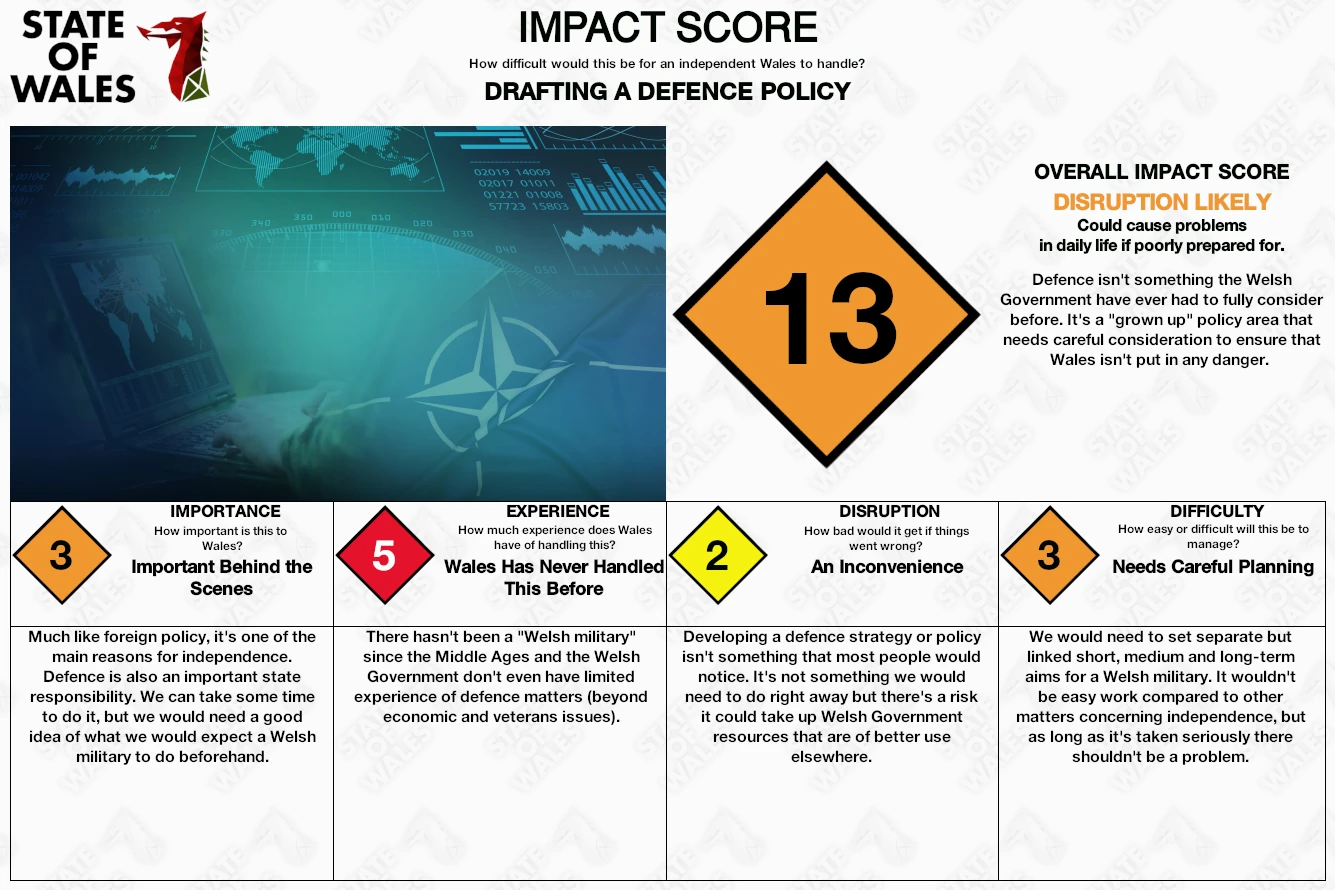
The overall score (out of 20) is the total of the scores for the four mini-categories (out of 5 each).
How Much Will This Cost?
Headline: A defence strategy by itself would have few direct costs, but it would help give us an idea of how much Wales would need to spend on defence each year.
The cost of developing a defence policy would be however much it costs civil servants and government ministers to draft it in terms of hours worked.
Would any new taxes need to be introduced? /
No.
Who will pay for this?
General taxation (all taxpayers).
How Long Would This Take?
It would probably be done in separate phases.
Interim/provisional defence and security policy to ensure Wales has enough in place to handle basic home defence duties and is secure from civil threats (i.e. terrorism, extremism, organised crime).
A strategy setting the medium-to-long-term ambitions for a Welsh military (i.e. whether Wales should join NATO and what level of capability we want the military to have).
Any laws relating to a Welsh military would be drafted and passed in the Senedd during this time. Until replaced, the Armed Forces Act 2006 would remain in force.
During this time, you would expect a civil defence policy to be in place, as well as work to establish a national security/intelligence service.
Ensure Wales has a military that can meet the level of capability we want.
This is likely to be when defence spending and recruitment starts to ramp up.
Defence Review every 4-10 years. Risk Register (or equivalent) updated every 2-4 years.
People & Work
Indirectly, everyone resident in Wales as defence is about keeping us safe.
Directly, civil servants, military advisors and senior military officers would be the ones doing most of the work in terms of drafting a defence strategy and leading reviews.
Indirectly, several thousand posts would be created as we would effectively be building a military and an equivalent of the Ministry of Defence from scratch. Some of these may be filled by Welsh people currently serving in the British military.
Directly, drafting a defence strategy would not create many jobs in itself, other than the civil servants given the task of doing it.
You Might Also Like....
UK Government (March 2021). “Global Britain in a competitive age“.
UK Government, Press Release (25th February 2025). “Prime Minister sets out biggest sustained increase in defence spending since the Cold War, protecting British people in new era for national security”
UK Government, Ministry of Defence (2nd June 2025). “Strategic Defence Review 2025”.
Welsh Government, Local Resilience Forums, Community Risk Registers.
Government of Ireland, Department of Defence (2024). “Defence Policy Review”.
Government of Iceland, “National Security”.
Government of Finland, Ministry of Defence (19th December 2024). “Government Defence Report”.
Swiss Armed Forces (4th November 2024). “Strengthening Defence Capability (English language summary)”.
Government of New Zealand, Ministry of Defence (7th April 2025). “Defence Capability Plan 2025”.
No AI tools were used to draft this post.