Image Source: Sky News
Donations keep this site going. If you like what I’m doing here and think this work is important to the independence movement, consider a donation. One-off or monthly; as little or as much as you want. Click the links below, or full details are available here.
What happens now?
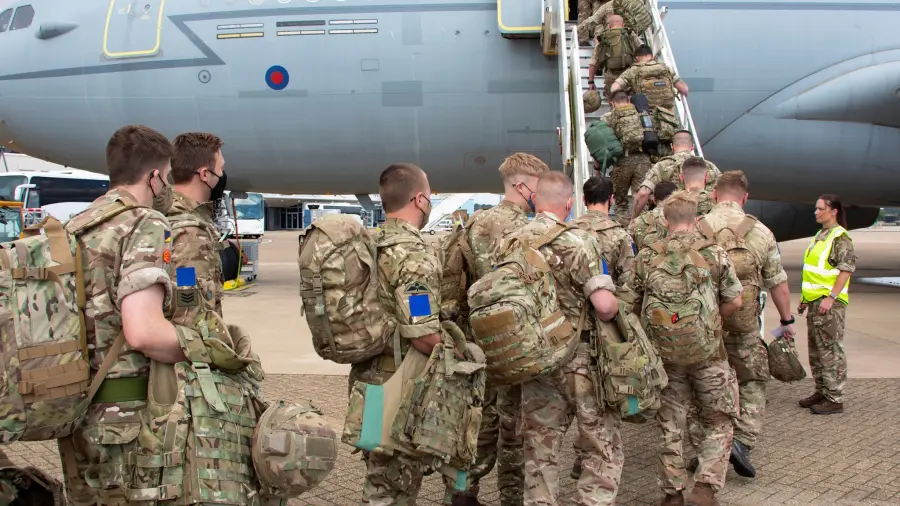
At the moment, the power to deploy UK armed forces abroad for military action is held by the UK Government under royal prerogative.
This means that while the reigning monarch is the Commander-in-Chief of the British armed forces, in practice the UK Prime Minister and UK Cabinet have the authority to deploy or use the British military in any way they see fit.
For political reasons, a UK Prime Minister may seek a vote to authorise the use of UK military abroad from the MPs in the UK House of Commons – but there’s no strict requirement in UK constitutional law for them to do so1.
Other routine deployments abroad – stationing, training, military exercises etc. – are a matter for military commanders and civil servants rather than politicians.
Within the UK, the Welsh Government, local government and police can request military assistance if they need it. That might be because the military has specialised equipment or training to deal with a situation or emergency that local councils or the emergency services don’t have.
This is called “military aid to the civil authorities” or MACA. One example would be bomb disposal (undertaken by the Royal Logistics Corps), while military units were deployed as part of the COVID-19 vaccination programme.
While MACA is funded out of the UK’s defence budget, it isn’t strictly free, and the military can claim back costs. Drafting in the military is also considered a last resort in the UK2. In other countries, their militaries play a more active role in civil defence.
What could an independent Wales do?
Wales would likely have a similar arrangement for MACA/civil defence – though how deeply involved a Welsh military would be when it comes to civil defence will be looked at separately.
There could be a small number of instances where the Welsh Government would be able to authorise deployment of the military (at home or abroad) without having to seek the approval of the Senedd. This would probably be limited to “self-defence” – such as responding to an imminent attack or terrorist incident.
A Welsh constitution (or constitutional law) could grant the Senedd ultimate authority when it comes to deploying a Welsh military in a situation where they could face a real risk of sustaining casualties. So that would cover standard military action, peacekeeping missions and disaster relief.
Before the 2014 independence referendum, the Scottish Government proposed3 having a constitutional “triple lock” so that military deployments could only take place when:
The action is in accordance with the principles of the UN Charter (though this could be changed to include decisions by the North Atlantic Council if Wales joins NATO).
- It’s properly agreed by the Scottish Government.
- And also approved by the Scottish Parliament.
- Ireland has something similar4, though it’s currently being reformed as of 2025.
This may be a good starting point for Wales too, requiring a simple majority vote in the Senedd. It should also be standard practice that the relevant Senedd committee holds an inquiry after every major deployment in order to learn lessons.
You Might Also Like....
UK House of Commons Library (14th October 2024). “Military action: Parliament’s role”.
UK House of Commons Library (28th July 2022). “Deploying the armed forces in the UK”.
Scottish Government (November 2013). “Scotland’s Future” (p 251).
Defence (Amendment)(No.2) Act 1960, Section 2.
No AI tools were used to draft this post.