Image Source: Z22 under Creative Commons Licence By-SA-3.0
Donations keep this site going. If you like what I’m doing here and think this work is important to the independence movement, consider a donation. One-off or monthly; as little or as much as you want. Click the links below, or full details are available here.
What Happens Now?
The UK Government began the roll-out of a text message-based (cell broadcast) emergency alert system in 20231. So far, the system – which sends a message from specific phone masts if there’s a “danger to life” in the area – has been tested roughly once a year.
It was first operationally used in Wales during Storm Darragh in December 2024, when the UK Met Office issued a rare “Red” warning for wind.
It’s standard practice for severe weather warnings (or other such warnings) to be issued during radio and television broadcasts or via online media.
There are currently separate warning systems and scales for severe weather, flooding, terror/civil threats and utility interruptions.
The UK Government introduced a cell broadcast/mobile text alert Emergency Alert System in 2023, though there’s no formal advice to the public on how to deal with civil emergencies or prepare for them.
Previous efforts such as “Protect & Survive” (1974) and “Preparing for Emergencies” (2004) have been mocked for either offering ineffective advice or being a form of scaremongering.
Does This Work for Wales?
As long as you’ve got a compatible device, the phone alert system should work – but people with older phones/tablets or no phones at all may not receive them. The emergency alerts in Wales are also bilingual.
Some organisations – such as flood warnings from Natural Resources Wales – require households to sign up for a free warning service if they need specific/urgent information.
In September 2025, the Senedd’s Climate Change & Infrastructure Committee report into the Welsh Government’s response to Storm Bert concluded that people in disadvantaged areas were less likely to engage with severe weather and flood warnings2.
Emergency Alerts & Independence: Pros & Cons
The obvious one (regardless of independence or not): an adequate warning system can save lives and property.
It would be for authorities based in Wales to decide when/how to warn the public. There have been instances in the past where Wales has faced the brunt of severe weather but not been given enough advanced warning (for example, Storms Ciara and Dennis in 2020, which occurred before the UK’s alert system was introduced).
It might focus people’s attentions so they think more carefully about the kind of risks they face and what they would do if they received an emergency alert.
The range of alerts and the thresholds to trigger them could be lowered to include things like localised flood and road closure warnings.
If the technology can be adapted to issue warnings from specific phone masts, they can be even more localised to avoid sending warnings to people who would otherwise be unaffected by an incident.
Having an integrated/unified national alert system free to everyone would bring together all of the separate alerts from separate authorities and public bodies into a single place.
There’s always the risk that people won’t/don’t take warnings seriously. Warnings may also be redundant if an emergency is already being widely reported in the news (especially if there’s a big lead-in, such as a major Atlantic storm).
Regardless of what the Welsh Government decides to do or not do, there would be political blowback. Do too little, and you would be accused of not doing enough to warn people. Do too much, and you would be accused of scaremongering.
A mobile-based alert system may miss out on people who don’t have modern mobile phones or access to the internet. This may not be a long-term problem as internet access increases, but it would certainly be a problem in the medium term.
Some emergencies may happen too quickly for a warning to reach people in time, while issuing warnings too often/”crying wolf” may make people complacent.
There’s a documented risk to domestic violence victims by using a mobile-based alert system (i.e. making an abuser aware of a hidden phone).
There’s a broader argument that prevention (i.e. not building on floodplains) is better than reacting after an event. Having a warning system gives the impression that things like flooding are inevitable when there are engineering solutions that could prevent the worst damage.
What Do Other Countries Do?
![]()
As far as I’m aware, Ireland has no formal emergency alert system. Warnings related to severe weather and flooding are usually issued by major broadcasters and news outlets.
There is a local authority-backed free text alert system (MapAlerter) which issues alerts and advisories from the majority (but not all) of Ireland’s county councils. This includes flood warnings, road closures and power/water supply issues.
![]()
New Zealand has a mobile alert system similar to that of the UK. Alerts can be issued by the emergency services, local civil defence agencies and certain government departments (i.e. health).
![]()
Denmark has introduced a cell broadcast-based warning system (S!RENEN).
Emergency information and alerts are also usually provided by the main national broadcasters as part of an agreement with Denmark’s Emergency Management Agency.
Denmark also maintains a network of local sirens, though they are rarely used.
![]()
An emergency alert system is maintained and operated by Japan’s Meteorological Agency. These are most commonly used to issue early warnings of serious earthquakes and tsunamis, but have been used in recent years to warn of potential debris from North Korean ballistic missile launches.
TV and radio broadcasting are interrupted to relay the messages, while in some communities loudspeakers may also be used.
![]()
The US maintains the Emergency Alert System, which allows public authorities (at the local, state or national level) to issue a warning on radio and television. These warnings can target specific broadcasting areas. The majority of these relate to severe weather, particularly tornadoes.
There’s a separate system which issues a message to mobile devices.
What Options Does Wales Have?
Warning System
Separate warnings would be issued by separate agencies. The Met Office (or its successor in an independent Wales) would be responsible for weather warnings, Natural Resources Wales would be responsible for flood and wildfire warnings, the security services or police would maintain terror alert levels, etc.
Each agency would retain its own warning system (i.e. the Red, Amber, Yellow weather warnings and the Flood Watch, Flood Warning and Severe Flood Warnings).
There would be a single warning system covering all kinds of civil emergencies. The easiest way to do this would be a Red, Amber, Yellow/traffic light system.
Red would continue to mean an immediate life-threatening event. Amber would be an event with a serious local or regional impact. Yellow would be a warning to take care generally.
So a “Red” warning would cover Severe Flood Warnings, the current Red weather warnings (i.e. 90-100 mph+ winds during daytime) and specific incidents like (for argument’s sake) a dangerous chemical spill or fire.
Emergency alerts would likely only be issued for “Red” and possibly “Amber” warnings.
Warning Method
Wales wouldn’t have an emergency alert system and would rely on public service broadcasters and the press to publish warnings as and when they are issued. This is effectively what happens now for non-life-threatening emergencies.
Wales would use the existing system, but the range of alerts would be expanded to include (for argument’s sake) flood warnings, missing vulnerable people, localised power or water outages, school closures or other urgent information (i.e. warnings to keep windows and doors closed if during a fire or chemical spill).
The issue is that it excludes people who don’t have access to mobile devices. You would assume that the most serious alerts would be published by the media regardless.
As well as text messages to mobile devices, programmes would be interrupted for the most serious emergency alerts. There would be technical challenges to doing this as people move to streaming. There would have to be text and audio for accessibility reasons, and they would need to be bilingual. This would likely be deemed intrusive or scaremongering.
Sirens probably aren’t practical in the 21st Century, or could only be introduced in a limited way. The reason given for the Cold War network being dismantled was that more homes have double or triple glazing, making sirens harder to hear.
What's at Stake?
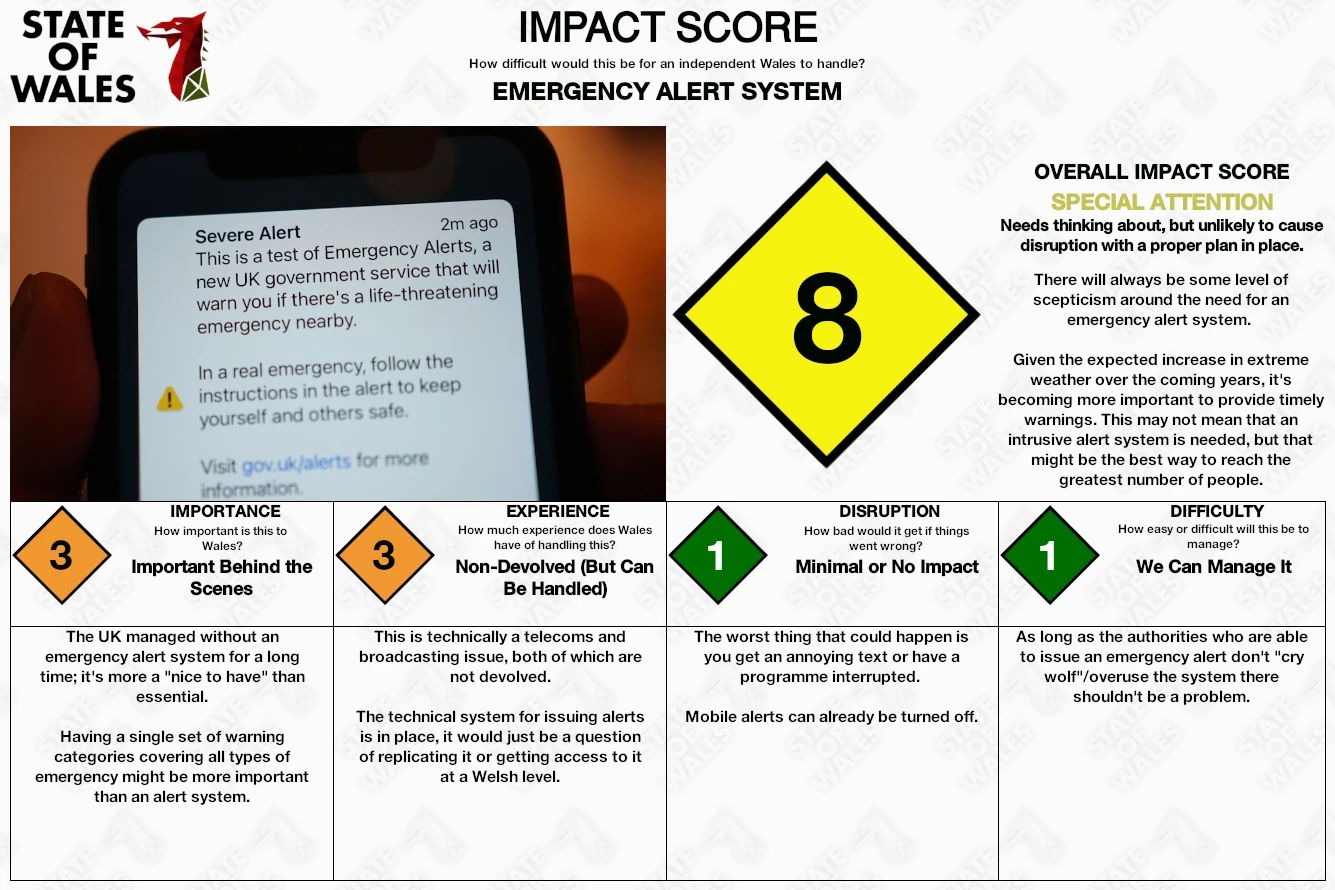
The overall score (out of 20) is the total of the scores for the four mini-categories (out of 5 each).
How Would This Be Run?
This was looked at, in part, separately.
Alerts could be issued by any competent public authority (i.e. a local council, fire service, NHS, or Natural Resources Wales). Though if we wanted to restrict access, warnings could instead be issued either by a National Emergency Management Agency or through a Cabinet-level emergency response committee.
How Much Will This Cost?
Headline: The current UK-wide cell broadcast alert system costs around £8.5 million per year to run3.
A proportional Welsh share of that would be around £425,000 per year. A Wales-only system would likely use the same technology (which has already been set up), but would need a separate partnership/agreement with mobile operators to issue Wales-only warnings.
A more extensive warning system (i.e. broadcasting as well as mobile alerts) would need further investment and an agreement with broadcasters.
Having a wider-ranging alert system may lead to some small savings on property and content insurance. For example, if insurers believe that advanced warning could lead to people and businesses taking action to prevent damage.
Would any new taxes need to be introduced?
No.
Who will pay for this?
General taxation (all taxpayers).
How Long Would This Take?
The cell broadcast alert system is already in place and active. The Welsh Government would, after independence, have responsibility for broadcasting and telecoms.
Setting up a completely new system, or expanding the current one, would probably require negotiations with broadcasters, internet providers and mobile operators.
Any legal changes (i.e. creating a new National Alert System) would likely be done through regulations in the Senedd rather than a law, which would be a bit quicker and more specific.
People & Work
Everyone, but particularly people living in high-risk areas (i.e. next to a river, near an industrial estate or former coal tip).
There may be a small number of technical roles created to maintain an alert system, but there are unlikely to be any significant job implications one way or another.
You Might Also Like....
UK Government. “How alerts work“.
Senedd Cymru, Climate Change, Environment & Infrastructure Committee (September 2025). “Response to recent storms” (p 24-28).
UK Parliament, Written Questions (19th January 2024). “Emergencies: Mobile Phones“. £25.3 million is the quoted figure for a three-year period.
No AI tools were used to draft this post.