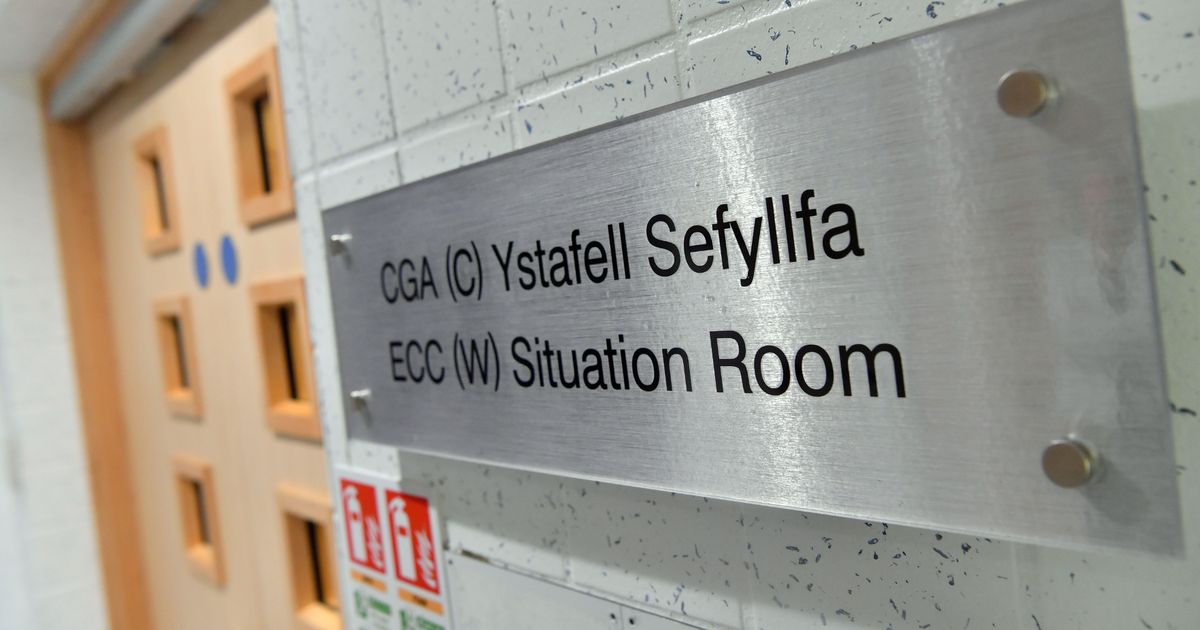
Image Source: Wales Online
Donations keep this site going. If you like what I’m doing here and think this work is important to the independence movement, consider a donation. One-off or monthly; as little or as much as you want. Click the links below, or full details are available here.
What Happens Now?
Under the Civil Contingencies Act 2004, local authorities (the 22 unitary authorities in Wales), fire & rescue authorities, the NHS (local health boards in Wales) and Natural Resources Wales are considered lead responders during a civil emergency. These are known as Category 1 responders.
Emergency planning is a statutory/legal responsibility of local government. This means that all Category 1 responders have a legal duty to have plans in place prevent and respond to civil emergencies as defined in the Act.
The seats of local government will often act as a headquarters/base of operations during a civil emergency (often called “Gold Command” or alike).
While emergency planning and emergency powers are not devolved, the Welsh Government has a specific role in responding to major emergencies within Wales, particularly in areas of devolved policy.
They will often act as the lead authority above Category 1 responders and will act as a liaison between the military and civil authorities.
The Welsh Government leads the Wales Resilience Forum, which sets the national strategy for emergency management.
Additionally, the UK Resilience Academy/UKRA (formerly known as the Emergency Planning College, and outsourced by the UK Government to Serco) provides training to local government officers and senior civil servants. The UKRA is based in Yorkshire.
The UK Government introduced a cell broadcast/mobile text alert Emergency Alert System in 2023, though there is no standing advice to the public on how to deal with civil emergencies or prepare for them.
Previous efforts such as “Protect & Survive” and “Preparing for Emergencies” were roundly mocked as either offering ineffective advice or being a form of scaremongering.
Does This Work for Wales?
Awareness of civil preparedness is arguably much stronger amongst civil authorities than the military, largely due to measures brought in under the Civil Contingencies Act.
The system seems to work well, and, for the most part, the civil emergencies that public authorities deal with most often will either be related to extreme weather and/or flooding.
The issue in Wales – and around the UK more generally – is confusion over the specific roles of different organisations depending on the type of incident.
The response by public authorities – including the Welsh Government – to the Covid-19 pandemic received criticism. In particular, there was a sense that the Welsh Government lacked preparedness (the expectation during the 2010s was that the next pandemic would be flu) and that the structures in place were too complicated1.
There have been calls to reform emergency preparedness measures across the UK to learn lessons from the pandemic.
The public’s role – particularly volunteers/charities – is less clear overall. This was picked out for criticism in an independent review of the Civil Contingencies Act.
Civil Preparedness, Emergency Planning & Independence: Pros & Cons
If we want to keep things as they are, the Civil Contingencies Act would remain in force after independence until the Senedd decides to change/update it (common law system).
We would be able to change how, when, and why emergency powers are used by the Welsh Government and other civil authorities.
Giving the public a greater role in preparedness and civil defence could have wider benefits on society (i.e. increased first aid skills, improved local responses, and increased mutual aid).
It would be for authorities based in Wales to decide when/how to warn the public. There have been instances in the past where Wales has faced the brunt of severe weather but not been given enough advanced warning (for example, Storms Ciara and Dennis in 2020).
Civil authorities would have access to full military resources dedicated solely to Wales (if needed).
Voluntary organisations involved in civil aid and civil defence-like tasks (i.e. mountain rescue, cave rescue, RNLI) could be integrated into military reserve units, giving them access to reservist benefits (i.e. pay, training, ranks).
Although the temptation would be to stick with the Civil Contingencies Act (because it’s the easiest thing to do), the current system isn’t without its flaws, and it might not be the option that suits Wales’ needs.
Any service reliant on volunteers is at risk of falling short of numbers, money or skill sets.
Local government will be in the best position to respond to most emergencies. There’s a risk of overcomplicating the system if different tiers of government are responsible for different types of emergencies (and that’s before you add the military).
Emergency planning and civil defence are only effective if the public takes advice and warnings seriously. As experienced during the Covid-19 pandemic, a sizable chunk of the public doesn’t like following government-issued advice (for whatever reason).
Regardless of what the Welsh Government decides to do or not do, there would be political blowback. Do too little, and you would be accused of not doing enough to warn people. Do too much, and you would be accused of scaremongering.
What Do Other Countries Do?
![]()
Ministerial responsibility for civil defence lies with Ireland’s Minister for Defence. They oversee the Irish Government’s Office of Emergency Planning, which provides advice and strategic guidance to all public authorities that may have to deal with a civil emergency.
Ireland also has a separate, volunteer-based uniform civil defence force (Civil Defence Ireland), which is considered part of Ireland’s wider defence forces. Units are largely organised at the local authority level.
Their role is to support the emergency services and local authorities during civil emergencies, supported by the military if needed. In 2024, Civil Defence Ireland responded to over 3,000 separate incidents, supported by 2,300 registered volunteers2.
![]()
Denmark has a dedicated Minister for Resilience & Preparedness, whose responsibilities include civil defence.
The Danish Emergency Management Agency (Beredskabsstyrelsen) is the central agency tasked with responding to civil emergencies at a national and local level. They’re also tasked with emergency planning and issuing guidance to prevent accidents (similar to the UK’s Health & Safety Executive).
The Danish Resilience Agency is tasked mainly with cybersecurity.
People taking part in conscription can opt to join the Agency and be trained to act as a civil defence force. This lasts for 9 months.
The standing guidance is for households to have enough supplies on hand to manage for three days without help3.
![]()
Civil defence and preparedness are mainly left to individuals, overseen by Finland’s Interior Ministry.
There’s a heavy emphasis on preparedness – to a far greater extent than the majority of countries in Europe – as part of the concept of “Total Defence”. The Finnish Government issues specific guidance to the public in multiple languages relating to different types of civil emergencies4.
There are legal obligations on housing providers and businesses to provide and maintain civil defence shelters. There are over 50,000 such shelters with room for almost the entire population5.
Additionally, a high proportion of the population will have also received some form of military training through conscription and a period in active reserve.
![]()
Of the international examples listed here, New Zealand faces the biggest threat from natural hazards. These include earthquakes, tsunamis, volcanoes, and tropical cyclones.
Civil defence is mainly the responsibility of public authorities. There’s a dedicated National Emergency Management Agency (NEMA) run by New Zealand’s equivalent of the Home Office. NEMA is the main emergency management agency and has around 180 full-time staff and an annual budget, as of 2024-25, of NZ$56 million (£24.6 million)6.
NEMA provides support and guidance to local and regional government, the emergency services, businesses and providers of key services. They act as the equivalent of a “Category 1” responder in Wales, as set out in the Civil Contingencies Act.
There are 16 regional civil defence management groups made up of local councillors.
New Zealand’s parliament is set to debate an Emergency Management Bill before the end of its current term (November 2026). This will replace the existing Civil Defence Emergency Management Act 2002.
NEMA’s public information programme is called “Get Ready”7 and lists advice and guidance to the public and businesses covering a range of different emergencies. New Zealand also hold an annual national earthquake and tsunami drill (ShakeOut).
What Options Does Wales Have?
Emergency Planning & Management
This would be in line with what currently happens. Emergency planning would remain a legal duty of local authorities (bottom-up), likely working with the existing local resilience forums (as outlined in the Civil Contingencies Act). The Welsh Government would provide strategic oversight, but wouldn’t get directly involved unless it has to.
Technically, fire and rescue services count as a local authority, as do local health boards.
This could be beefed up so that every local authority is legally required to have an emergency response centre and emergency supply store. Though this may require extra one-off and ongoing funding from the Welsh Government to maintain.
Emergency planning would be undertaken nationally (top-down), with local authorities taking instructions from the Welsh Government.
The main advantage is that it may cut down on the number of duplicated tasks, and it should, in theory, mean that the same service would be provided in all parts of Wales with an accountable minister or department. It may be easier to fully fund and resource emergency planning as well.
The downside is that the current local authority-led arrangement is what current emergency planning is based on. For example, local authority highways departments have equipment that may be used during severe weather, which the Welsh Government currently only has for the trunk road network (because trunk roads are managed directly by the Welsh Government).
In addition to providing aid to civil authorities, the military (and/or Welsh equivalent of the Ministry of Defence) would plan for civil defence, not just provide a response to it.
It’s probably down to a question of resources and expertise. Local authorities may be better placed to address risks in civilian infrastructure (i.e. flood engineering and highways), while the military may be best placed to deal with specific national security threats and manage resources (i.e. emergency supply stores).
The obvious choice would be Natural Resources Wales (NRW). They would need the additional resources and staff to perform this role. The issue would be that it’s another duty added to a long list of duties. Also, emergency planning isn’t just restricted to natural disasters like flooding (even if that’s the most common type of incident).
This would be an arms-length Welsh Government agency tasked with the response to civil emergencies and setting the overall strategy – probably working with, or instead of, emergency planning officers in local government.
It would be staffed by full-time civil servants and officers, but could coordinate with voluntary groups (similar to the umbrella agency mentioned in the piece looking at the military’s role).
Also, as covered previously (“What would independence mean for health & safety?”), a possible Health & Safety Council or Health & Safety Commissioner could form part of an Emergency Management Agency. This would align health & safety with emergency planning, meaning both could be run a bit more efficiently and take into account cross-cutting themes (i.e. industrial safety).
Civil Preparedness
The “let people use their common sense” approach, which would likely be popular with conservatives and libertarians because you’re all on your own.
How prepared you would be would depend on how much money you have to spend and how good you are at planning and storage.
Each household would take responsibility for its own preparedness with no advice or help from the central government. See also: Aesop’s fable about The Ant & The Grasshopper.
This “soft touch” is similar to what happens now in the UK, though that’s starting to change. It’s still very much a background issue, but there is far more talk of preparedness and civil defence now than there was before the pandemic.
This appears to be what most countries do. Some of the agencies in Wales, such as Natural Resources Wales, do have standing advice in the event of floods, but this could be brought together in a “one-stop shop” website or app.
This could be part of a wider push towards “mutual aid” (communities helping themselves wherever possible).
This was covered previously and is similar to Ireland. There would be a separate uniform agency focused entirely on civil defence duties, likely working very closely with the fire service and local authorities.
Units would likely be organised and run based on existing local authority boundaries. Different units may train or specialise in specific tasks based on the expected civil defence requirements in their given area (i.e. mountain rescue for mountainous areas).
What's at Stake?
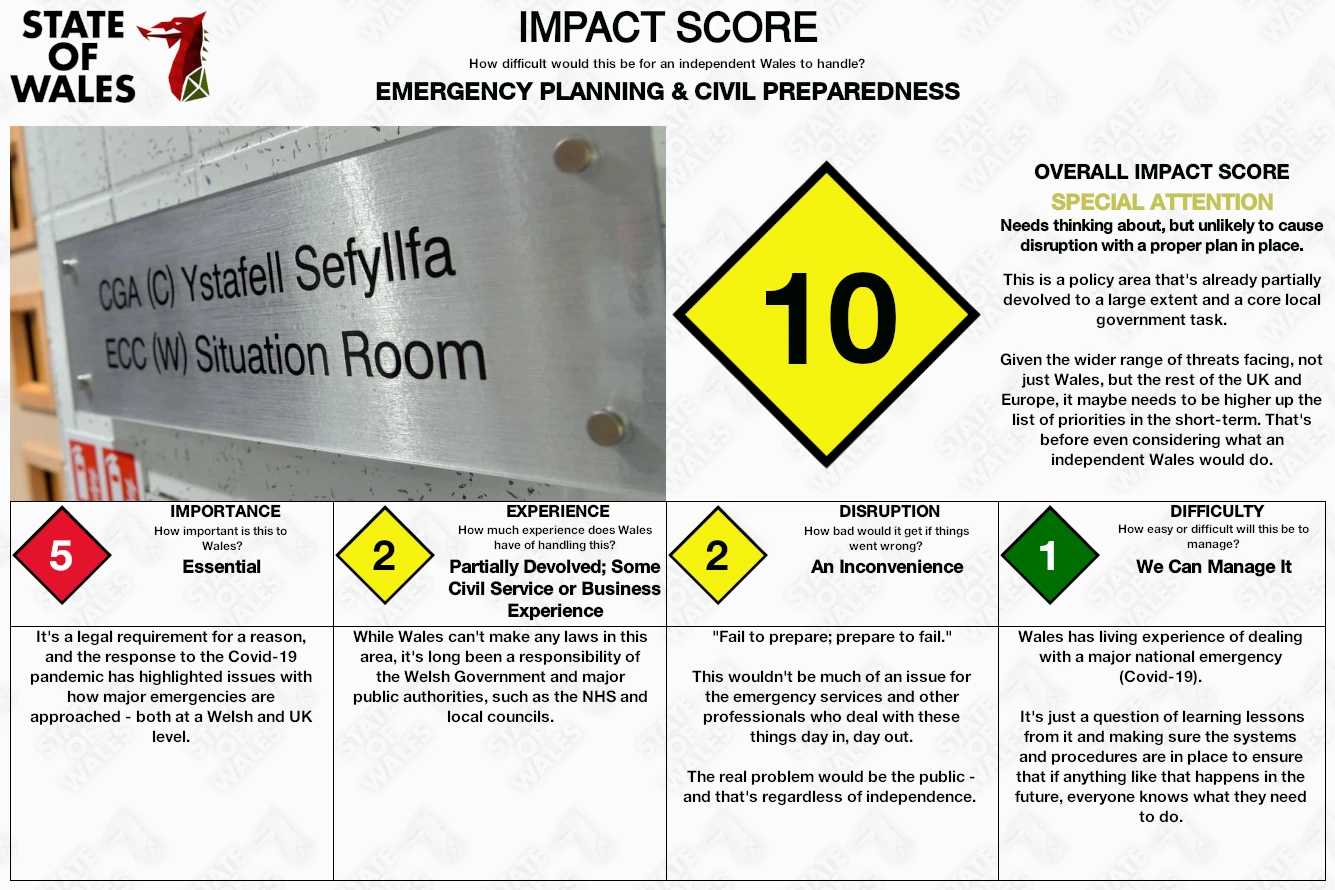
The overall score (out of 20) is the total of the scores for the four mini-categories (out of 5 each).
How Would This Be Run?
This was looked at earlier under the “What options does Wales have?” section.
In terms of ministerial accountability for civil defence, it would likely be the Prime Minister/equivalent of the Cabinet Office, the Welsh equivalent of the Home Office/Interior Ministry, or a Welsh equivalent of the Ministry of Defence.
A Welsh MoD would be a better fit if the military were to play an active role in civil defence. The Home Office/Interior Ministry is what most countries appear to do, as they usually run fire services.
During a major incident, there would likely be a Cabinet-level committee put together at short notice to oversee the Welsh Government’s response (i.e. a Welsh equivalent of “Cobra”). This already exists (the Welsh Government’s Emergency Co-ordination Centre and Civil Contingencies Committee), but would take on greater responsibility after independence.
How Much Will This Cost?
Headline: At least £15 million to maintain current yearly emergency planning spending.
In 2024-25, the 22 Welsh local authorities spent around £3.8 million on emergency planning8. In the 2026-27 Welsh budget, total spending on emergency planning across all Welsh Government departments (capital and revenue) was at least £11 million9.
You would assume that Welsh Government spending would be used to fund a standalone Emergency Management Agency, with operational support on the ground coming from a mix of local councils, NHS, the emergency services, the military and volunteers.
Technically, any money spent on things like fire and rescue services, flood prevention and highways (i.e. dealing with flooding and debris) could count as civil defence spending. The combined capital and revenue budget for the fire services in Wales (as of 2024-25) is around £210 million per year.
Would any new taxes need to be introduced?
No.
Who will pay for this?
General taxation (all taxpayers); some of this would be council tax (or its replacement). Voluntary organisations that form part of the Welsh civil defence response could also take part in charitable fundraising.
How Long Would This Take?
The default option is that the Civil Contingencies Act continues to work as it does currently – so it’s already in place.
Setting up a standalone civil defence agency or uniform service would take longer. For want of an example, setting up an agency of the size of Natural Resources Wales (formed by the merger of three separate Welsh Government agencies) took around 18 months10.
People & Work
Technically, everyone. Although it would have a particular impact on people living in/businesses operating in areas that face specific risks that would need a civil defence response (i.e. living or working next to a river).
A national Emergency Management Agency may need 50-100 civilian staff, some of whom may already be embedded within local authorities (emergency planning officers). These could be potentially joined by some assigned military personnel and resources on standby.
Setting up a standalone volunteer civil defence agency (similar to Ireland’s) may create a small number of full-time administration, training and operational command positions (maybe no more than 30-40). There may be more posts for volunteers. These would likely be organised into units at a local authority/council level.
You Might Also Like....
BBC (18th July 2024). “’Too complex’ Wales Covid plan damned by inquiry”
Government of Ireland, Department of Defence (10th December 2025). “Department of Defence and Defence Forces Annual Report 2024” (p52-56).
Danish Emergency Management Agency. “Three days“.
Suomi.fi. “Preparing for incidents and crises“.
Government of Finland, Ministry of the Interior. “Civil Defence Shelters“
Government of New Zealand, Department of the Prime Minister & Cabinet. “Annual Report 2025” (p 31-39, 60-62).
Government of New Zealand. “Get Ready“
StatsWales. “Budgeted revenue expenditure by service detail, local environmental services, other central services, emergency planning“.
Welsh Government (20th January 2026). “Final Budget Tables 2026-27”. Includes combined spending on Health Emergency Planning (£9.01 million) and Resilience & Civil Contingencies (£2 million).
BBC News (29th November 2011). “One environment body will save £158m – Welsh government“
No AI tools were used to draft this post.