Senedd Home
Oggy Bloggy Ogwr
State of Wales
Sunday, August 16, 2026
  • About & Contact
    • About State of Wales
    • Comments Policy
    • Complaints Policy
    • Contact
    • Disclaimer
  • Elections Centre
  • The Independence Index
    • The Independence Index (Full)
    • Foreign Policy
      • Relations with the former UK & Ireland
      • Relations with Europe
      • Foreign Policy (General)
      • International Organisations & Law
      • Overseas Aid
    • Defence
      • Defence Policy
      • NATO
      • Armed Forces
      • National Security
      • Civil Defence
    • Rules & Regulations
      • Safety & Standards
      • Intellectual Property
    • Economics & Money
      • Business & Economy
      • Currency
      • Tax & Spending
      • Transport & Infrastructure
    • Society
      • Communities & Housing
      • Culture & Sport
      • Education
      • Health
      • Media & Communications
      • Science & Technology
    • The State
      • Environment & Natural Resources
      • Justice
      • Local Government
  • Support & Donate
No Result
View All Result
  • About & Contact
    • About State of Wales
    • Comments Policy
    • Complaints Policy
    • Contact
    • Disclaimer
  • Elections Centre
  • The Independence Index
    • The Independence Index (Full)
    • Foreign Policy
      • Relations with the former UK & Ireland
      • Relations with Europe
      • Foreign Policy (General)
      • International Organisations & Law
      • Overseas Aid
    • Defence
      • Defence Policy
      • NATO
      • Armed Forces
      • National Security
      • Civil Defence
    • Rules & Regulations
      • Safety & Standards
      • Intellectual Property
    • Economics & Money
      • Business & Economy
      • Currency
      • Tax & Spending
      • Transport & Infrastructure
    • Society
      • Communities & Housing
      • Culture & Sport
      • Education
      • Health
      • Media & Communications
      • Science & Technology
    • The State
      • Environment & Natural Resources
      • Justice
      • Local Government
  • Support & Donate
No Result
View All Result
State of Wales
No Result
View All Result
Home Rules & Regulations

What would independence mean for health and safety?

Owen Donovan by Owen Donovan
June 4, 2025
in Rules & Regulations, Safety & Standards
What would independence mean for health and safety?

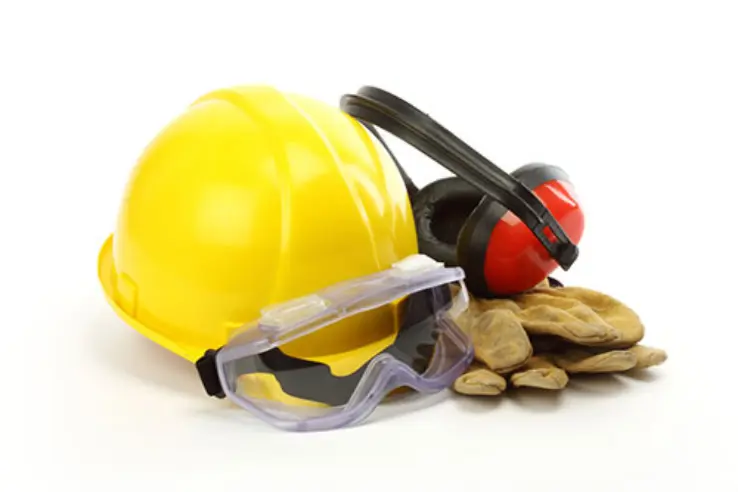
Travel Medicine Alliance under Creative Commons Licence BY-ND-4.0

Share on FacebookShare on TwitterShare on RedditShare on BlueskyShare by email

Image Source: Travel Medicine Alliance under Creative Commons Licence BY-ND-4.0

This site is best viewed in landscape mode on smartphones.
Support IndyWales? Support State of Wales!

Donations keep this site going. If you like what I’m doing here and think this work is important to the independence movement, consider a donation. One-off or monthly; as little or as much as you want. Click the links below, or full details are available here.

What Happens Now?

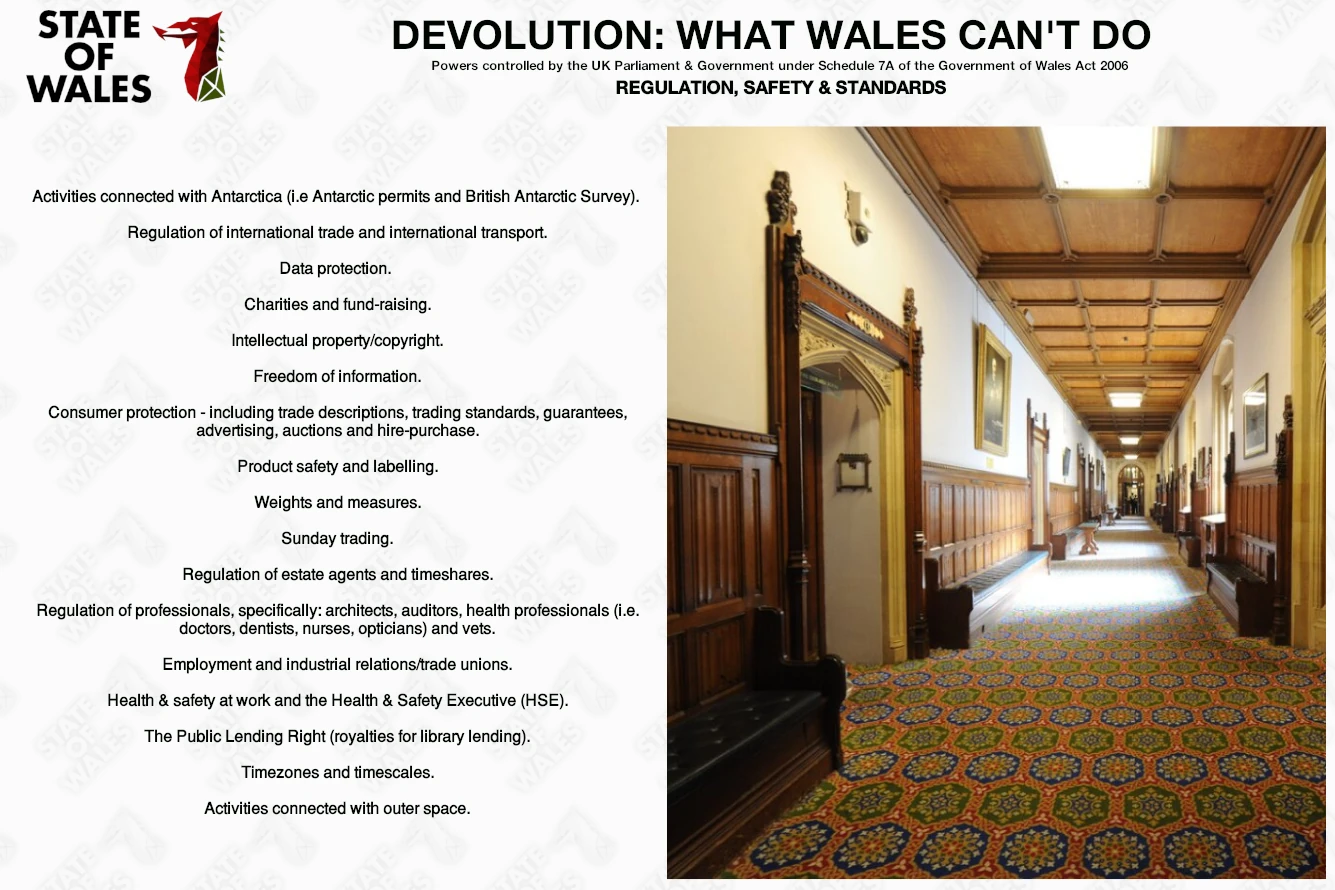
“Health and safety” lies within a grey area regarding devolution.

The Senedd can pass laws and regulations in policy areas devolved to Wales that are “health and safety-related”. One example would be the 20mph speed limit in built-up areas.

Despite that, the lion’s share of responsibility for health and safety remains with the UK Parliament and UK Government.

In England, Scotland and Wales (not Northern Ireland) this is enforced by the Health & Safety Executive (HSE) – a UK Government executive agency.

Does This Work for Wales?

Yes.

You could spend hours listing Welsh industrial accidents and the thousands of people killed or seriously injured as a result. Nonetheless, the number of people killed at work in Wales has dramatically declined over the last century.

According to HSE figures, in 20241 there were 90,000 work-related ill-health cases in Wales. This is at a higher rate (5,870-per-100,000 workers) than the GB average (5,220). More than half of these (54%) are related to mental health.

Additionally, there were 24,000 non-fatal work-related accidents (slightly lower than the GB average) and 7 fatal accidents (slightly higher than the GB average). The average number of fatal accidents at work per year averages 11 across the last five years. The HSE says Wales still has a high proportion of workers employed in “high risk” industries such as farming and construction2.

Independence: Health & Safety - Pros & Cons

Pros of Independence
Cons of Independence
Pros of Independence

The Senedd and Welsh Government would be able to react more quickly to urgent workplace or public safety issues or loopholes whenever they crop up.

It would be far easier for Welsh-based campaigners to lobby for tighter regulations or new health and safety laws at the Senedd instead of the UK Parliament or to the HSE directly.

Given that the HSE themselves say that proportionally more people in Wales work in “high-risk” industries, it makes sense for health & safety laws to be made and enforced in Wales so it can be tailored to our specific needs.

There would be an opportunity to redraft and update current health and safety laws – possibly as a new made-for-Wales Health & Safety Act. This would be far easier and quicker to do at the Senedd than the UK Parliament (fewer politicians, one chamber, easier law-making process).

Cons of Independence

The current system works well. There’s a risk that if things are changed too quickly loopholes would be created or employers would start cutting corners.

We would take on responsibility for enforcing and policing health & safety at work. In some cases, we might not have the right people or experience to do it straight away.

We might miss making changes to the law if health and safety rulings in England and Scotland don’t play a part in decision-making in Wales.

We could elect Welsh governments that either make too many extra health and safety laws (“nanny state”) or cut back/make too few laws (populists arguing that “‘elf ‘n’ safety’s gone mad”).

What Do Other Countries Do?

Northern Ireland
Ireland
Denmark
Switzerland
New Zealand
Northern Ireland


Health and safety is devolved to Northern Ireland and responsibility lies with Health & Safety Executive Northern Ireland (HSENI). HSENI is a public body sponsored by the Northern Irish Government and was established in 1998.

Health & safety laws are almost identical to those in England, Scotland and Wales.


Ireland


Ireland’s system is almost identical to Great Britain.

Responsibility for enforcement lies with the Health & Safety Authority, which is an Irish Government executive agency. Its role is similar to the HSE in England, Scotland and Wales.


Denmark


Most workplace health and safety tasks are the responsibility of a government-sponsored agency: the Danish Working Environment Authority (DWEA). Health and safety laws were most recently updated in 2010, when more responsibilities over inspections, enforcement, information gathering and regulations were handed to DWEA.


Switzerland


There are two federal/all-Switzerland health and safety laws. The canton/federal state governments are responsible for on-the-ground health & safety monitoring for most businesses, with a specialist insurer – Suva – handling high-risk workplaces.

At a federal level, the Federal Coordination Commission for Occupational Safety finances and enforces health and safety rules.


New Zealand


Worksafe New Zealand is the health and safety regulator and, much like HSE, is a government agency.

The New Zealand Government has a more hands-on role in developing health and safety policies and regulations. In 2015, separate health and safety laws were brought together into a single law.
 

What Options Does Wales Have?

Changes to Health & Safety Laws
Regulator: Welsh equivalent of HSE
Regulator: Health & Safety Council
Regulator: Health & Safety Commissioner
Changes to Health & Safety Laws

“Corporate death penalty” (judicial dissolution) – Courts would have the power to dissolve companies guilty of corporate manslaughter, other serious health and safety breaches or significant breaches of environmental laws. Anyone running such a business could also be banned from being a company director and would automatically fail a “fit and proper person” test.

“Hillsborough Law” – There’s a campaign to change the law so public authorities must be open and honest when investigations are held into deaths caused by public officials failing to do their jobs properly or being negligent (such as the 1989 Hillsborough disaster). The (Conservative) UK Government rejected the idea in 2023 and Labour has (so far) failed to follow through on a pledge to introduce such a law3.

Improvements to farm safety – Statistically, farms are one of the most dangerous workplaces due to the wide range of risks involved (machinery, chemicals, outdoor working, livestock etc.). Ireland introduced regulations in 2023 that provided incentives for farmers to buy and install certain safety equipment4.

Digital threats and cybersecurity as a health & safety matter – Some sectors like energy, retail and utilities are directly threatened by cyber criminals and state-backed hackers. A serious hack may pose a risk to workers and the public. Cybersecurity and digital threats could be fully incorporated into health and safety laws.

Regulator: Welsh equivalent of HSE

Wales would continue to have a government executive agency. It would presumably be formed out of existing HSE offices, assets and staff that already work in Wales.

Regulator: Health & Safety Council

Instead of having a separate regulatory authority for health and safety, a Health & Safety Council would be established. It would include representatives from trade unions, businesses, the legal profession, and both local and central government.

Regulator: Health & Safety Commissioner

Based on the other public commissioners in Wales (i.e. Future Generations, Welsh Language), a single Commissioner would be appointed by the Senedd on a single 7-year term. They would be supported by the remaining assets of the HSE in Wales.

What's at Stake?

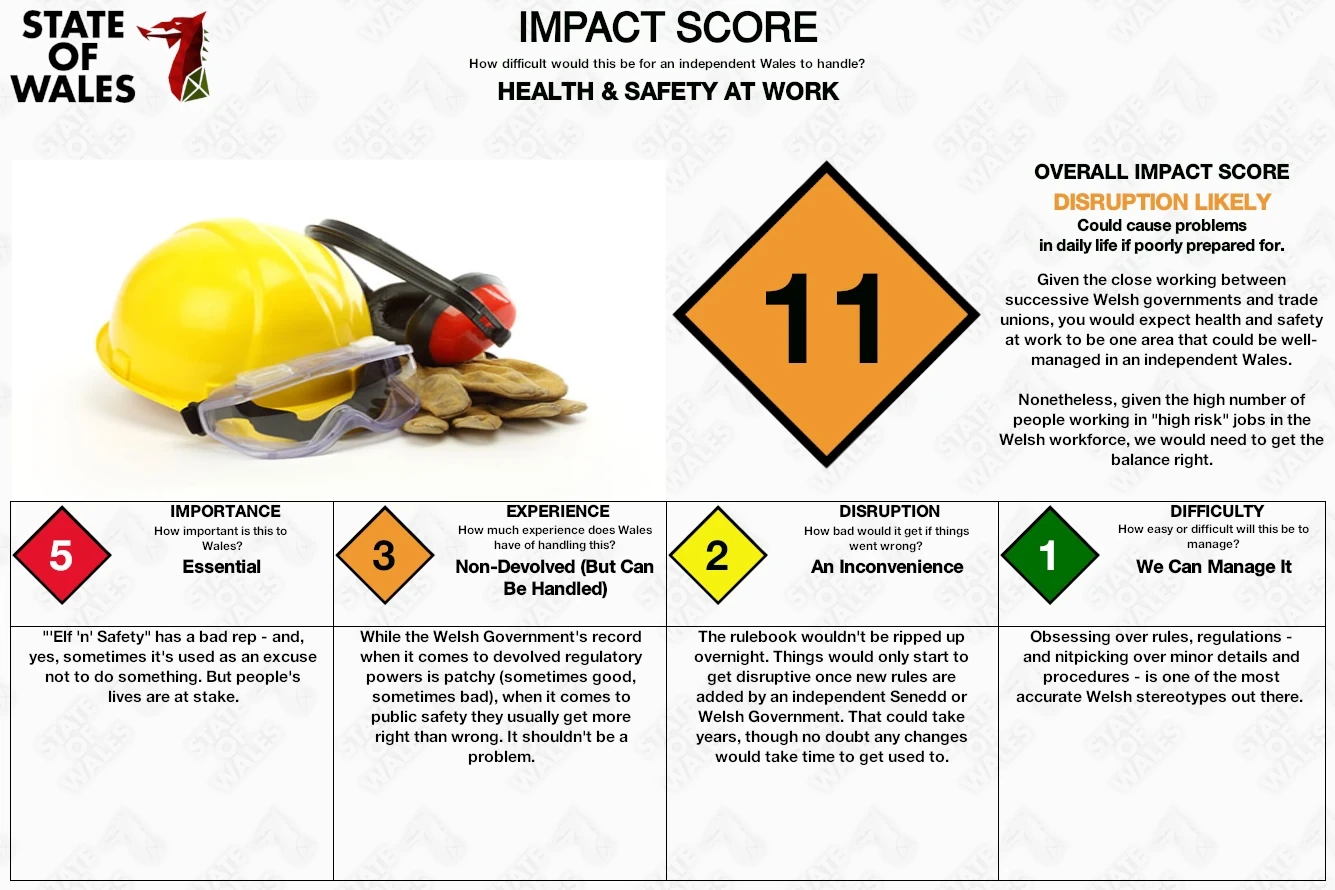
The overall score (out of 20) is the total of the scores for the four mini-categories (out of 5 each).

How Would This Be Run?

Regulator: Welsh equivalent of HSE
Regulator: Health & Safety Council
Regulator: Health & Safety Commissioner
Regulator: Welsh equivalent of HSE

This agency would act as regulator and enforcer of health & safety rules, similarly to the HSE.

Regulator: Health & Safety Council

The Council would be responsible for drafting regulations, proposing new health & safety policies and developing strategies.

Local government would be responsible for on-the-ground enforcement, similar to their current role in environmental health and building control.

Regulator: Health & Safety Commissioner

The Commissioner – as a named point of contact – would act as regulator and would enforce health & safety rules. They could launch their own independent health & safety investigations or reports similar to powers granted to the Public Services Ombudsman.

How Much Will This Cost?

Headline: Likely between £12-16 million per year. Costs would be partially covered by fees and charges (i.e. registering hazardous substances).

Welsh equivalent of HSE
Health & Safety Council
Health & Safety Commissioner
Welsh equivalent of HSE

In 2024-25, HSE had annual running costs of £313 million5. A “Welsh share” of this works out at around £16 million. The exact costs would depend on the expected workload and staffing levels, but there’s the potential that a “smaller” Welsh-focused HSE might be cheaper to run.

Health & Safety Council

An equivalent body in Wales – the Education Workforce Council – had annual running costs of just over £12 million in 2023-246.

Additional funding would need to be provided to local councils for on-the-ground enforcement.

Health & Safety Commissioner

If a Health & Safety Commissioner had an office similar in size to the Welsh Language Commissioner, it would have running costs of at least £3.5 million per year7.

In practice, the costs would likely be closer to those mentioned elsewhere due to the need for on-the-ground inspectors and agents.

Would any new taxes need to be introduced?

No, though fees would be set by the Health & Safety body.

Who will pay for this? 

Businesses that fail health & safety inspections. This is currently called an “intervention fee” where the HSE inspects a business to see what’s wrong and what needs to be fixed.

Businesses that work with hazardous materials would need to pay registration and/or licensing fees.


How Long Would This Take?

Welsh equivalent of HSE
Health & Safety Council
Health & Safety Commissioner
Welsh equivalent of HSE

This would likely be formed out of the current HSE offices in Cardiff, Carmarthen and Wrexham. It should be straightforward/quick, though any gaps in skills and experience would need to be found and filled.

Health & Safety Council

This would need a change to the law – such as a new Senedd-drafted Health & Safety Act. That could take up to a year and another 6-12 months to bring the council together and arrange for on-the-ground enforcement.

Health & Safety Commissioner

Much like a Health & Safety Council, this would probably need a change to the law – which would take up to a year. The Senedd would then need to appoint a Health & Safety Commissioner.

People & Work

Who does this impact?

In 2020, the HSE recorded that 10.5% of the Welsh workforce was employed in the two highest-risk categories (A & B). This works out to be around 150,000 people.

Would any jobs be created or lost?

The HSE employs “over 100” people at its three Welsh offices8.

Based on the number of employees at equivalent agencies in Northern Ireland and Ireland, you would expect a Welsh health & safety agency to employ up to 150 people.

So there’s the potential for an extra 50 jobs to be created (as senior roles currently undertaken elsewhere in the UK would need to be replicated in Wales) – though it depends on how the system is set up.

A Welsh replica of HSE would employ the most people, while fewer new roles would be created if we went for a Council (run by a part-time board) or Commissioner (smaller office).

You Might Also Like....

What weights and measures would an independent Wales use?
Rules & Regulations

What weights and measures would an independent Wales use?

by Owen Donovan
June 4, 2025
0

...

Read moreDetails
Will businesses have more rules to follow after independence?

Will businesses have more rules to follow after independence?

June 3, 2025
The Public Services Ombudsman

The Public Services Ombudsman

June 3, 2025
Load More
    1. Health & Safety Executive (20th November 2024). “Workplace health and safety statistics, Wales, 2024”.

    2. Health & Safety Executive (4th November 2020). “Exploration of the relationship between regional fatal injury rates and differences in industry composition” (p3).

    3. D. Conn, The Guardian (8th April 2025). “Hillsborough families call for ‘all or nothing’ law as Labour expected to break pledge”.

    4. Irish Government, Department of Agriculture, Food and the Marine (20th June 2023). “National Farm Safety Measure 2023”.

    5. Health & Safety Executive (28th November 2024). “Annual Report 2023-24” (p103).

    6. Education Workforce Council. “Annual Report & Accounts for 2023-24”.

    7. Welsh Language Commissioner. “Annual Report 2023-24” (p109-110).

    8. Health & Safety Executive. “About HSE in Wales”.

Use of AI

No AI tools were used to draft this post.

Donations Welcome
Tags: BusinessDenmarkEnvironmental HealthFarmingHealth & SafetyIndustry & ManufacturingIrelandNew ZealandNorthern IrelandProperty & ConstructionPublic CommissionersPublic SafetyPublic SectorREG 103SwitzerlandTrade Union & Industrial Relations
Previous Post

Who would be responsible for national statistics and the census after independence?

Next Post

What weights and measures would an independent Wales use?

Owen Donovan

Owen Donovan

Archive

Categories

Copyright

Creative Commons Licence

State of Wales by Owen Donovan is licensed under a Creative Commons Attribution-NonCommercial-NoDerivatives 4.0 International License.

Subscribe by Email

Search

No Result
View All Result
No Result
View All Result
  • Go To Senedd Home
  • Go To Oggy Bloggy Ogwr
  • About & Contact
    • About State of Wales
    • Comments Policy
    • Complaints Policy
    • Contact & Subscribe by Email
    • Disclaimer
  • Features
    • After the UK
    • Chinny Reckon
    • Devil’s Advocate
    • How Wales Works
    • Road to Brexit
  • The Independence Index
    • The Independence Index (full)
    • Economics & Money
      • Business & Economy
      • Currency
      • Tax & Spending
      • Transport & Infrastructure
    • Society
      • Communities & Housing
      • Culture & Sport
      • Education
      • Health
      • Media & Communications
      • Science & Technology
    • The State
      • Environment & Natural Resources
      • Justice
      • Local Government
  • Elections Centre
  • Wales FAQ
    • How is Wales funded?
    • How are laws in Wales made?
  • Support & Donate