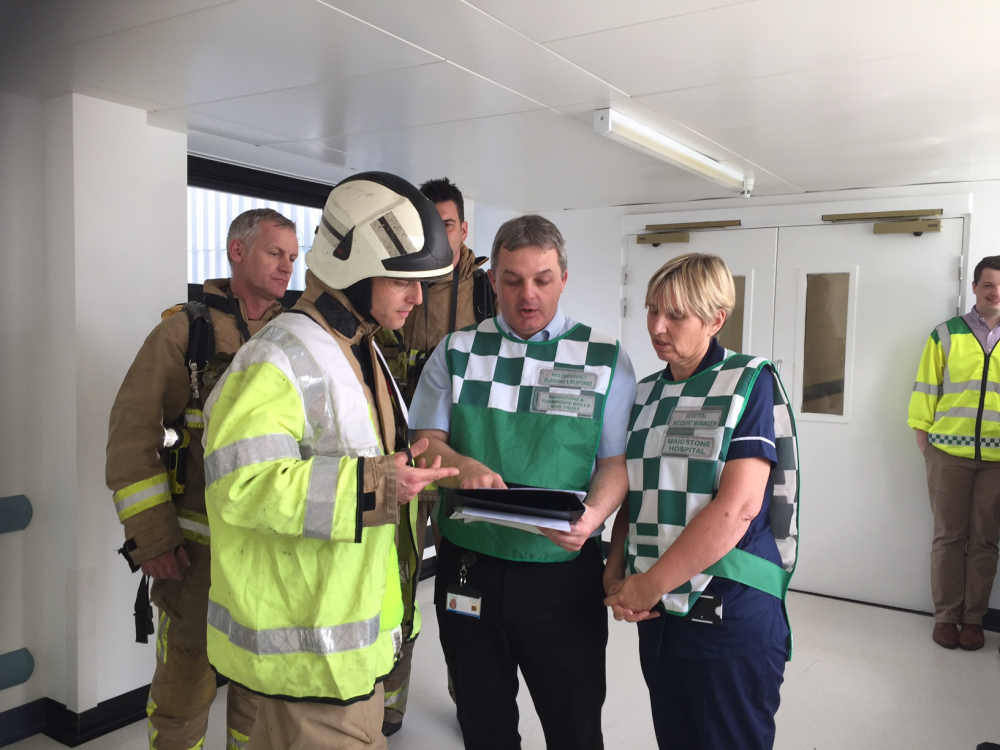
Image Source: Maidstone & Tunbridge Wells NHS Trust, Crown copyright
Donations keep this site going. If you like what I’m doing here and think this work is important to the independence movement, consider a donation. One-off or monthly; as little or as much as you want. Click the links below, or full details are available here.
The Civil Contingencies Act 2004 is the UK’s main emergency planning and emergency management law.
It was introduced to modernise and improve how the UK’s public authorities respond to various types of “emergency”.
An “emergency” is defined in the Act1 as any event in the UK which:
- Threatens serious damage to human welfare (including loss of life, homelessness, damage to property or interruption to key supplies and services).
- Threatens serious damage to the environment.
- Would fall under the definition of war, terrorism or threats to the UK’s national security.
The UK's Emergency Powers
The Act gives the UK Government the power to pass emergency regulations, effectively “by decree” (Orders-in-Council)2.
These regulations can be introduced to respond directly to an emergency as defined in Part 1 of the Act (listed above). This can include, amongst other things, restricting movements into or out of a given area, imposing curfews, enabling the deployment of the armed forces, or the confiscation and/or destruction of property (including livestock).
However, they cannot be used to enforce any form of conscription, to ban strikes, to change human rights laws or emergency powers themselves, or to create new serious criminal offences.
Emergency regulations can only remain in place for a maximum of 30 days unless the UK Parliament votes to extend them.
How are civil emergencies managed in the UK?
Law-making powers around civil defence and civil emergencies are not devolved.
Despite this, the Welsh Government is a “regional lead” when responding to civil emergencies in Wales – particularly in devolved policy areas.
The Welsh Government leads the Wales Resilience Forum, which sets the national strategy for emergency management.
Local authorities (the 22 unitary authorities in Wales), fire & rescue authorities, the NHS (local health boards in Wales) and Natural Resources Wales are considered lead responders to a civil emergency – known as Category 1 responders.
Category 2 responders include specialist agencies that may only get involved if an emergency directly impacts their area of expertise. This list includes utilities companies, transport authorities, the Health & Safety Executive (HSE) and the Coal Authority.
You would assume the new body being established in Wales to monitor coal tips would be included in the future.
Category 1 and 2 responders come together during a civil emergency (local resilience forums) to coordinate their response. As of 2026, there are four local resilience forums in Wales; one for each police force area.
Local government also takes the lead when it comes to emergency planning. This is considered a legal obligation (“statutory responsibility”).
What lessons can be learned from the Covid-19 pandemic (and from threats by Russia)?
The Civil Contingencies Act wasn’t used during the COVID-19 pandemic3.
Instead, the UK Parliament passed an emergency law in March 2020 (Coronavirus Act 2020), which was granted consent to cover devolved policy areas by the Senedd.
The reason given for this is that regulations made under the Civil Contingencies Act need constant re-approval by the UK Parliament (because they can only last for 30 days). This wasn’t considered practical. Also, it was known that the pandemic was coming weeks in advance.
An independent review of the Civil Contingencies Act was published in 20234. Its conclusions and recommendations include:
- Despite the Act being largely fit for purpose, resilience (as government policy) has been neglected, and some parts of the Act need to be modernised.
- Voluntary and Community Organisations should be properly considered as partners when responding to an emergency.
- Consideration should be given to establishing a single/UK-wide Civil Contingencies Agency.
- The training of staff involved in emergency planning needs to improve.
- There needs to be a better way of working out how prepared parts of the public sector are to deal with emergencies.
You Might Also Like....
Civil Contingencies Act 2004, Part 1, Section 1
Civil Contingencies Act 2004, Part 2.
UK Parliament, House of Commons Library (24th March 2025). “Intergovernmental relations during the Covid-19 pandemic“
National Preparedness Commission (March 2022). “An Independent Review of the Civil Contingencies Act & Its Supporting Arrangements“
No AI tools were used to draft this post.