Image Source: Defence Imagery, Open Government Licence
Donations keep this site going. If you like what I’m doing here and think this work is important to the independence movement, consider a donation. One-off or monthly; as little or as much as you want. Click the links below, or full details are available here.
What Happens Now?
Countries that have good relations with each other – or a high level of trust – may share intelligence, or even undertake joint operations as part of a formal agreement or alliance.
This sharing could take the form of intelligence reports prepared by intelligence officers, internet data, data held on databases, information/tip-offs from confidential sources/agents and military or geographical data (i.e. satellite imagery).
The UK is a member of the “Five Eyes” intelligence alliance along with the United States, Canada, Australia and New Zealand. Members of the alliance have access to highly advanced surveillance, software and cybersecurity systems.
Beyond the “Five Eyes”, other major Western countries have varying degrees of access. These include Denmark, Norway, France, and the Netherlands (“Nine Eyes”). Also, Germany, Belgium, Spain, Sweden, and Italy (“14 Eyes”).
Some intelligence may be shared as part of NATO or other specific intelligence alliances.
Since 2015, it’s been the policy of the United States to share information about planned terror attacks or violent crimes even with hostile countries or countries without a formal intelligence-sharing agreement.
For example, Russia was issued a warning from US intelligence services before an Islamist terror attack in Moscow in March 2024, but the warning was ignored.
Does This Work for Wales?
It’s not entirely relevant in the case of Wales because the UK Government sets the policy on our behalf. Wales has no say in who the UK Government and security services share intelligence with and why.
There may well have been instances where international intelligence sharing has led to successful counter-terrorism or organised crime operations in Wales, such as anti-drug smuggling operations or the arrest of fugitives.
What Would Be the Pros & Cons of Independence?
Wales would be able to decide which countries to share intelligence with and on what terms (and vice versa, which could be considered a disadvantage).
Wales would have a seat at the table at major international security conferences (possibly as a NATO or European Union member).
Some intelligence-sharing arrangements are embedded within major international agreements and organisations. These include Interpol, the European Union’s Security Policy, Organisation for Security & Cooperation in Europe (OSCE) and NATO (if an independent Wales were a member of any of them).
We would be building a “Welsh intelligence community” from the ground up, meaning we can learn from best practices from around the world.
New Zealand sets a precedent for a relatively small country with a small military budget being a member of the “premier” Five Eyes intelligence alliance. There would also be an opportunity to negotiate an intelligence-sharing pact (specifically relating to internal security threats) between the nations of GB & Ireland.
The Welsh Government has just as little experience of handling national security as defence and foreign policy. This is doubly impacted by (unlike Scotland and Northern Ireland) having no devolved control over the criminal justice system.
Wales would likely not be able to be part of the “Five Eyes” alliance if we didn’t have some signals/communications intelligence capability. This is likely to be the most expensive and time-consuming element to set up.
Wales would lose access to/support from the UK’s intelligence community (other than through an intelligence sharing agreement).
Additionally, we would have no national security/intelligence capability from the start (other than the police); this would have to be built up from scratch.
You can “fight smart” using new and emerging technology all you want, but that presents as many risks as it does opportunities.
What Do Other Countries Do?
![]()
Ireland is (as far as I’m aware) not a part of any formal intelligence-sharing arrangement, but does take part in intelligence sharing as part of the European Union. Ireland’s tailored partnership with NATO may also lead to intelligence sharing – particularly around the security of undersea infrastructure in light of the threat posed by Russia.
![]()
Denmark is a member of NATO and the European Union. Denmark is also a member of the “Nine Eyes” intelligence group, which means it has a closer relationship to US intelligence services than other NATO members (likely because of Greenland).
![]()
Finland is a member of NATO and the EU and has at least one bilateral intelligence-sharing agreement with the United States.
![]()
New Zealand is one of the “Five Eyes” – an English-speaking intelligence sharing alliance along with the US, UK, Australia and Canada. New Zealand government policy is also to share intelligence with other countries “on a formal and ad hoc basis”- though this is subject to ministerial approval and an assessment of human rights obligations.
What Options Does Wales Have?
This would presumably either be the Five Eyes alliance (which includes all the major English-speaking countries except neutral Ireland) or the looser/outer group Nine Eyes alliance. The latter (which would be more realistic) would mean Wales joining the UKUSA Agreement treaty as a third party.
There are other intelligence-sharing alliances too, such as the Bern Club (which covers most European Union member states).
The obvious choice would be one covering Great Britain & Ireland, separate from Five Eyes and more keenly focused on cross-border issues. This would take time to set up.
This could be on an informal like-for-like basis (share with us, share with you) in response to specific requests. Or, it could be done to pass on urgent intelligence to friendly/allied countries.
What's at Stake?
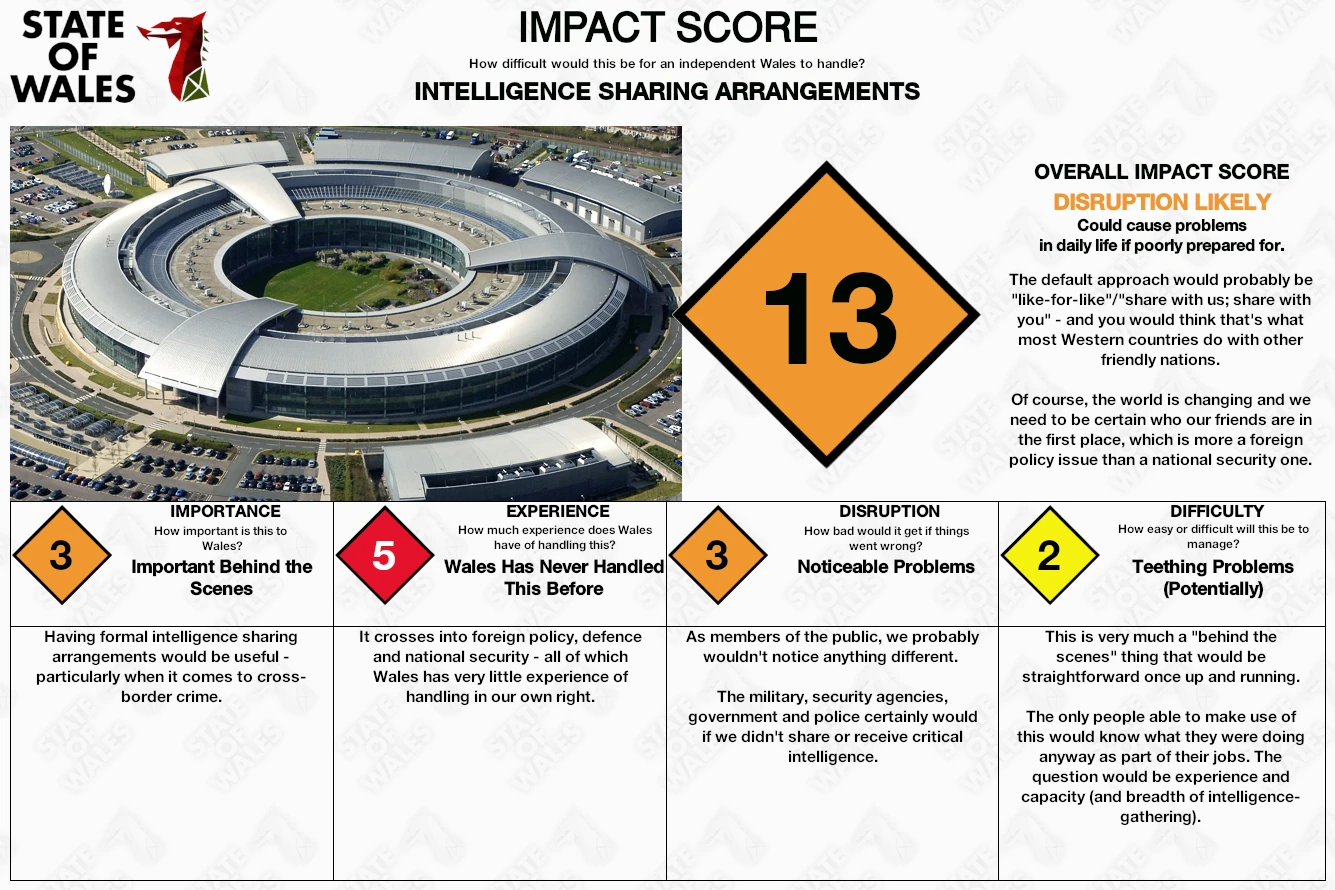
The overall score (out of 20) is the total of the scores for the four mini-categories (out of 5 each).
How Would This Be Run?
An independent Wales may be part of formal intelligence-sharing agreements through membership of certain international organisations.
Where there isn’t an agreement in place, the practical policy option would be “like for like”; if a friendly country shares intelligence with us, we would do the same with them.
Authorisation to share intelligence with foreign countries and agencies could be granted by a Cabinet-level committee. This would either be a stand-alone National Security Committee or a combined Defence & National Security Committee.
Where pre-arranged intelligence sharing isn’t practical (i.e. an urgent threat), the responsible minister could have the power to authorise intelligence sharing by themselves with the approval of the relevant security agency – though they would need to inform members of the Cabinet-level committee that they had done so.
How Much Will This Cost?
No direct cost implications, though preventing terror attacks or foreign espionage efforts would save money.
Would any new taxes need to be introduced?
No.
Who will pay for this?
Indirectly, general taxation (to fund intelligence services).
How Long Would This Take?
The bigger issue here is the principle of intelligence sharing rather than how long it takes.
Joining an intelligence alliance would require negotiation, which would take however long it takes; it would be impossible to put a timeline on it.
People & Work
Anyone who would be working in the intelligence community in Wales, including ministers and civil servants who provide oversight.
There are unlikely to be any job implications one way or another.
You Might Also Like....

No AI tools were used to draft this post.