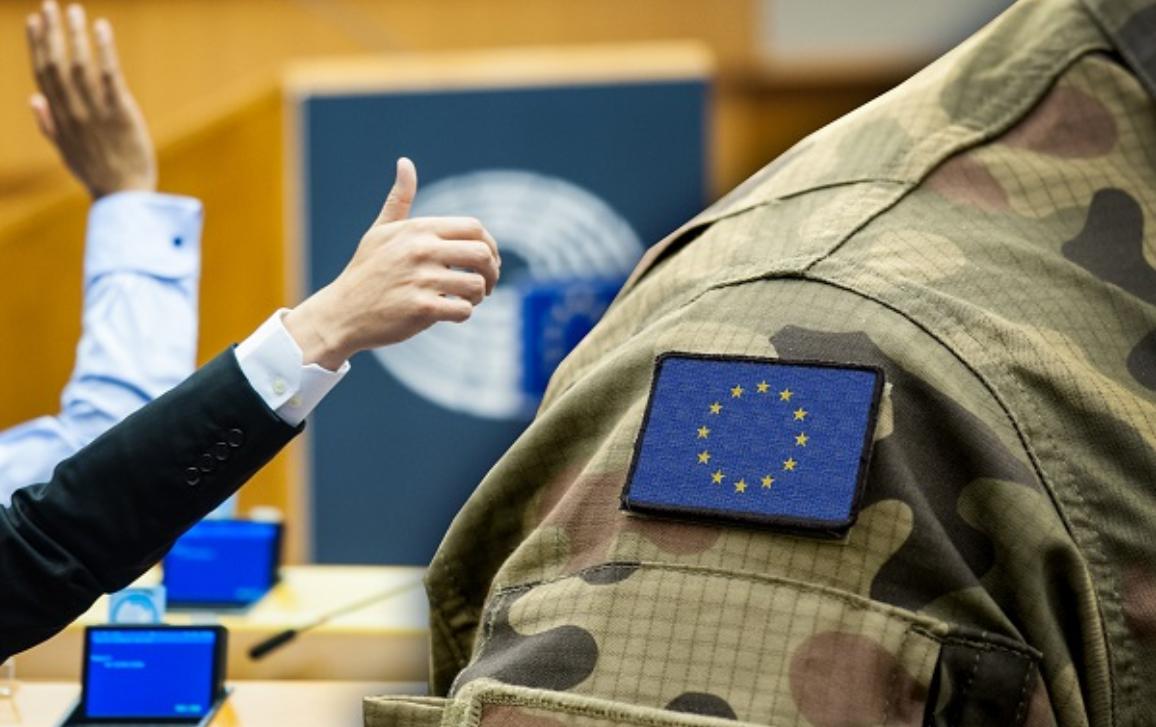
Image Source: European Parliament
Donations keep this site going. If you like what I’m doing here and think this work is important to the independence movement, consider a donation. One-off or monthly; as little or as much as you want. Click the links below, or full details are available here.
What Happens Now?
Wales – along with the rest of the UK – left the European Union (EU) in January 2020 following the 2016 referendum. At that referendum, Wales voted by 52.5% to 47.5% to “Leave” the EU.
As part of the Brexit process, the UK withdrew from the EU’s Common Security & Defence Policy (CSDP), which is sometimes called a European Defence Union.
The CSDP is focused on peacekeeping and conflict resolution, with EU member states contributing part of their military towards missions under the EU banner. Although NATO is the main defence alliance in Europe, the CSDP also makes it easier for the militaries of EU member states to work together.
In May 2025, the UK Government and European Union agreed a security and defence partnership1. As part of this agreement, the UK became an observer to the CSDP.
Does This Work for Wales?
At the moment, it’s irrelevant because Wales (and the UK) are no longer in the EU.
Defence is one area in which the UK “punches above its weight” at a European level. So, the UK no longer playing a full part in the CSDP is perhaps one of the few areas of Brexit where the EU likely came off worse than the UK (though the impact has been lessened by most EU member states and the UK being NATO members).
It would only become fully relevant if an independent Wales decided to (re)join the EU in the future.
The biggest drawback has been that the UK has been partially locked out of EU defence spending programmes due to Brexit. This would impact Welsh businesses working in the defence industry.
The UK Government has been negotiating the terms of accessing EU rearmament funding and loans (called Security Action for Europe/SAFE). It’s expected that the UK would have to pay to access it2. If the UK pays, Wales pays.
EU Membership & Defence: Pros & Cons
Wales would be able to fully contribute towards Europe’s strategic independence, becoming less reliant on (an increasingly unreliable) United States for defence via NATO.
Wales would become a party to the EU’s free trade deals and defence funds. This may make it a bit easier to buy defence equipment from major EU suppliers like Airbus, as well as those based in in Germany (Rheinmetall, Diehl), France (Dassault, Thales), Italy (Iveco), Poland (PGZ), Austria (Steyr) and Sweden (Saab).
Similarly, having full access to the EU could boost the Welsh-based defence and aerospace sectors and make it easier to access EU funds and loans.
EU membership and the CSDP may make it easier to work more closely with Ireland on defence, particularly in terms of maritime and air defence (the latter is a noticeable weakness in Ireland’s defence capabilities). This could include forming a joint EU battlegroup.
The EU has enough collective diplomatic and economic power to make a difference globally (such as in imposing sanctions on Russia). This would amplify Wales’ “voice” – as a potential full EU member – far more than we currently can through the UK.
In terms of defence, NATO is and remains (for the foreseeable future) far more important. Whether an independent Wales joins NATO or not isn’t a question tied to EU membership.
Similarly, if an independent Wales adopts a neutrality policy, taking part in the CSDP may conflict with that in some respects.
Wales could have access to the EU’s single market without needing to join the EU and take part in the CSDP, such as EFTA membership or a Wales-EU free trade deal.
The CSDP and all of the organisations and bodies involved are an over-complicated mess. Many European militaries still can’t work properly with each other (i.e. radically different equipment) or duplicate the same tasks, making the policy less effective. Wales would be no different.
It’s part of the long-standing debate about whether there needs to be an “European Armed Forces”; these debates were tied to arguments made to leave the EU in 2016.
CSDP peacekeeping missions have had, at best, mixed success3. Contributions of personnel from EU member states appear to be quite small. It’s hard to see what benefit such missions would be to Wales (as an EU member) or the countries to which the missions are deployed.
Wales would share decision-making powers over things like applying sanctions with the EU. One element of the EU’s Common Foreign & Security Policy is that member states work to apply the same sanctions.
What Do Other Countries Do?
26 of the 27 EU member states take full part in the CSDP in which they work together on defence matters, called Permanent Structured Cooperation (PESCO). This includes joint projects to develop new defence technology and weapons.
Malta is the only EU state which doesn’t take part. This is due to concerns that it may violate their Constitution’s clauses relating to neutrality.
Ireland takes part despite officially being a neutral country, though it seemingly only takes part in peacetime elements and has a constitutional opt-out from taking part in a mutual defence agreement4.
What Options Does Wales Have?
When a country applies for EU membership, it’s judged on 35 separate membership terms and conditions called “Chapters”5.
Chapter 31 covers foreign, security and defence policy and states:
“Member States must be able to conduct political dialogue in the framework of the Common Foreign & Security Policy (CFSP), to align with EU statements, to take part in EU actions and to apply agreed sanctions and restrictive measures. Applicant countries are required to progressively align with EU statements, and to apply sanctions and restrictive measures when and where required.”
The CFSP includes the Common Security and Defence Policy as one of its core elements.
A country can’t join the EU until all 35 Chapters are “closed”.
A chapter is “closed” when the country applying for EU membership meets the requirements, or has made reforms to do so. Each government of EU member states also has to agree that the requirements of each Chapter have been met before they can be closed.
So by the very act of applying to join the EU, an independent Wales would be accepting the Common Security and Defence Policy as a condition of EU membership.
What's at Stake?
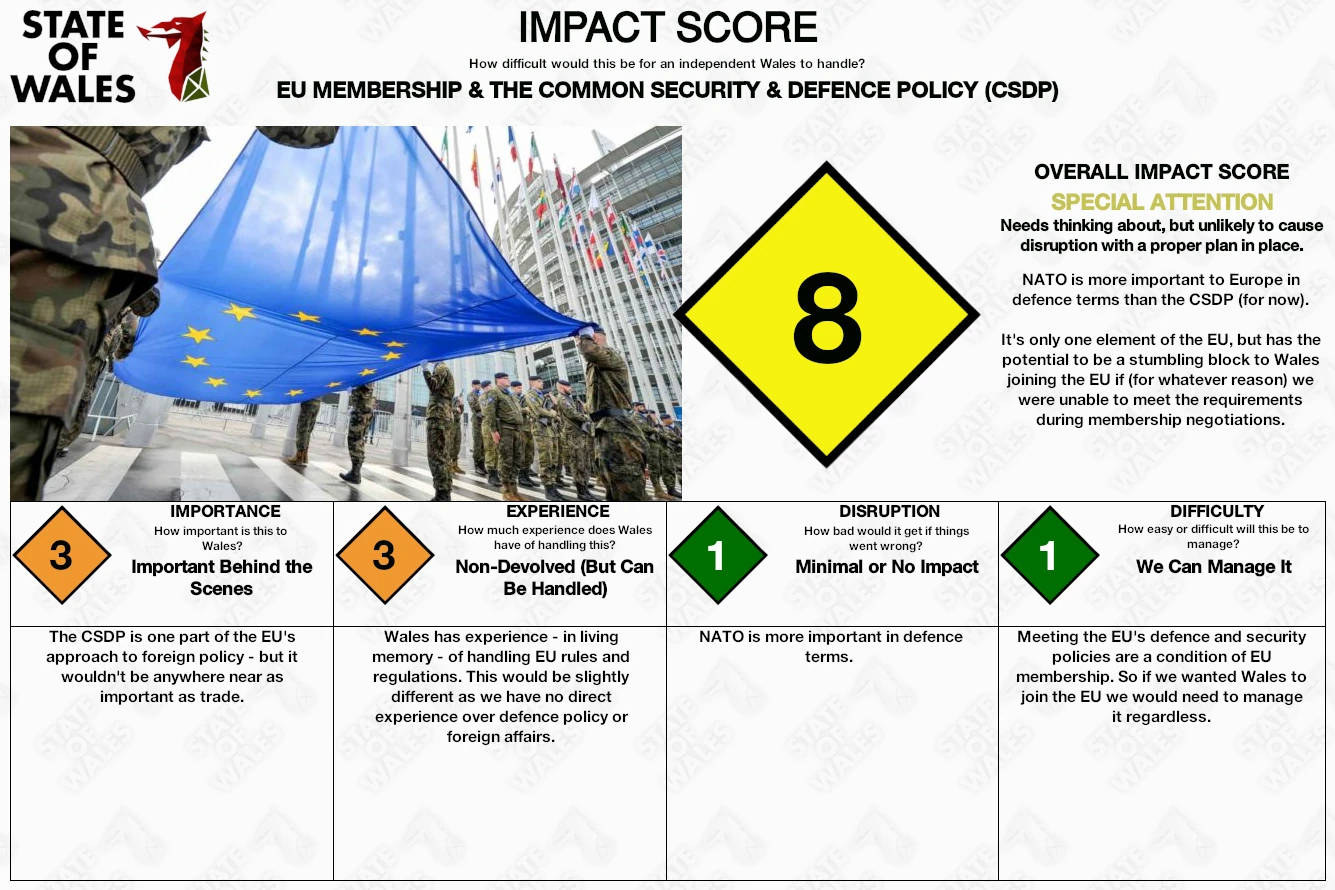
The overall score (out of 20) is the total of the scores for the four mini-categories (out of 5 each).
How Would This Be Run?
Each EU member state elected a set number of Members of the European Parliament (MEPs) based on its population. MEPs are responsible for making EU laws/regulations and setting the EU’s budget.
The total number of MEPs is capped at 751. An independent Wales would likely elect between 8-10 MEPs after the number of MEPs per country is recalculated (Wales only elected 4 MEPs when the UK was an EU member).
All MEPs have to be elected by proportional representation, but Wales would decide what electoral system to use and whether MEPs would be from an all-Wales list or would represent regions/constituencies.
Welsh MEPs would be members of EU Parliament committees. One of these is the Committee for Security & Defence.
The European Commission is responsible for the day-to-day running of the EU and acts as a mix of a government and civil service.
As a full EU member, Wales would put someone forward as an EU Commissioner. That Commissioner would be given a policy responsibility (much like a Cabinet minister in the Welsh or UK Governments).
The High Representative for Foreign Affairs & Security Policy is the EU Commissioner responsible for the CDSP. As of 2025, the post is held by former Prime Minister of Estonia (population 1.4 million), Kaja Kallas.
The Welsh First/Prime Minister would sit on the European Council. They would help set the EU’s policies.
The Presidency of the European Council rotates amongst member states every 6 months, so Wales would hold the presidency at some point. That would mean setting the agenda and leading negotiations – but it would be time-consuming and may distract from the day job.
How Much Will This Cost?
Headline: The EU funds its defence agencies and funds out of its own budget, which Wales (as an EU member) would contribute to.
Wales would make a yearly contribution to the EU’s budget.
This would be based on customs duties (on imports from outside the EU), a share of VAT and a set figure based on the size of Wales’ economy within the EU. In 2014, Wales’ contribution to the EU budget was estimated to be £625 million6 (before the UK’s then rebate). At 2025 prices, that would be around £851 million.
Would any new taxes need to be introduced?
No, but we would have to set VAT rates to match those of the EU.
Who will pay for this?
Based on how the EU budget is paid for: importers, anyone buying anything with added VAT and general taxpayer funding.
How Long Would This Take?
In short, it would likely take anything between 2-6 years (from the point of applying) for an independent Wales to join the EU, depending on how quickly the “Chapters” can be closed.
People & Work
It would be mostly relevant to senior military officers, civil servants working in defence and national security, the Welsh diplomatic service and the Welsh defence and aerospace industries.
It depends on the performance of the economy, but free movement would make it easier for Welsh citizens to find work in other EU member states. It may also make Wales more attractive for investment from EU defence and aerospace companies.
As an EU member, Welsh citizens would be able to apply for jobs with EU institutions involved in the Common Security & Defence Policy.
As an example, Ireland has around 50 staff working within the EU’s External Action Service (which manages the CSDP)7.
You Might Also Like....
UK Government (19th May 2025). “Security and defence partnership between the European Union and the United Kingdom of Great Britain and Northern Ireland”.
Gregorio Sori, Politico (22nd August 2025). “EU sets conditions for UK payments into SAFE defence fund“
Dr Simon Duke, European Institute of Public Administration (22nd January 2018). “Written evidence to UK Parliament Committee” (8.1-8.6).
Constitution of Ireland, Article 29, Section 4, Clause 9.
European Commission. “Conditions for membership, Chapters of the acquis”.
G Ifan, RW Jones, EG Poole (May 2016). “Estimating Wales’s Net Contribution to the European Union” (p 6-7).
European Union, External Action Service. “Annual Activity Report 2024” (Annex 3, Table 2).
No AI tools were used to draft this post.