Senedd Home
Oggy Bloggy Ogwr
State of Wales
Monday, August 17, 2026
  • About & Contact
    • About State of Wales
    • Comments Policy
    • Complaints Policy
    • Contact
    • Disclaimer
  • Elections Centre
  • The Independence Index
    • The Independence Index (Full)
    • Foreign Policy
      • Relations with the former UK & Ireland
      • Relations with Europe
      • Foreign Policy (General)
      • International Organisations & Law
      • Overseas Aid
    • Defence
      • Defence Policy
      • NATO
      • Armed Forces
      • National Security
      • Civil Defence
    • Rules & Regulations
      • Safety & Standards
      • Intellectual Property
    • Economics & Money
      • Business & Economy
      • Currency
      • Tax & Spending
      • Transport & Infrastructure
    • Society
      • Communities & Housing
      • Culture & Sport
      • Education
      • Health
      • Media & Communications
      • Science & Technology
    • The State
      • Environment & Natural Resources
      • Justice
      • Local Government
  • Support & Donate
No Result
View All Result
  • About & Contact
    • About State of Wales
    • Comments Policy
    • Complaints Policy
    • Contact
    • Disclaimer
  • Elections Centre
  • The Independence Index
    • The Independence Index (Full)
    • Foreign Policy
      • Relations with the former UK & Ireland
      • Relations with Europe
      • Foreign Policy (General)
      • International Organisations & Law
      • Overseas Aid
    • Defence
      • Defence Policy
      • NATO
      • Armed Forces
      • National Security
      • Civil Defence
    • Rules & Regulations
      • Safety & Standards
      • Intellectual Property
    • Economics & Money
      • Business & Economy
      • Currency
      • Tax & Spending
      • Transport & Infrastructure
    • Society
      • Communities & Housing
      • Culture & Sport
      • Education
      • Health
      • Media & Communications
      • Science & Technology
    • The State
      • Environment & Natural Resources
      • Justice
      • Local Government
  • Support & Donate
No Result
View All Result
State of Wales
No Result
View All Result
Home Foreign Policy

Could an independent Wales stay outside of the EU and Single Market?

Owen Donovan by Owen Donovan
May 20, 2025
in Foreign Policy, Relations with Europe
Could an independent Wales stay outside of the EU and Single Market?

Gallagher Group

Share on FacebookShare on TwitterShare on RedditShare on BlueskyShare by email

Image Source: Gallagher Group

This site is best viewed in landscape mode on smartphones.
Support IndyWales? Support State of Wales!

Donations keep this site going. If you like what I’m doing here and think this work is important to the independence movement, consider a donation. One-off or monthly; as little or as much as you want. Click the links below, or full details are available here.

What Happens Now?

Wales – along with the rest of the UK – left the European Union (EU) in January 2020 following the 2016 referendum. At that referendum, Wales voted by 52.5% to 47.5% to “Leave” the EU.

Since then, the UK has negotiated (with some difficulty) a trading agreement with the EU. The agreement will be reviewed every five years, with the first review set to take place during 2026. A “reset” of some issues was agreed in May 2025.

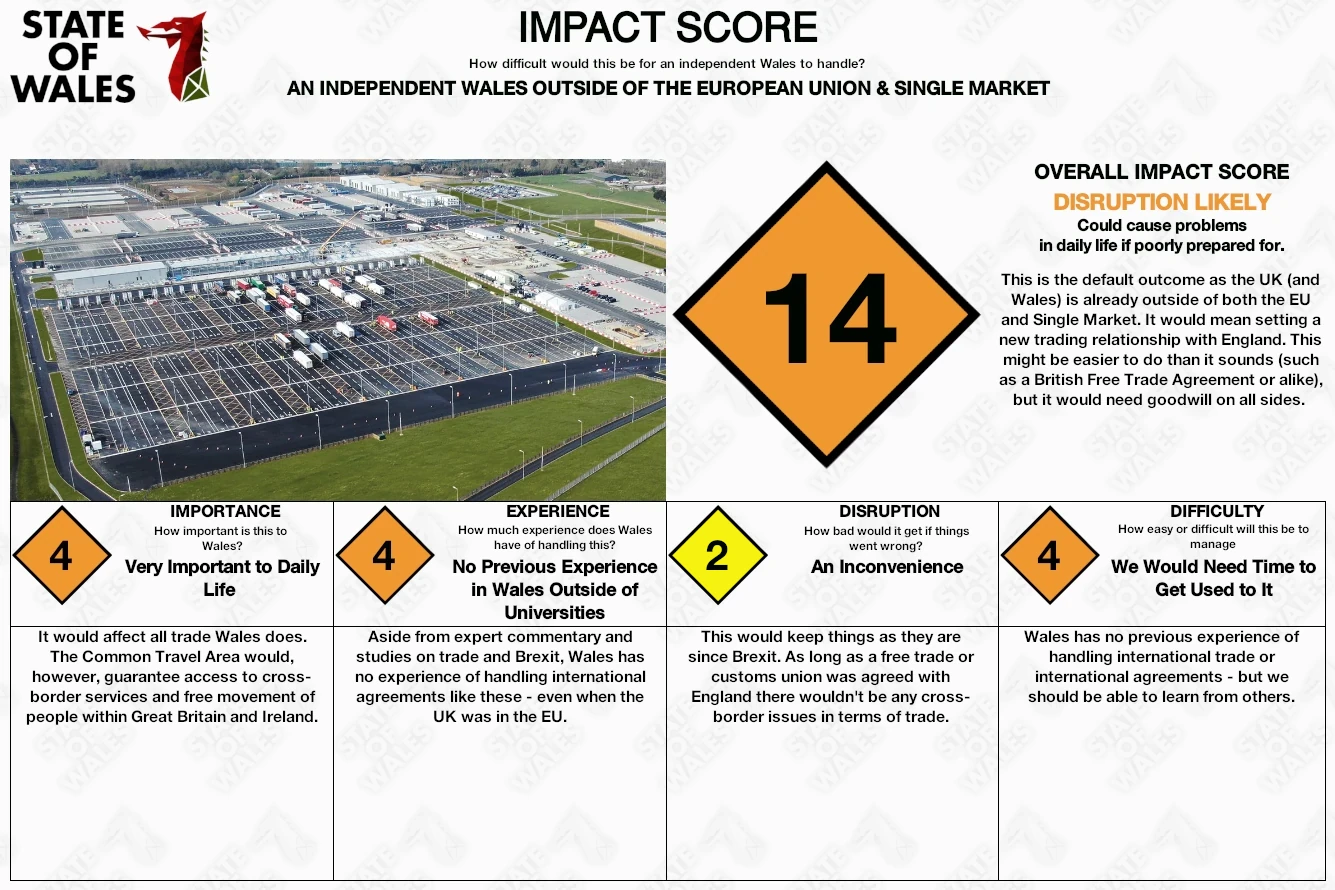
Wales staying out of the EU would, therefore, largely keep things as they are now.

Does This Work for Wales?

Trade figures suggest that Brexit hasn’t impacted trade in goods between Wales and the EU that much, with the value of goods exported and imported remaining relatively steady both before and after Brexit1.

However, there have been other noticeable impacts from Brexit – a process led almost entirely by the UK Government – elsewhere.

Adding the loss of funding towards rural support schemes, the Welsh Government estimated that Brexit has cost Wales £1.1 billion in funding as of 2022. EU economic development funding was lost at the end of 2023.

It’s replacement – the UK Government’s “Shared Prosperity Fund” – was estimated to be worth £775 million less than its EU equivalent in 20222. The formula used to work out how much each local authority would receive was criticised for not taking populations into account3.

IndyWales Sticks with Brexit: Pros & Cons

Pros of Independence
Cons of Independence
Pros of Independence

Staying outside the EU would honour the 2016 referendum result in Wales.

Wales would be able to negotiate trade deals independently. We can decide for ourselves how “deep” we want our ties to the EU (and elsewhere) to be based on our own interests.

Wales would not have to share powers with the EU (or another trade bloc) and would have full control over economic and social policy (including immigration).

The Common Travel Area maintains free movement between Wales and the rest of Britain & Ireland.

Cons of Independence

Does Wales have the skills and experience needed to negotiate trade deals as an independent country outside of a bigger trade bloc?

Recent polling suggests that people in Wales* (and the UK more generally) support rejoining the EU or having Single Market access4.

Wales has already lost access to EU funding that hasn’t been properly replaced by the UK Government, despite promises from the 2016 Leave campaign that it would be5. Wales would then lose access to UK “Shared Prosperity Fund” by becoming independent.

Unless negotiated beforehand, an independent Wales would have no trade agreement with either England/the rest of the former UK or the EU. The Common Travel Area protects free cross-border movement, but would every single border crossing point with England need a customs post?

Wales would be the junior partner in any trade negotiations, giving us a weak hand; it’s sometimes better to be part of a bigger bloc, and the EU holds far more economic power than the UK (or England alone).

* The Welsh sample in the poll is small at just 123 people, though other polls have consistently shown Welsh support for rejoining the EU since 2021.

What Do Other Countries Do?

Faroe Islands
Armenia
Turkey
Faroe Islands

Despite being a self-governing nation within Denmark, the Faroe Islands are outside of the EU and Single Market. They negotiated a free trade agreement with the EU in 1997. There’s a heavy focus on fisheries, and there isn’t free movement of “services, capital and goods”6.

Armenia

A revised Partnership & Cooperation Agreement between the EU and Armenia was agreed during 2021. As Armenia is part of a separate Eurasian Economic Union, the trade element isn’t that deep and it’s more about bringing Armenia laws and regulations more in line with EU norms.

Turkey

Turkey has an Association Agreement with the EU alongside a Customs Union. That means goods can be traded between the EU and Turkey without customs checks and alike, but Turkey remains outside the EU and the Single Market.

What Options Does Wales Have?

Sign up to the Trade & Cooperation Agreement
Create a new free trade area/bloc
Negotiate a Wales-EU Free Trade Agreement
Negotiate an Association Agreement with the EU
Sign up to the Trade & Cooperation Agreement

Wales signs the existing UK-EU post-Brexit agreement, meaning trade between Wales and the EU would be on the same terms as they are now. We can negotiate the Wales-England trading relationship separately, possibly as a Free Trade Area or Customs Union.

Create a new free trade area/bloc

Subject to negotiation, the former nations of the UK & the Crown Dependencies could set up a British Free Trade Area separate from equivalents like the EFTA. This would maintain free trade and a customs union – possibly a currency union as well. Trade deals would be negotiated as a bloc with Wales having equal say in our own right.

Negotiate a Wales-EU Free Trade Agreement

Wales would negotiate a stand-alone free trade agreement with the EU that doesn’t involve Single Market Access. New Zealand signed an EU Free Trade Agreement in 2023. This included things like tariff-free trade on 90%+ of products and was estimated to provide a NZ$600 million boost to the New Zealand meat industry7.

Negotiate an Association Agreement with the EU

An Association Agreement – similar to that mentioned for Turkey – is a type of partnership which gives the signing nation some preferential treatment and closer working. It may or may not be signed alongside a Free Trade Agreement of some kind.

What's at Stake?

The overall score (out of 20) is the total of the scores for the four mini-categories (out of 5 each).

How Would This Be Run?

Sign up to the Trade & Cooperation Agreement
Create a new free trade area/bloc
Negotiate a Wales-EU Free Trade Agreement
Negotiate an Association Agreement with the EU
Sign up to the Trade & Cooperation Agreement

Wales would be represened on the (as it’s called now) UK-EU Partnership Council by a government minister.

Create a new free trade area/bloc

Likely run as a Council of Ministers similar to the EFTA.

Negotiate a Wales-EU Free Trade Agreement

Based on the New Zealand example, the agreement would be monitored by special committees.

Negotiate an Association Agreement with the EU

A Wales-EU Association Council would be set up. This would be made up of Welsh Government ministers, EU Commissioners and representatives from EU member states. They would meet at least once a year based on Ukraine’s Association Agreement.

How Much Will This Cost?

Headline: At least £343 million in lost “UK Shared Prosperity Fund” money (2024-25). Other indirect costs and benefits too.

That assumes the Shared Prosperity Fund would continue as is for a long time anyway.

How the wider Welsh economy would be affected depends on the kind of trade agreements we reach with other countries and trade blocs, with England being the top priority. You would need an economist to make a proper estimate, though trade between Wales and England is worth up to £25 billion a year in both directions combined9.

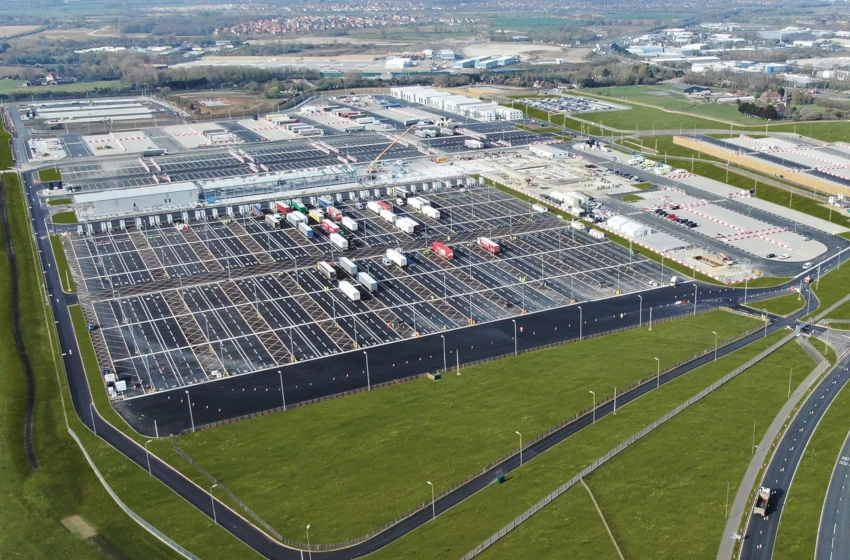
There would be a cost attached to building custom inspection points along the English border (if needed). The “Farage Garage” at Holyhead cost £46 million10.

Would any new taxes need to be introduced?

Probably not, though the amount of tax income raised in Wales each year would depend on the performance of the Welsh economy. That could be impacted in a good or bad way depending on which option we pick.

Who will pay for this?

Nobody would “pay” for it directly; again, it depends on the kind of trade deals we negotiate and how it impacts the economy.

How Long Would This Take?

Trade & Cooperation Agreement
Free trade area/bloc
Wales-EU Free Trade Agreement
Wales-EU Association Agreement
Trade & Cooperation Agreement

It would need the agreement of England (as the UK’s successor state) and probably approval by all of the EU’s member states as well as the EU Commission and EU Parliament. This could be done during the 18-24 month transition period of independence so it’s in place on day one.

Free trade area/bloc

The EFTA was founded over a period of 6-9 months between 1959-1960. Given that the nations of GB already have close ties, this might be relatively easy to negotiate (in principle).

Wales-EU Free Trade Agreement

Anything between 18 months and 6 years+; it depends on how well talks go. New Zealand’s Free Trade Deal took 12 rounds of talks between 2018 and 2022 to finalise and a further 2 years to come into force8.

Any Free Trade Agreement would need to be approved by EU member states and the EU Parliament too.

Wales-EU Association Agreement

If you want examples: Georgia’s Association Agreement took around 2 years from negotiations to ratification. Ukraine’s took about 5 years. Moldova took 3 years. Talks on an agreement with Andorra and San Marino began in 2014 and are yet to be ratified as of April 2025 (due to issues around tax havens, mainly).

People & Work

Who does this impact?

Everyone resident in Wales, but particularly importing and exporting businesses.

Would any jobs be created or lost?

There would be jobs created in customs – as happened in the aftermath of Brexit. Up to 50,000 extra staff were reportedly needed11, with a proportional Welsh share of that figure being around 2,500.

It’s difficult to predict overall as – again – it depends on trade agreements. Favourable trade deals might increase jobs and investment; bad deals could lead to job losses and investment being cut back.

You Might Also Like....

EU Referendum: The Results
Elections Centre

EU Referendum: The Results

by Owen Donovan
June 24, 2016
0

...

Read moreDetails
Brexit: Why did Wales vote Leave?

Brexit: Why did Wales vote Leave?

June 27, 2016
Council of Europe

Council of Europe

July 26, 2025
What would happen if an independent Wales joins the EU, but England remained outside the EU?

What would happen if an independent Wales joins the EU, but England remained outside the EU?

May 20, 2025
How would Wales join the EU as an independent country?

How would Wales join the EU as an independent country?

May 20, 2025
Load More
    1. Welsh Government Statistics (17th April 2024). “Welsh international goods trade: 2023”.
    2. Welsh Government (4th May 2022). “Written Statement: Loss of funding to Wales as a result of the UK Government’s arrangements for replacement EU funding”.
    3. Phillips, D. Institute for Fiscal Studies (18th July 2022). “UK Shared Prosperity Fund allocations for Welsh councils are flawed, costing some areas millions”.
    4. YouGov (25th January 2025). “How do Britons feel about Brexit five years on?”
    5. BBC Wales (14th June 2016). “Welsh EU cash ‘maintained’ after Brexit, say vote Leave.”
    6. Faroe Islands Government. “Agreement on the Free Trade between the Faroe Islands and the European Community”.
    7. New Zealand Government (1st July 2022). “New Zealand secures major free trade deal with European Union”.
    8. European Commission. “EU-New Zealand agreement – Documents”.
    9. Office of National Statistics (10th February 2025). Interregional trade in goods and services, UK: 2019 and 2020.
    10. Place North West (9th December 2021). “HMRC unveils £46 million Brexit customs post plans”.
    11. Financial Times (27th February 2020). “Border red tape will mean 50,000 new form-fillers after Brexit”.
Use of AI

No AI tools were used to draft this post.

Donations Welcome
Tags: ArmeniaBrexitCommon Travel AreaEuropean Single MarketEuropean UnionFaroe IslandsFP 201New ZealandTradeTurkey
Previous Post

What role would an independent Wales have with the Crown Dependencies & Overseas Territories?

Next Post

Could an independent Wales join the Single Market but stay outside of the EU?

Owen Donovan

Owen Donovan

Archive

Categories

Copyright

Creative Commons Licence

State of Wales by Owen Donovan is licensed under a Creative Commons Attribution-NonCommercial-NoDerivatives 4.0 International License.

Subscribe by Email

Search

No Result
View All Result
No Result
View All Result
  • Go To Senedd Home
  • Go To Oggy Bloggy Ogwr
  • About & Contact
    • About State of Wales
    • Comments Policy
    • Complaints Policy
    • Contact & Subscribe by Email
    • Disclaimer
  • Features
    • After the UK
    • Chinny Reckon
    • Devil’s Advocate
    • How Wales Works
    • Road to Brexit
  • The Independence Index
    • The Independence Index (full)
    • Economics & Money
      • Business & Economy
      • Currency
      • Tax & Spending
      • Transport & Infrastructure
    • Society
      • Communities & Housing
      • Culture & Sport
      • Education
      • Health
      • Media & Communications
      • Science & Technology
    • The State
      • Environment & Natural Resources
      • Justice
      • Local Government
  • Elections Centre
  • Wales FAQ
    • How is Wales funded?
    • How are laws in Wales made?
  • Support & Donate