Image Source: Public domain
Donations keep this site going. If you like what I’m doing here and think this work is important to the independence movement, consider a donation. One-off or monthly; as little or as much as you want. Click the links below, or full details are available here.
Formed following the Second World War, the Council of Europe is a separate organisation from the EU, focusing on protecting human rights, democracy and the rule of law across the continent.
It currently has 46 member states, with 5 observers.
It isn’t a political union or trade zone. It’s more of a forum to debate issues like human rights.
The Council of Europe is run by a Committee of Ministers1. Members of this committee include government ministers responsible for the foreign policy of their member states.
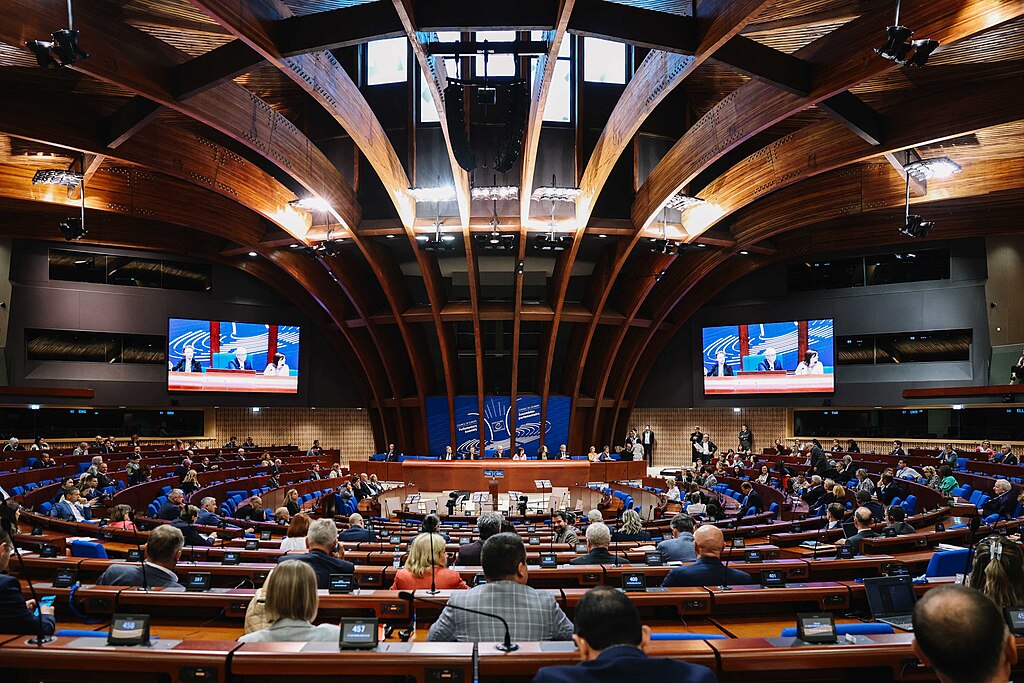
Additionally, the parliaments/legislatures of each member state send representatives to the Parliamentary Assembly of the Council of Europe (PACE). The total number of representatives is capped at 661, with the number allocated to each member state based on its population.
The role of the Parliamentary Assembly is to uphold the principles of the Council of Europe2. This includes, for example, undertaking investigations into potential human rights abuses in member states and sending observers to monitor elections.
The headquarters for the Council of Europe, Parliamentary Assembly and European Court of Human Rights are all in Strasbourg, France.
It’s worth stressing again that, although they can be easily confused, all of this is separate from the European Union (which has its own set of basic rights for the EU member states) and the European Court of Justice (which enforces EU laws).
The European Conventions
The Council of Europe has drafted several important human rights treaties, called conventions. As of 2025, there are 228 separate treaties.
The most famous of these is the European Convention on Human Rights (ECHR), which is enforced by the European Court of Human Rights.
The ECHR has 18 original articles, with several additions made in later years (called protocols).
The list of rights protected by the ECHR includes (amongst others): a right to life, right to privacy, right to freedom of religion and assembly, right to fair trial, right to vote by secret ballot and protection from slavery, torture and discrimination. It also bans the death penalty except during wartime.
The ECHR was written into UK law via the Human Rights Act 1998.
Will the UK pull out of the ECHR?
There’s an ongoing debate in parts of the British media and political establishment about the UK withdrawing from the ECHR, replacing it with a “British Bill of Rights”. This would be done by repealing the Human Rights Act3.
It stems from frustration in certain quarters that “undesirable elements” (such as convicted criminals, illegal immigrants and terror suspects) have used the ECHR to challenge decisions made by the government or the courts.
It’s unclear which rights those advocating for a withdrawal would like to water down or get rid of. The main goal would be to make it harder to challenge government and court decisions on human rights grounds.
One major stumbling block has been that under the terms of the Good Friday Agreement, the ECHR has to remain in law.
You Might Also Like....

Council of Europe, “The Committee of Ministers”.
Parliamentary Assembly of the Council of Europe, “The powers of the Assembly“.
A. Donald, J. Grogan, UK in a Changing Europe (15th May 2024). “Leaving the European Convention on Human Rights”.
No AI tools were used to draft this post.