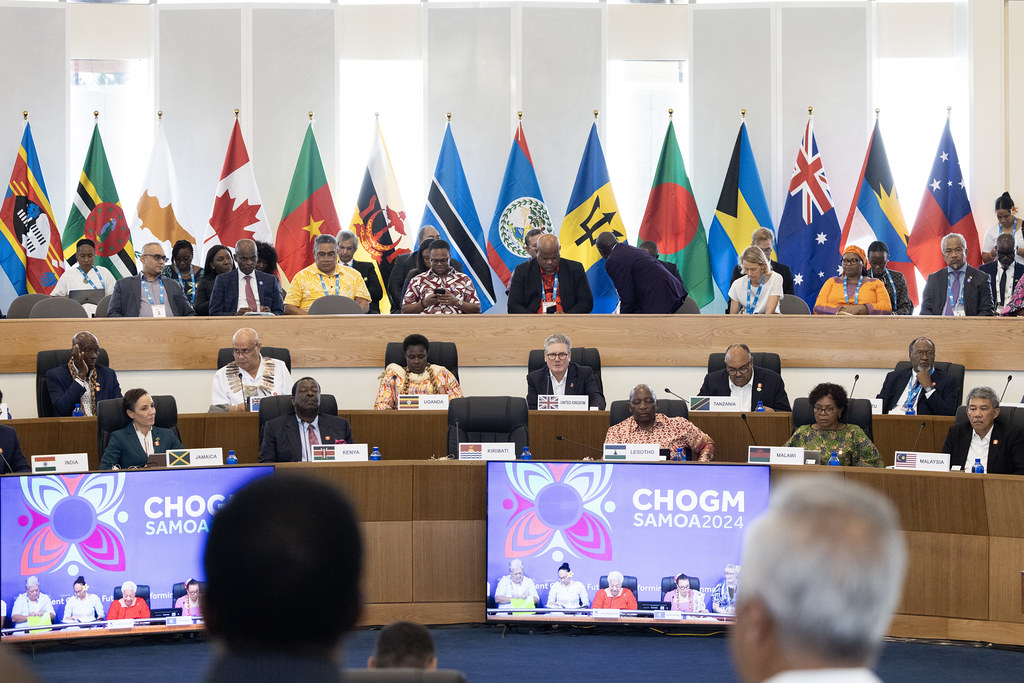
Image Source: UK Prime Minister via Flickr under Creative Commons Licence BY-NC-ND 2.0
Donations keep this site going. If you like what I’m doing here and think this work is important to the independence movement, consider a donation. One-off or monthly; as little or as much as you want. Click the links below, or full details are available here.
What Happens Now?
The UK is one of 56 independent countries that make up the Commonwealth of Nations.
The majority of Commonwealth countries are former colonies and dominions of the British Empire, though some newer Commonwealth member states have no previous ties to the UK.
The (ceremonial) Head of the Commonwealth is usually (but not automatically) the reigning UK monarch, who is also head of state of 14 other Commonwealth countries (called “Commonwealth Realms”). The majority of Commonwealth members are, nevertheless, republics.
In some (but not all) Commonwealth countries, citizens of Commonwealth member states have certain rights, which may include:
- A right to vote and (in some countries) to stand in elections.
- An easier pathway to residency or full/dual citizenship.
- A right to consular assistance from British embassies and high commissions if their home country doesn’t have a diplomatic mission in the same country. Some Commonwealth countries may issue emergency travel documents too.
- A right to join some country’s armed forces and apply for certain civil service jobs (usually with a valid visa).
Does This Work for Wales?
Wales isn’t a member of the Commonwealth in its own right; our membership is via the UK.
However, in certain circumstances, Wales acts as an independent Commonwealth member state – the most obvious example of which is Team Wales, which competes as an independent nation in the Commonwealth Games. The Senedd also takes part in the Commonwealth Parliamentary Association.
Membership of the Commonwealth is currently restricted to independent countries. As is the case with most matters related to foreign policy, Wales doesn’t have a voice within the Commonwealth or a seat at the top tables.
Commonwealth Membership: Pros & Cons
It’s the largest grouping of its kind of (mainly) English-speaking countries. Commonwealth member states are not considered to be entirely foreign to each other (hence why diplomatic missions are called high commissions rather than embassies).
While there isn’t a Commonwealth trade agreement, there is some evidence that Commonwealth member states do up to 20% more trade and invest more money with each other than with non-members1.
There are a lot of Commonwealth-tied organisations covering education, good governance, culture and charitable/third sector goals (called the “Commonwealth Family”).
Wales has a large resident population originally from Commonwealth countries (particularly southern Asia); as noted, Commonwealth citizens often enjoy certain rights in each other’s countries that are not granted to anyone else.
There’s no requirement for Commonwealth members to have the English monarch as head of state. So there’s no reason why Wales couldn’t remain in the Commonwealth as a republic (if we so wished).
Wales could seek to host a Commonwealth Heads of Government Meeting, which would be a major international networking event in its own right. There’s also the option of hosting the Commonwealth Games.
Other international organisations have become more important in terms of economics (EU, G7, G20), defence (NATO) or international diplomacy (UN). It can be argued – rightly or wrongly – that the Commonwealth is a relic of the British Empire and no longer serves any real purpose. It may end up disbanding long before Wales has a chance to join.
The Commonwealth hasn’t been effective at promoting rights across all member states. Several Commonwealth countries criminalise LGBTQ+ relationships (or worse), have been criticised for human rights abuses or retain the death penalty.
Welsh republicans may have a problem being a member of an organisation with the English monarch as its (ceremonial) Head.
Leaving the Commonwealth may be considered a “diplomatic snub” towards England and might damage relations with other major Commonwealth countries like India, Pakistan, Canada and Australia – some of which have sizable resident populations in Wales.
The future of the Commonwealth Games is uncertain. If Wales were independent, the Commonwealth Games would no longer be the only multi-sports event we would compete in as “Wales” because we would take part in the Olympics, Paralympics and others.
There are plenty of important countries that are not members of the Commonwealth. As an independent nation, we wouldn’t automatically have to think in terms of Commonwealth or non-Commonwealth; it’s not as if we would ignore Ireland or the US, for example, because they’re not Commonwealth members.
What Do Other Countries Do?
![]()
Ireland was a member of the Commonwealth between 1926 and 1949. Ireland formally left the Commonwealth once it officially transitioned from a dominion (what we would now call a Commonwealth Realm), with the monarch as head of state, to a republic.
Until only a few days after Ireland officially became a republic2, Commonwealth members had to retain the monarch as head of state. The rules were changed to accommodate India.
There’s been no serious campaign for Ireland to (re)join the Commonwealth.
![]()
Malta secured independence from British rule in 1964 and immediately joined the Commonwealth with the English monarch as head of state. Malta became a republic in 1974.
Malta has hosted the Commonwealth Heads of Government meeting twice.
![]()
New Zealand is one of the original independent members of the Commonwealth and continues to retain the English monarch as head of state (“Commonwealth Realm”).
New Zealand has hosted the Commonwealth Games three times (1950, 1974, 1990) and one Commonwealth Heads of Government meeting.
![]()
The Cook Islands are a self-governing territory in an association agreement with New Zealand. While they have control over foreign policy, they are currently barred from being full members of the Commonwealth as they are not considered to be fully independent.
The Government of the Cook Islands has sought membership talks as of 2025, but these have so far not been successful.
What Options Does Wales Have?
It’s a simple choice: we either join the Commonwealth as an independent country or we don’t.
If we want to join, the current membership requirements are3:
- The country needs to be fully sovereign/independent4. The Cook Islands might end up testing this in the near future.
- An historic association with an existing Commonwealth member (which Wales does), with all other applicants considered on a case-by-case basis.
- To accept the Commonwealth’s fundamental values and principles, as well as its norms and conventions (such as the use of English as the main working language and the English monarch as Head of the Commonwealth).
- To demonstrate a commitment to democracy, free and fair elections, the rule of law, good governance and human rights.
- To become an active part of the Commonwealth Foundation and promote civil society bodies.
An independent Wales would have to make an expression of interest in joining.
The Secretary-General would then discuss the application with member states. If agreed, an invitation to make a formal application will be issued to Wales.
Wales would have to present evidence that we meet the membership criteria, which would then be considered at the next Commonwealth Heads of Government meeting following the application.
What's at Stake?
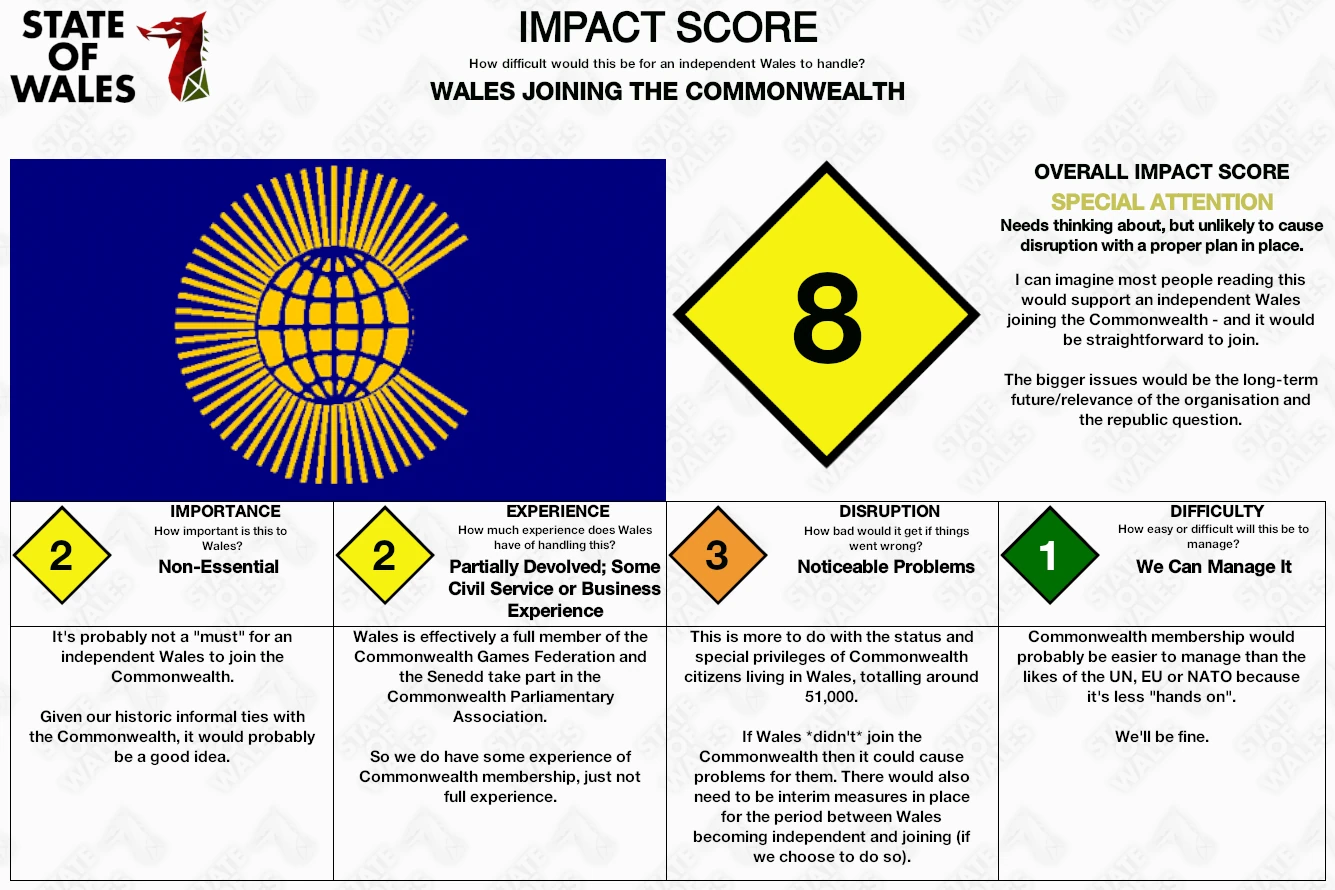
The overall score (out of 20) is the total of the scores for the four mini-categories (out of 5 each).
How Would This Be Run?
The day-to-day running of the Commonwealth is handled by the Commonwealth Secretariat, based in London.
The heads of government of the Commonwealth meet roughly every two years. Declarations are usually drafted and issued at these meetings on important issues.
These declarations set the Commonwealth’s official position on certain issues, including its own rules or other important matters (like climate change or human rights).
How Much Will This Cost?
Headline: Around £1 million per year.
The Commonwealth Secretariat’s budget in 2023-24 was £46million5. Most of this funding comes from the UK, Australia and Canada.
The combined contribution from the UK to the Commonwealth Secretariat, Commonwealth Youth Programme and Commonwealth Technical Support Fund in 2023-24 was £10.3 million6. You would therefore expect a Welsh contribution to be similar to New Zealand’s, which was just over £1 million.
The Commonwealth Sport Foundation, which oversees the delivery of the Commonwealth Games, is a registered charity. Commonwealth Games Wales (aka. “Team Wales”) is responsible for supporting Wales’ Commonwealth Games athletes and is funded by a mix of sponsorships, National Lottery funding and Welsh Government grants (via Sport Wales).
The Commonwealth War Graves Commission is separate from the Commonwealth (despite the name). So it doesn’t count here.
Would any new taxes need to be introduced?
No.
Who will pay for this?
General taxation (all taxpayers).
How Long Would This Take?
The newest member of the Commonwealth – Togo – took about two months to join7 from a formal application request by the Togolese Parliament to acceptance by the 2022 Commonwealth Heads of Government meeting later that year.
Informally, Togo had been trying to join the Commonwealth since 2014.
People & Work
At least 52,000 people living in Wales at the time of 2021 census were born in Commonwealth countries8. The largest group are from southern Asia (India, Pakistan, Bangladesh, Sri Lanka).
As noted, Commonwealth citizens usually enjoy special rights in each other’s countries.
People from England, Scotland, Northern Ireland and the Crown Dependencies would have even greater rights via the Common Travel Area – which isn’t tied to either the Commonwealth or the European Union’s free movement rules.
There are unlikely to be any job impacts one way or another, though it may potentially make it a bit easier for Commonwealth citizens (outside of the Common Travel Area) to work in Wales and vice versa.
You Might Also Like....
UK House of Lords Library (2nd July 2021). “Renewing the UK’s trading relationship with Commonwealth countries”.
London Declaration (1949).
Commonwealth of Nations. “Joining the Commonwealth”.
Edinburgh Declaration (1997).
Commonwealth of Nations. “Annual Results Report 2023-24” (p6-8).
Financial Statements for the Commonwealth of Nations (2023-24)
The Voice (26th April 2022). “Togo to join Commonwealth”.
StatsWales, Census 2021. “Usual resident population of Wales by detailed country of birth and area”.
The actual figure is likely to be a bit higher. Only listed individual Commonwealth countries were counted (Ghana, Nigeria, Kenya, South Africa, India, Pakistan, Bangladesh, Sri Lanka, Malaysia, Singapore, Canada, Jamaica, Australia, New Zealand), totalling 52,217 residents. Zimbabwe (2,801 residents) wasn’t included as it’s currently not a Commonwealth member.
No AI tools were used to draft this post.