Image Source: UK Prime Minister via Flickr under Creative Commons Licence BY-NC-ND 2.0
Donations keep this site going. If you like what I’m doing here and think this work is important to the independence movement, consider a donation. One-off or monthly; as little or as much as you want. Click the links below, or full details are available here.
What Happens Now?
The Group of Seven (G7) and Group of Twenty (G20) are two (of several) international forums made up of the world’s largest economies.
They are the foreign policy equivalent of an exclusive members-only club. Being no stranger to exclusive members-only clubs, the UK is a member of both the G7 and G20.
The G7’s membership includes the world’s largest economies that are also democracies, at least in principle, with the EU present as a non-voting member. They usually hold a summit between the heads of government at least once a year.
The G20 is made up of the world’s largest economies more generally, with less of a focus on democracy. The EU and the African Union are present as full members. Like the G7, it meets once a year.
While binding decisions may be made elsewhere (such as in the EU, NATO or UN), these forums are usually where the “big players” work on the details. They exist to ensure their interests are taken into account before they’re imposed on everyone else. So they’re quite influential.
Does This Work for Wales?
You can argue that Wales benefits from the UK being involved in these forums.
There’s an assumption that anything which benefits the UK benefits Wales in terms of foreign policy; sometimes it does, sometimes it doesn’t.
Wales would always benefit more by being a full member of any international organisation or forum in our own right, than we do by hoping that the UK Government might speak up on our behalf.
There are similarly influential international forums that the UK isn’t a member of.
These include the EU3 (the three biggest economies in the EU), BRICS (an anti-Western equivalent of the G7, so the Russians are pushing hard to make it a “thing”), OPEC (a forum for major oil-producing countries), as well as regional groups like the Visegrad Group and Arctic Council (where the UK is an observer).
IndyWales & No More G7 or G20: Pros & Cons
The G7 and G20 may not be a good fit for Welsh foreign policy goals.
There are plenty of alternative international forums to join, some of which feed into the G20 (like the Global Governance Group/3G).
The G7 and G20 lack transparency, with everything done behind closed doors.
Some of the largest and most influential economies aren’t members of either the G7, G20 or both and don’t suffer because of it. China and India are obvious examples (G7), while Switzerland and Spain – with their very large financial service sectors – aren’t members of either.
Loss of international “prestige”/face by not being a member of a “club”. It would underline Wales’ status as a smaller country and economy.
The G7 and G20 influence global economic policies. It would be better to have some say than no say.
Wales doesn’t have much of a financial services sector to justify membership (even indirectly, such as via the European Union) in the first place. This could be considered both a good thing and a bad thing.
Although Wales is used to having decisions made for us instead of by us, it underlines that even if Wales became independent, it would still happen to a certain extent by largely self-selected “clubs”.
What Do Other Countries Do?
![]()
Ireland isn’t a member of either the G7 or G20 in its own right.
However, it does have non-voting membership of the G7 through the EU and also has membership of the G20 through the EU. Ireland is also a member of the Hansa grouping of northern European EU members, which co-operates on issues of finance.
![]()
Norway isn’t a member of either the G7 or G20.
Norway is, however, a member of the Nordic Council and the Nordic-Baltic Eight (NB8).
![]()
Switzerland isn’t a member of the G7 or G20. Switzerland has joined the Global Governance Group (3G), which often has a seat and say at G20 meetings.
![]()
New Zealand isn’t a member of the G7 or G20. New Zealand has joined the Global Governance Group (3G), which often has a seat and say at the G20.
New Zealand is a Commonwealth member, full member of the Pacific Community and is also a member of the Five Eyes intelligence-sharing group of English-speaking countries.
New Zealand is also seen as a proposed member of a “CANZUK” alliance made up of Canada, “the UK”, Australia and New Zealand that’s being pushed (mainly) by conservatives and Brexit supporters.
What Options Does Wales Have?
There are some international clubs and regional forums that you would expect Wales to either seriously consider joining or be a member of straight away, such as the British-Irish Council and the Commonwealth.
The EU has a non-voting seat at the G7 and a full seat on the G20. This means all EU member states are collectively represented.
While some will say the UK does the same thing for Wales, individual EU member states are independent countries that have far more say in the EU’s position on foreign policy than Wales does within the UK. The EU also represents a much larger and more economically powerful union.
This is a Singapore-based international group consisting of 30 small and medium-sized developed economies that are not big enough to join the G20. Eight European countries are members.
The obvious suggestion would be a formal grouping of governments of independent and non-independent Celtic nations. This could develop into some form of Celtic Union (ranging from something based on the Nordic Council or Benelux, to a full political union). A cultural organisation already exists (Celtic League).
For the sake of offering alternatives, other suggestions include a European or global forum for “small democracies” (countries that are democracies with a population of under 10 million people), bi/tri-lingual nations, or countries with high potential for renewable energy production and exports (an “OPEC-like” for green energy).
What's at Stake?
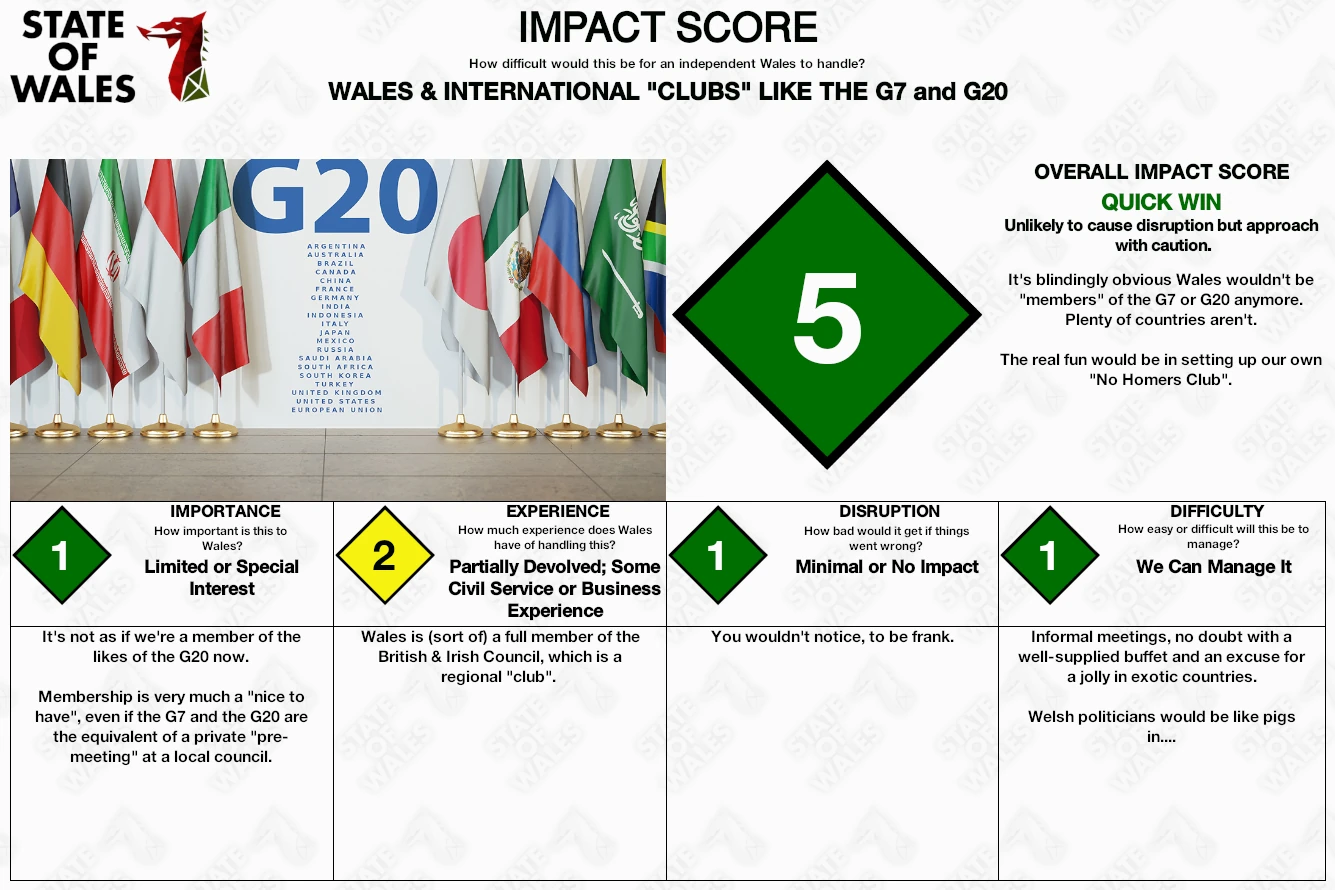
The overall score (out of 20) is the total of the scores for the four mini-categories (out of 5 each).
How Would This Be Run?
Country groups/clubs are usually informal and meet at annual summits hosted by one of the member states. Each country would usually be represented by the head of government (i.e. Prime Minister) or the relevant government minister.
Some, but not all, may have a permanent Secretariat/administration body of some kind to oversee the day-to-day running of the organisation.
How Much Will This Cost?
Headline: No direct costs.
If Wales joined an alternative group, there would be costs attached to hosting summits etc., though this wouldn’t happen very often. The real cost is in the supposed loss of prestige by no longer being in the G7 or G20 (through UK membership).
Would any new taxes need to be introduced?
No.
Who will pay for this?
Nobody (no direct costs).
How Long Would This Take?
Doesn’t apply, although setting up a new organisation would take time and negotiations.
People & Work
In principle, nobody. Although some people may be upset at Wales no longer being part of G7 or G20 conversations through the UK’s membership, even if there is no perceivable benefit to Wales.
No direct job implications.
You Might Also Like....
No AI tools were used to draft this post.