Image Source: Knowsphotos via Flickr under Creative Commons Licence BY-NC-2.0
Donations keep this site going. If you like what I’m doing here and think this work is important to the independence movement, consider a donation. One-off or monthly; as little or as much as you want. Click the links below, or full details are available here.
The United Nations (UN) was created in 1945 as an organisation committed to international cooperation, as set out in the UN Charter.
Nearly every single independent country in the world is a member of the UN, alongside 2 observers (Vatican City and Palestine). This arguably makes it the most important global diplomatic forum.
The UN’s main headquarters is in New York City, USA, with major campuses in Geneva (Switzerland), Vienna (Austria) and Nairobi (Kenya).
The UN Charter & Goals: Has it been a success?
The UN Charter is (debatable) one of the most important documents in human history.
It’s the closest we’ve come to creating a set of international laws and rights that apply to the entire planet. In principle, all member states are expected to resolve disputes peacefully and respect the independence/sovereignty of other members1.
The UN successfully oversaw decolonisation efforts during the second half of 20th Century, is a major provider of humanitarian aid and has taken big steps to protect human culture.
The UN has also proven that global action can make a positive impact on the environment, playing a leading role in phasing out CFCs2. This is expected to help close the hole in the ozone layer over the Antarctic later this century.
The previous attempt at a global diplomatic forum – The League of Nations – ultimately failed during the build-up to the Second World War.
There are eerie similarities between that period and the 2020s.
The UN has often failed to act quickly enough to humanitarian catastrophes or has shown that it’s unable to properly enforce its ideals. Examples include its response (or lack of) to the Rwandan genocide, the Second Congo War, the Yugoslav Wars, the Russian invasion of Ukraine and various atrocities in the Middle East.
This may be down to the UN not having the resources or political clout it needs to deal with so many things at the same time.
The UN’s Decision-Making Bodies & Agencies
The UN has six main organs (decision-making and policy bodies):
- UN General Assembly – The “parliament” of the UN, made up of all member states voting on a “one member, one vote” basis. The General Assembly appoints members to its respective committees/agencies, debates key global issues (“resolutions”) and decides the UN’s policies.
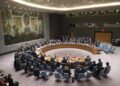
- UN Security Council – Arguably the most powerful of the UN’s organs in terms of global politics. The 15-member committee is responsible for maintaining global peace and security. Its five permanent members (USA, Russia, China, UK, France) can’t be removed and have the power to veto any Security Council decision. The other 10 members are elected by the General Assembly for fixed terms.
- UN Economic & Social Council (ECOSOC) – A 54-member committee dedicated to social policy, international development, environmental and sustainable development issues.
- UN Trusteeship Council – Oversees decolonisation efforts and issues involving dependant territories (like the British Overseas Territories). It only meets as and when required and there has been discussion about it being disbanded in the future – though this would require a rewritten UN Charter.
- International Court of Justice (ICJ) – A court established under the UN Charter3, the ICJ administers justice under international law (i.e. border disputes). It’s based in The Hague, Netherlands. Its judgements have often proven difficult to enforce.
- UN Secretariat – Oversees the day-to-day running of the UN, headed by a Secretary-General who is nominated by the UN Security Council and appointed by the UN General Assembly.
The UN also runs agencies to deliver its objectives. Some of these organisations are perhaps – aside from the Security Council – what people immediately think of when they hear “UN”. The more prominent ones include:
- UN Educational, Scientific and Cultural Organisation (UNESCO) – HQ Paris, France; 195 member states – Specialises in cultural, education and scientific cooperation; the most famous being the Millennium Development Goals and the protection of World Heritage Sites. As of 2025, there are 4 UNESCO World Heritage Sites in Wales.
- UN Children’s Fund (UNICEF) – HQ New York City, United States – Provides development assistance to children and mothers.
- World Food Programme (WFP)– HQ Rome, Italy – Has a goal to end global hunger and provide emergency food aid to nations facing shortages or famine.
- UN Relief and Works Agency (UNRWA) – HQ Amman, Jordan; 27-member advisory council & 3 observers – A specialist agency focusing on the needs of Palestinian refugees, including education, finance, health care and emergency assistance.
- UN-Habitat – HQ Nairobi, Kenya; 58 members elected from the UN’s Economic & Social Council – A programme working towards better housing in urban areas of the developing world.
- UN High Commissioner for Refugees (UNHCR) – HQ Geneva, Switzerland; 98 members – Coordinates international action to protect refugees and resolve refugee-related issues.
- UN Human Rights Council (UNHRC) – HQ Geneva, Switzerland; 47 members – Responsible for promoting and protecting human rights. UNHRC has faced criticism in recent years for being dominated by bloc votes from members with poor human rights records. The US has also had an on-off engagement with the body.
You Might Also Like....
UN Charter, Article 2.
Montreal Protocol (1989).
UN Charter, Chapter XIV.
No AI tools were used to draft this post.