Image Source: United Nations via Flickr under Creative Commons Licence BY-NC-ND 2.0
Donations keep this site going. If you like what I’m doing here and think this work is important to the independence movement, consider a donation. One-off or monthly; as little or as much as you want. Click the links below, or full details are available here.
What Happens Now?
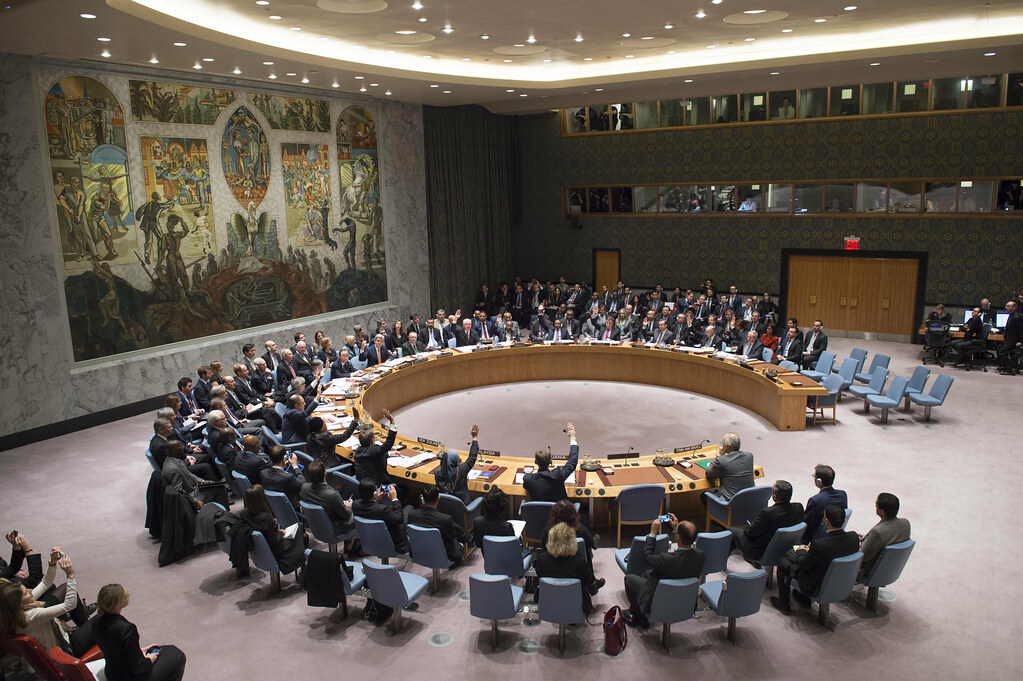
The UN Security Council is a UN committee responsible for maintaining world peace. As such, it’s probably the UN’s most powerful and influential body.
Its role includes monitoring global security issues, passing resolutions/statements on world security matters, and even imposing sanctions. These sanctions could include travel bans, embargoes and asset freezes1.
In certain situations, Security Council sanctions may authorise the use of military force in the interest of maintaining global peace and security2.
This power hasn’t been used very often, but one of the more well-known ones is Security Council Resolution 678, which led to the First Gulf War.
The UN Security Council’s membership is made up of 15 UN member states.
The UK is one of five permanent members of the Security Council alongside France, the United States, Russia (as successor to the Soviet Union) and China.
This means the UK can’t be removed from the Security Council and also has the power to “veto”/block any decision drafted by the Security Council.
The remaining 10 members are elected by the UN General Assembly (more on this later).
Does This Work for Wales?
You could argue there’s some value in “Wales” having a permanent UN Security Council seat via the UK. It’s an influential position in global affairs. That’s despite, in practice, the UK generally (but not always) following the lead of the Americans.
It’s certainly not a Welsh voice, and the interests of the UK won’t always be in the interests of Wales.
One of the main reasons the UK has a permanent seat is that when the UN Charter was being drafted, the UK was still a colonial power (along with France). That ended within 15-20 years of the UN’s founding.
UN Security Council Membership: Pros & Cons
If elected to the position, Wales would have a voice and vote on some of the most important global issues of the day.
As the Presidency of the UN Security Council rotates, if elected, Wales would be guaranteed to hold it at least once, possibly twice, during a two-year term.
If the Welsh military plays a prominent role in UN peacekeeping missions, a position on the Security Council would help pass measures that could offer them greater protection or support.
England would almost certainly inherit the UK’s permanent Security Council seat as it would have a strong legal and historic argument that England is the continuing state of the UK (based on the precedent that Russia inherited the USSR’s seat). England (as the UK) can also veto any attempt to remove itself. This might force the UN to reform the Security Council.
Wales would, by association, lose a permanent seat on the Security Council and would be shut out of Security Council discussions unless elected as a non-permanent member.
Generally, the Security Council isn’t very effective at what it was set up to do (maintaining global peace and security).
Security Council membership would place additional burdens on Wales’ permanent mission to the UN, both in trying to get elected and in the work involved while holding a seat.
There may be a view that Wales will vote in a similar way to England (if elected). If that isn’t the case, and Wales votes differently from England and the United States on a controversial matter (i.e. Israel-Palestine), it may cause diplomatic rows. Similarly, there may be attempts to “buy” or pressure Wales to vote a certain way3.
What Do Other Countries Do?
![]()
Has been elected to the Security Council four times (1962, 1981, 2001, 2021), so it averages a seat on the Council roughly every 20 years.
![]()
Has been elected to the Security Council four times (1954, 1966, 1993, 2015).
![]()
Is, as of 2025, a sitting member of the Security Council, having been elected to the Council five times in total (1953, 1967, 1985, 2005, 2025).
![]()
Is one of 59 UN member states to have never been elected to the Security Council4.
![]()
Joined the UN in 2002 and was elected to the Security Council for the first and only time in 2023.
What Options Does Wales Have?
Either put ourselves forward for a seat or not.
It would be a good idea to wait until Wales has been a UN member for a few years before actively considering putting ourselves forward for a seat.
Wales could also work out a “rota” with other countries (particularly Ireland, Scotland and the Nordic countries) so we don’t run against each other.
What's at Stake?
How Would This Be Run?
Member states are divided into five regions (Africa, Asia-Pacific, Latin America & Caribbean, Eastern Europe, Western Europe & Other). An independent Wales would be part of the Western Europe & Other regional group.
Five member states are elected each time, with either one or two countries being elected from each regional group. Those elected serve a two-year term.
Elections are normally held in June each year by the UN General Assembly. The winner has to receive at least two-thirds of the votes cast for each seat.
There are no limits on the number of times a member state can put itself forward for election, though it can’t stand for back-to-back terms.
The Presidency of the UN Security Council rotates amongst its members each month.
“One member, one vote”. Though the five permanent members of the Security Council can “veto”/block any decision or resolution, even if every other member of the Security Council votes in favour of it.
How Much Will This Cost?
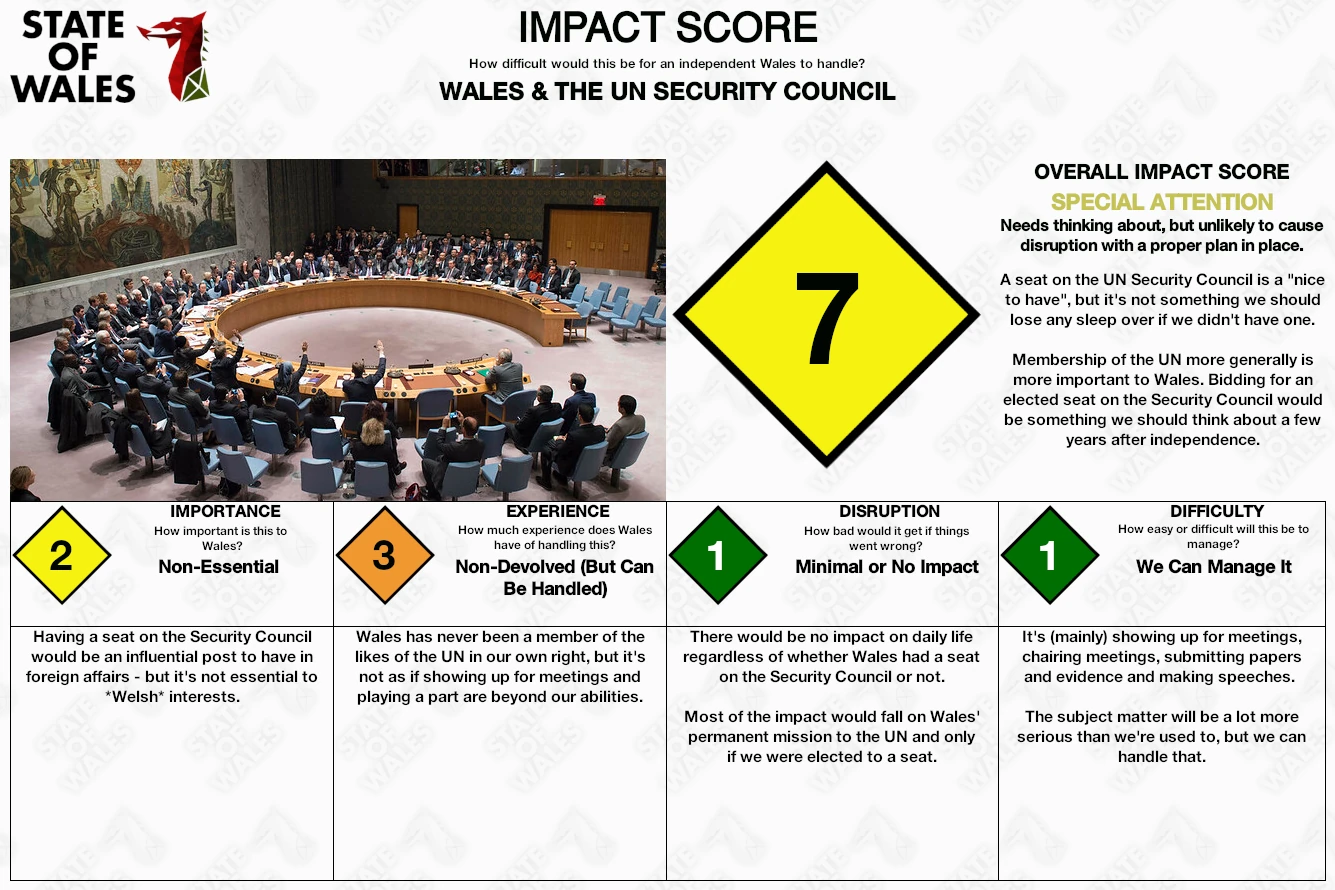
Headline: No direct costs.
The Security Council is funded out of general contributions to the UN. In a previous post, Wales’ contribution was estimated to be in the region of £6 million per year.
Would any new taxes need to be introduced?
No.
Who will pay for this?
General taxation (all taxpayers).
How Long Would This Take?
Wales would be able to put itself forward for election as a non-permanent member of the UN Security Council once we’ve joined the UN and a seat in the Western Europe & Others grouping becomes available.
Two seats representing Western Europe & Others are normally available in odd-numbered years, and one seat in even-numbered years.
People & Work
The Welsh diplomatic service would be the most directly affected by it. It would also generate more work for the Welsh Government in terms of foreign policy and defence if Wales holds Security Council membership.
Nobody else would be directly affected, though what Wales would say/do in the UN Security Council could change how the rest of the world sees us.
None, other than those tied to a Welsh permanent mission to the UN and those in the Welsh Government responsible for drafting foreign affairs and defence policies.
You Might Also Like....
United Nations (4th May 2016). “UN sanctions: what they are, how they work, and who uses them”.
UN Charter, Chapter VII, Article 42.
Vreeland, JR (May 2019), Annual Review of Political Science. “Corrupting International Organisations; United Nations & Human Rights”.
United Nations, Security Council. “Countries never elected as members of the Security Council”.
No AI tools were used to draft this post.