Senedd Home
Oggy Bloggy Ogwr
State of Wales
Sunday, August 9, 2026
  • About & Contact
    • About State of Wales
    • Comments Policy
    • Complaints Policy
    • Contact
    • Disclaimer
  • Elections Centre
  • The Independence Index
    • The Independence Index (Full)
    • Foreign Policy
      • Relations with the former UK & Ireland
      • Relations with Europe
      • Foreign Policy (General)
      • International Organisations & Law
      • Overseas Aid
    • Defence
      • Defence Policy
      • NATO
      • Armed Forces
      • National Security
      • Civil Defence
    • Rules & Regulations
      • Safety & Standards
      • Intellectual Property
    • Economics & Money
      • Business & Economy
      • Currency
      • Tax & Spending
      • Transport & Infrastructure
    • Society
      • Communities & Housing
      • Culture & Sport
      • Education
      • Health
      • Media & Communications
      • Science & Technology
    • The State
      • Environment & Natural Resources
      • Justice
      • Local Government
  • Support & Donate
No Result
View All Result
  • About & Contact
    • About State of Wales
    • Comments Policy
    • Complaints Policy
    • Contact
    • Disclaimer
  • Elections Centre
  • The Independence Index
    • The Independence Index (Full)
    • Foreign Policy
      • Relations with the former UK & Ireland
      • Relations with Europe
      • Foreign Policy (General)
      • International Organisations & Law
      • Overseas Aid
    • Defence
      • Defence Policy
      • NATO
      • Armed Forces
      • National Security
      • Civil Defence
    • Rules & Regulations
      • Safety & Standards
      • Intellectual Property
    • Economics & Money
      • Business & Economy
      • Currency
      • Tax & Spending
      • Transport & Infrastructure
    • Society
      • Communities & Housing
      • Culture & Sport
      • Education
      • Health
      • Media & Communications
      • Science & Technology
    • The State
      • Environment & Natural Resources
      • Justice
      • Local Government
  • Support & Donate
No Result
View All Result
State of Wales
No Result
View All Result
Home Foreign Policy

Would treaties signed by the UK still apply to an independent Wales?

Owen Donovan by Owen Donovan
July 29, 2025
in Foreign Policy, International Organisations & Law
Would treaties signed by the UK still apply to an independent Wales?

Saudi Arabian Government via Twitter

Share on FacebookShare on TwitterShare on RedditShare on BlueskyShare by email

Image Source: Saudi Arabian Government via Twitter

This site is best viewed in landscape mode on smartphones.
Support IndyWales? Support State of Wales!

Donations keep this site going. If you like what I’m doing here and think this work is important to the independence movement, consider a donation. One-off or monthly; as little or as much as you want. Click the links below, or full details are available here.

What Happens Now?

Nation-states have control over matters within their territories – a principle called “Westphalian sovereignty” (or just “sovereignty” for short). However, no nation is completely independent.

Since the founding of the United Nations, there has been an effort to create a body of international law and a court system. This is so that nation-states know their rights and responsibilities to each other and can be held accountable when they break the rules (what’s known as the “rules-based order“).

Treaties and agreements between nation-states form the backbone of international law. They’re not permanently binding, meaning states can withdraw from them at any time. However, it’s a good idea not to withdraw from treaties without a good reason, as it’s a bit like breaking a contract.

The UK has signed up to 15,000 treaties, as of 20251.

In some cases, treaty violations might justify suspending a country from an international organisation, sanctions or even military action.

For the International Court of Justice (ICJ) to have jurisdiction over a treaty dispute case, the treaty in question has to be registered with the United Nations.

A criminal case, such as a war crime or act of genocide, may be heard at the International Criminal Court (ICC). The UK is a party to the treaty which set it up.

As a member of the Council of Europe, the UK is also bound by the European Convention on Human Rights (ECHR) and several other treaties.

The World Trade Organisation (WTO) handles most trade disputes.

Does This Work for Wales?

Only to a limited extent.

As part of the UK, Wales is a party to any treaties the UK has signed on our behalf. Though under the principle of “Westphalian sovereignty”, only the UK – in the eyes of other nation-states – has control over the territory of Wales.

Independence would grant “sovereignty” over Wales to the people and government of Wales.

There will be some agreements and treaties signed by the UK that are not necessarily in the interests of Wales. For example, some of the post-Brexit trade deals – such as with New Zealand – have been said to be damaging to the Welsh lamb industry2.

We have no means to properly challenge issues like these because foreign policy and trade are controlled by the UK Government, with any concerns from Wales easily brushed off.

Wales & Existing International Laws & Treaties: Pros & Cons

Pros of Independence
Cons of Independence
Pros of Independence

The process of adding Wales to current treaties is seemingly straightforward (will be looked at later)3.

We can decide for ourselves which treaties we want to be a party to.

Wales would have a seat at the top tables of international organisations that manage these treaties and agreements, such as proposing amendments.

Wales would be able to negotiate treaties with other countries individually (bilateral treaties), and they would have the full force of international law. This would be a big step up from the “memorandums of understanding” the Welsh Government has negotiated and signed since devolution.

Cons of Independence

The task of going through 15,000 treaties and deciding which ones Wales would want to be a party to or not would take a lot of time.

Wales has no experience of negotiating international treaties. This is a job (albeit important) that’s currently handled on our behalf by the UK – which is arguably a more efficient use of resources.

There’s the potential that loopholes would open if Wales isn’t party to certain treaties or overlooks them by accident.

Wales would likely need to seek agreement from England and third-party countries to sign bilateral treaties (treaties signed only between the UK and another country or organisation). Though it would be better to negotiate our own.

What Do Other Countries Do?

Czech Republic & Slovakia (Velvet Divorce)
1991 Minsk Agreement (Former Soviet Union)
Montenegro
Czech Republic & Slovakia (Velvet Divorce)


As the former state (Czechoslovakia) had been dissolved (as the United Kingdom would be in our case), both countries issued similar declarations that they would be bound to any treaties and agreements signed by Czechoslovakia4.

It did, however, result in at least 12 claims from other countries that both the Czech Republic and Slovakia had breached bilateral agreements signed by Czechoslovakia5.


1991 Minsk Agreement (Former Soviet Union)

The agreement, in principle, resulted in a declaration that the former Soviet republics would honour any obligations under treaties signed by the USSR. In practice, different countries took different approaches. Some felt they had no obligations, others considered themselves bound to them5.


Montenegro

There’s a legal case related to this issue. Russian oligarch, Oleg Deripaska, sued Montenegro for €600 million (£520 million), claiming they had breached an investment treaty signed between Russia and the former Yugoslavia (briefly known as Serbia & Montenegro). Montenegro’s government took over an aluminium plant and aluminium ore mine majority-owned by Deripaska when it went into bankruptcy, and then sold them off. Deripaska wasn’t compensated.

The case went to arbitration at the Swedish Court of Appeals. Deripaska argued that under the terms of the treaty, he was due compensation. However, the court ruled in Montenegro’s favour (though granting Deripaska a right to appeal), concluding that Montenegro wasn’t automatically bound by the treaty as a successor state to the former Yugoslavia and, therefore, the court had no right to arbitrate.
What Options Does Wales Have?

The treaty governing this is the 1978 Vienna Convention on the Succession of States with respect to Treaties. The only problem is that very few countries have signed it (including the UK), so it’s unclear if it would even apply.

What would happen depends on how an independent Wales would be defined in international succession terms.

If Wales counts as a “newly-independent state” then we have a “clean slate” in international law, meaning Wales wouldn’t be bound to any treaties signed by the UK6. The case involving Montenegro mentioned earlier suggests this may apply to Wales.

Another scenario is that Wales would be counted as a “separation from part of a state”, meaning we would be bound to treaties the UK signed, unless there’s agreement otherwise7.

If we wanted to join bilateral treaties signed between the UK and other countries and organisations, then we would likely need agreement from England and the other country/organisation to do so.

What's at Stake?

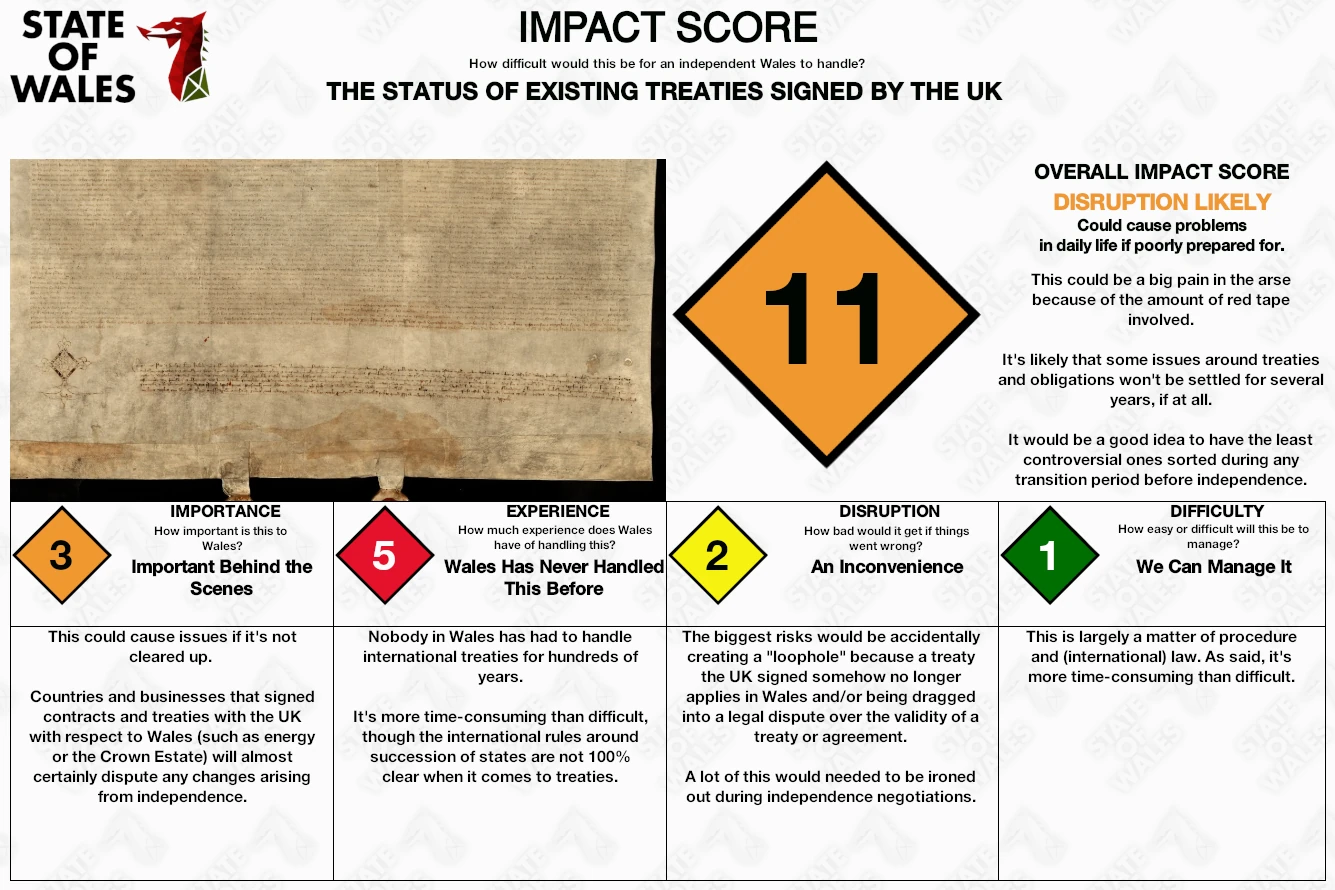
The overall score (out of 20) is the total of the scores for the four mini-categories (out of 5 each).

How Would This Be Run?

The Welsh equivalent of the Foreign Office – presumably a dedicated Treaty/International Agreements team – would be responsible.

Treaties themselves are usually kept and looked after by a named international organisation or government (called a “depository”). The UK acts as a depository for around 50 treaties and agreements8. 

How Much Will This Cost?

Headline: No direct costs.

Some treaties and agreements may have costs associated with them. These might include commitments to spending in certain policy areas, or membership fees and penalties.

Would any new taxes need to be introduced?

No.

Who will pay for this?

General taxation (all taxpayers).

How Long Would This Take?

Treaties and agreements specifically relating to Wales as part of the UK would continue to apply (i.e. sea borders).

Any international laws written into UK law (i.e. the Human Rights Act) should continue to apply immediately following independence because of the common law system. This means any law passed by the Senedd or UK Parliament before independence would continue to be in effect until we repeal it or change it.

It’s just that Wales wouldn’t be a party to the treaty or agreement that was written into law straight away.

Joining those treaties would be an ongoing process, which will be looked at separately.

We would probably start with the obvious ones (UN Charter, Geneva Conventions, European Convention on Human Rights, ICC Rome Statute, maritime treaties etc.).

Some treaties may require an independent Wales to join an international organisation (i.e. the Council of Europe in the case of the European Convention).

People & Work

Who does this impact?

Welsh Government legal staff would be the ones most directly affected because they would likely be the people handling treaties.

Though depending on which treaties we become a party to, it could affect businesses (i.e. by having new international rules to follow), the courts, the Welsh military and all of us (i.e. human rights and consumer protections).

Would any jobs be created or lost?

There would probably need to be a team – likely qualified solicitors or experts in international law – dedicated to international agreements and treaties within a Welsh foreign department (a “Treaty Office” or alike), but this is likely to be a fairly small team.

You Might Also Like....

What would an independent Wales’ policy be towards nuclear, biological and chemical weapons?
Defence

What would an independent Wales’ policy be towards nuclear, biological and chemical weapons?

by Owen Donovan
September 30, 2025
0

...

Read moreDetails
How would an independent Wales ratify treaties?

How would an independent Wales ratify treaties?

July 29, 2025
United Nations (UN)

United Nations (UN)

July 26, 2025
Council of Europe

Council of Europe

July 26, 2025
Our Global Twins: Which independent countries are like Wales?

Our Global Twins: Which independent countries are like Wales?

May 17, 2025
Brexit

Brexit

May 17, 2025
Load More
    1. UK Government. “Guidance: UK Treaties”.

    2. BBC Wales (21st October 2021). “Welsh lamb: Concern NZ trade deal could make it unviable”.

    3. Vienna Convention on Succession of States with respect to Treaties (1978).

    4. UN General Assembly (31st December 1992). “’The Proclamation of the Czech National Council to All Parliaments and Nations of the World’ and ‘The Proclamation of the National Council of the Slovak Republic to Parliaments and Peoples of the World'”.

    5. Dumberry, Patrick. “Deripaska v Montenegro: The Alpha and Omega of State Succession to BITs, Journal of International Dispute Settlement (2025)”. Journal of International Dispute Settlement.

    6. Vienna Convention on Succession of States with respect to Treaties (1978), Article 16.

    7. Vienna Convention on Succession of States with respect to Treaties (1978), Article 34.

    8. UK Government, Foreign Commonwealth & Development Office. “Treaties for which the UK is depositary”.

Use of AI

No AI tools were used to draft this post.

Donations Welcome
Tags: Council of EuropeCzech RepublicDiplomacyFP 403Human RightsInternational LawInternational OrganisationsMontenegroPolitical HistoryPolitical TheoryRussiaSlovakiaTradeTreatiesUnited Nations
Previous Post

Would an independent Wales have a seat on the UN Security Council?

Next Post

How would an independent Wales ratify treaties?

Owen Donovan

Owen Donovan

Archive

Categories

Copyright

Creative Commons Licence

State of Wales by Owen Donovan is licensed under a Creative Commons Attribution-NonCommercial-NoDerivatives 4.0 International License.

Subscribe by Email

Search

No Result
View All Result
No Result
View All Result
  • Go To Senedd Home
  • Go To Oggy Bloggy Ogwr
  • About & Contact
    • About State of Wales
    • Comments Policy
    • Complaints Policy
    • Contact & Subscribe by Email
    • Disclaimer
  • Features
    • After the UK
    • Chinny Reckon
    • Devil’s Advocate
    • How Wales Works
    • Road to Brexit
  • The Independence Index
    • The Independence Index (full)
    • Economics & Money
      • Business & Economy
      • Currency
      • Tax & Spending
      • Transport & Infrastructure
    • Society
      • Communities & Housing
      • Culture & Sport
      • Education
      • Health
      • Media & Communications
      • Science & Technology
    • The State
      • Environment & Natural Resources
      • Justice
      • Local Government
  • Elections Centre
  • Wales FAQ
    • How is Wales funded?
    • How are laws in Wales made?
  • Support & Donate