Image Source: Public domain
Donations keep this site going. If you like what I’m doing here and think this work is important to the independence movement, consider a donation. One-off or monthly; as little or as much as you want. Click the links below, or full details are available here.
What Happens Now?
“Ratification” is when a treaty is formally approved by a nation-state.
It’s usually the last step before a treaty comes into force. Before this, the treaty’s terms will have been negotiated, drafted and signed.
In the UK, treaties are first sent to the UK Parliament. The House of Commons or House of Lords then have 21 days to vote to postpone ratification (if they so wish). If they don’t do this, the treaty is ratified automatically – although theoretically, the UK Parliament can vote to block a treaty over and over again1.
Following Brexit, the UK has full power over trade deals (which are a type of treaty). A new process was introduced whereby the UK Parliament can debate the details of a trade agreement, but it can’t vote to reject a trade deal. They can only vote to delay it under the 21-day rule.
Does This Work for Wales?
Wales doesn’t have much of a say when it comes to treaties negotiated by the UK as foreign policy isn’t devolved.
As Wales only elects 32 MPs to the UK Parliament (and has a small number of Lords), there’s no means for “Wales” to postpone a treaty being ratified.
The Welsh Government may be “consulted” during negotiations, but neither they nor the Senedd have any formal say. In 2019, a Senedd committee recommended that the Senedd should have a role in treaty and trade agreements similar to that of the UK Parliament, but this has seemingly never been accepted2.
Treaty Ratification & Independence: Pros & Cons
This is about how things are done, so there are no pros and cons as such. It’s more a matter of deciding which way to ratify treaties would best suit Wales.
What Do Other Countries Do?
![]()
Treaties need to be published/presented to (“laid”) at Dáil Éireann (lower chamber of parliament)3, though the Irish Government has the authority to ratify treaties on the country’s behalf.
Any treaty that requires a change to public funding needs to be approved by Dáil Éireann. Any treaty that would require a change to the Irish Constitution requires approval in a referendum.
![]()
Treaties imposing new international laws or obligations on Denmark need the approval of 5/6ths (around 150) members of the Folketing (Danish Parliament). If this threshold isn’t met, the treaty needs approval from the public in a referendum4.
This rule doesn’t apply to existing treaties (which I assume means changes or updates to treaties which are already in force).
![]()
The President of Iceland has the power to negotiate/conclude treaties with foreign countries. The Althingi (Icelandic Parliament) needs to approve any treaty that changes Iceland’s territory or places any additional duties on the state5.
![]()
Treaties are normally ratified by New Zealand’s Foreign Affairs Minister, though the New Zealand Parliament gets more of a say if a treaty requires changes to New Zealand law6.
What Options Does Wales Have?
The rules and procedures for ratifying and managing treaties would either be set out in a written Welsh constitution or an equivalent law.
All decisions regarding treaties would be made by the Welsh Government, with treaties ratified either by the First Minister or the minister responsible for foreign policy.
A copy of any treaty or agreement would be presented to the Senedd, but they wouldn’t have any say over it.
This would give the Senedd similar powers to the UK Parliament.
A treaty or agreement would be tabled at the Senedd, with Senedd members having a certain amount of time (i.e. 21 days) to vote to delay the treaty being ratified. If they don’t hold a vote, then the government can ratify the treaty.
Treaties and agreements can only be ratified by the Senedd, either with a simple majority vote (50%+1) or a supermajority (2/3rds of members).
This would be similar to Ireland and Denmark.
Most treaties would be approved by the Senedd, though treaties that would result in any changes to a Welsh constitution (or constitutional law) would need to be approved by the public in a referendum.
What's at Stake?
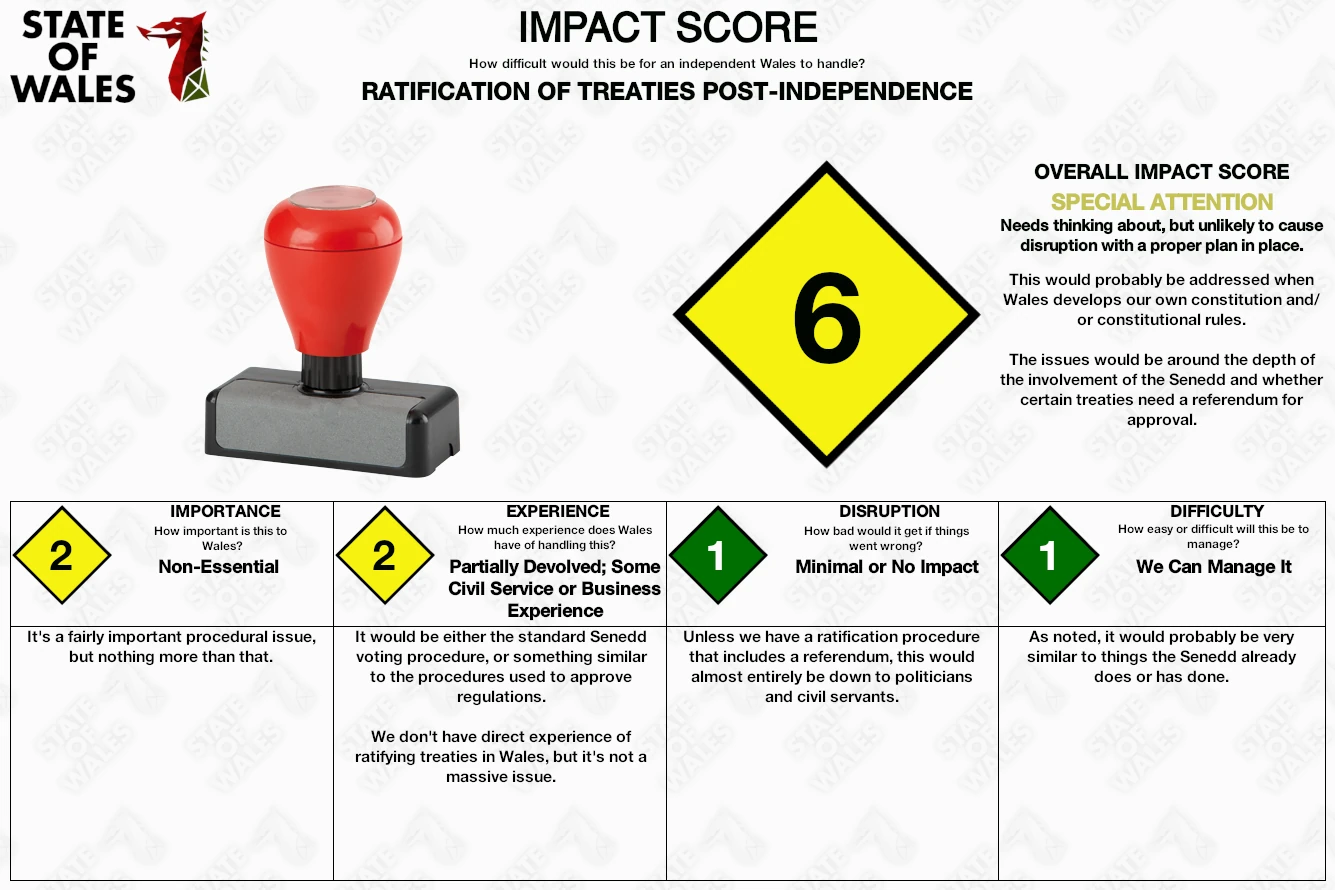
The overall score (out of 20) is the total of the scores for the four mini-categories (out of 5 each).
How Would This Be Run?
This was largely covered in the “What options does Wales have?” section.
We can either give powers on this to the Welsh Government or grant the Senedd (or the public, if we decide to hold referendums on certain treaties) more say.
How Much Will This Cost?
Headline: No direct costs.
It’s a rules and procedure issue. Though any treaty Wales signs may change public funding or have an impact on the wider economy (i.e. a free trade agreement, joining the EU or EFTA).
If we decided to hold referendums on certain treaties, a referendum would potentially cost up to £4.6 million each time, based on the costs of the 2016 Brexit referendum7.
Would any new taxes need to be introduced?
In principle, no. Although certain treaties (i.e. double taxation treaties) may change tax rules.
Who will pay for this?
General taxation (all taxpayers).
How Long Would This Take?
The process for ratifying treaties would either be included in a written Welsh constitution, Welsh constitutional law and/or official government guidance.
So the ratification rules would likely be in place either before or shortly after Wales becomes independent.
People & Work
The people most directly affected by this would be politicians, Welsh diplomats and civil servants working in a Welsh foreign affairs department. The number of people and businesses in Wales that it would impact depends on what a treaty deals with.
There would need to be a team – likely qualified solicitors or experts in international law – dedicated to international agreements and treaties within a Welsh foreign department (a “Treaty Office” or alike), but this is likely to be a fairly small team.
You Might Also Like....
UK Parliament, House of Commons Library (1st June 2021). “How Parliament treats treaties“.
Senedd Cymru, External Affairs & Additional Legislation Committee (1st February 2019). “UK international agreements after Brexit: A role for the Assembly”.
Constitution of Ireland, Article 29, Subsections 1-3.
Constitutional Act of Denmark, Chapter III, Article 20(2).
Constitution of Iceland, Article 21.
New Zealand Government, Ministry of Foreign Affairs & Trade (September 2021). “International Treaty Making“.
Electoral Commission. “Report: The costs of delivering the June 2016 referendum on the UK’s membership of the European Union”. Counting officers’ data, Wales.
No AI tools were used to draft this post.