Image Source: Eftaint under Creative Commons Licence BY-SA-4.0
Donations keep this site going. If you like what I’m doing here and think this work is important to the independence movement, consider a donation. One-off or monthly; as little or as much as you want. Click the links below, or full details are available here.
What Happens Now?
Wales – along with the rest of the UK – left the European Union (EU) in January 2020 following the 2016 referendum. At that referendum, Wales voted by 52.5% to 47.5% to “Leave” the EU.
Since then, the UK has negotiated (with some difficulty) a trading agreement with the EU. The agreement will be reviewed every five years, with the first review set to take place during 2026. A “reset” was agreed between the UK and EU in May 2025.
So right now, Wales is outside of both the Single Market and EU (aka. “Hard Brexit”).
Some campaigners before and after the 2016 referendum suggested the idea of either a customs union with the EU or Single Market access for the UK outside the EU (aka. “Soft Brexit”).
Does This Work for Wales?
Trade figures suggest that Brexit hasn’t impacted trade in goods between Wales and the EU that much, with the value of goods exported and imported remaining relatively steady both before and after Brexit1.
However, there have been other noticeable impacts from Brexit – a process led almost entirely by the UK Government – elsewhere.
Adding the loss of funding towards rural support schemes, the Welsh Government estimated that Brexit has cost Wales £1.1 billion in funding as of 2022. EU economic development funding was lost at the end of 2023.
It’s replacement – the UK Government’s “Shared Prosperity Fund” – was estimated to be worth £775 million less than its EU equivalent in 20222. The formula used to work out how much each local authority would receive was criticised for not taking populations into account3.
IndyWales & Single Market Access: Pros & Cons
It still honours the 2016 referendum result in Wales as we wouldn’t be an EU member.
Having Single Market access would mean no barriers (i.e. tariffs) to trading with EU or EFTA member states, which covers nearly all of Europe.
Welsh citizens would have free movement with the EU and vice-versa.
Wales would be able to negotiate trade agreements with everyone else outside the EU. It wouldn’t prevent a customs union or free trade agreement with England (or the rest of the former UK). It doesn’t impact the Common Travel Area either.
Wales would have more control over farming, fisheries and social policy than we would as a full EU member.
It may be argued (as it was from 2016-2020) that a “Soft Brexit” doesn’t honour the spirit of the 2016 referendum. Single Market access would mean applying EU laws and rules without having any (or very little) say in them.
What would happen during the “limbo” period between Wales becoming independent and then deciding what relationship we would want with the EU?
Wales would be opening up our job market fully to EU and EEA citizens.
It wouldn’t be a full customs union, meaning customs checks and declarations would still be needed on goods moving between Wales and the EU.We would also need a separate trade agreement with England to prevent customs declarations on goods moving across the border (the Common Travel Area protects free movement).
Single Market access wouldn’t mean that Welsh farmers access EU agricultural payments again. Wales wouldn’t have access to EU economic development funding either and we would lose access to existing replacement EU funding (i.e. Shared Prosperity Fund).
Wales would have to pay into various EU and EEA programmes including, ironically, paying towards economic development in EU member states.
What Do Other Countries Do?
![]()
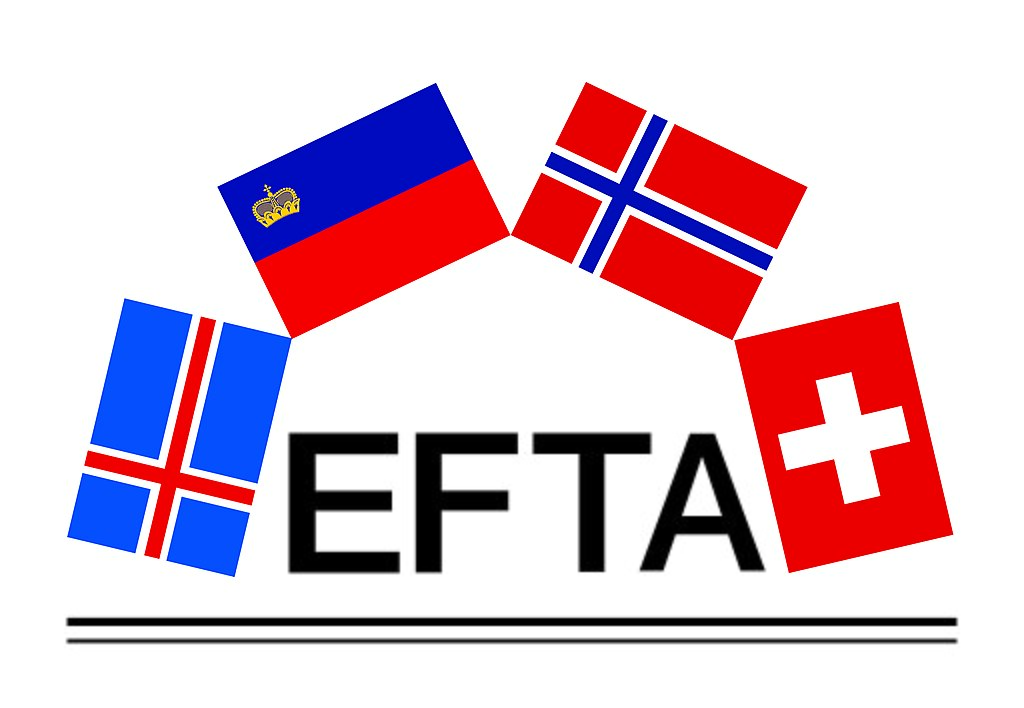
As a member state of the European Free Trade Association (EFTA), Norway signed the European Economic Area (EEA) agreement with the EU. This grants them full Single Market access. They need to apply EU laws and rules in certain areas.
![]()
Despite being an EFTA member state, Switzerland signed the EEA Agreement but never joined because it was rejected in a referendum. Instead, they negotiated separate agreements with the EU.
What Options Does Wales Have?
Any independent country can join the EFTA subject to EFTA Council approval4. Wales, as an EFTA member, would then be obliged to sign up to any EFTA free trade agreements. It would then be optional for Wales to sign the European Economic Area (EEA) Agreement, which would grant Wales Single Market access as an EFTA member state.
This would follow the Swiss model, whereby we negotiate a separate agreement that includes as many elements of the EEA agreement as we like. We would probably still have to accept freedom of movement of good, services, money and workers. We wouldn’t have to join the EFTA to do this.
This is only hypothetical, but a future British free trade area (if it ever exists) might negotiate EEA Agreement access on similar terms to the EFTA.
What's at Stake?
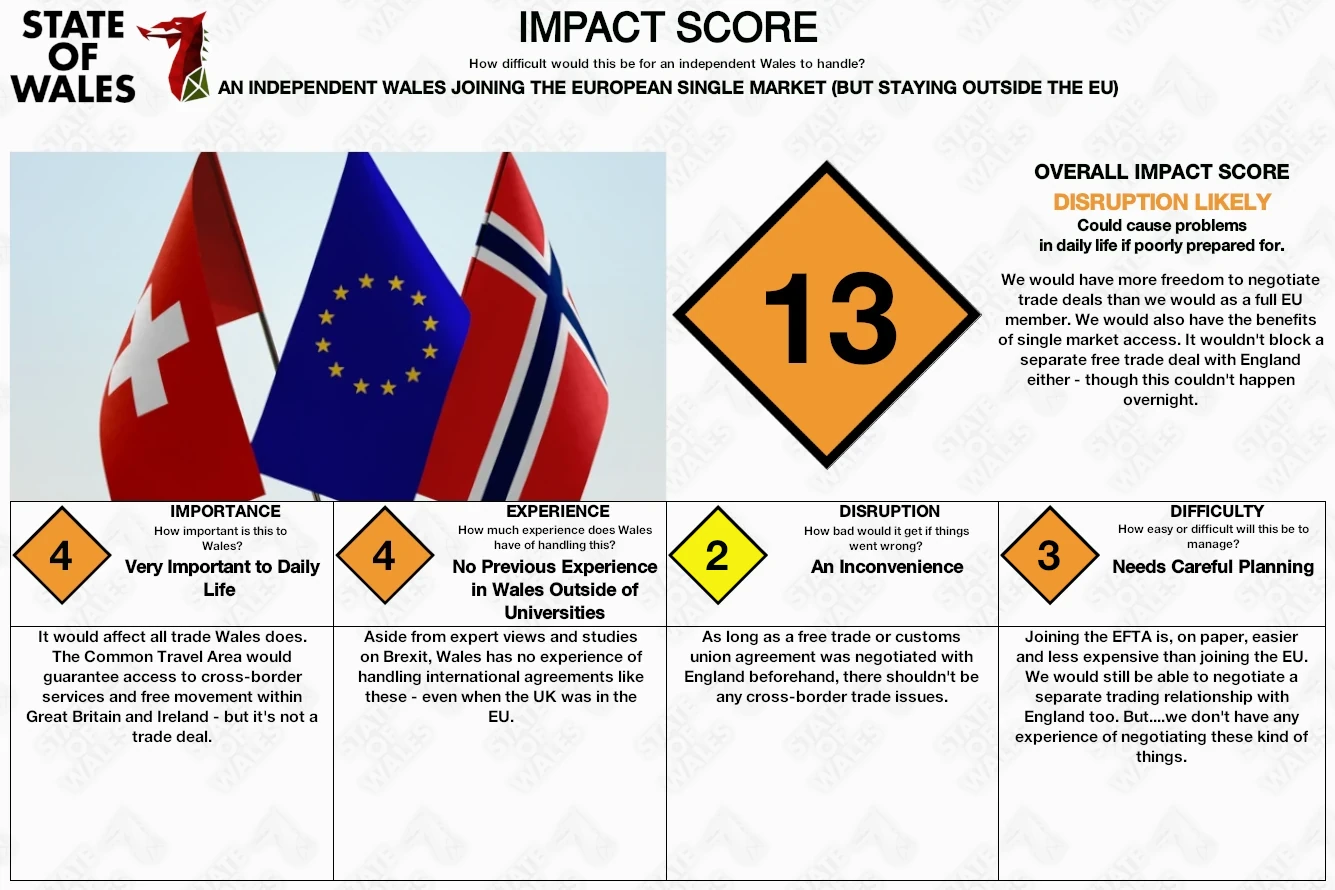
The overall score (out of 20) is the total of the scores for the four mini-categories (out of 5 each).
How Would This Be Run?
The main decision-making body is the EFTA Council, which meets 8 times a year with each member state appointing a permanent delegation. There’s also a parliamentary committee. The EFTA Court deals with disputes.
The EEA is managed by a separate EEA Joint Committee and other joint EU-EFTA committees.
Based on the Swiss model, there would be joint Wales-EU committees.
Would likely be a similar arrangement to Switzerland: joint EU-British Free Trade Area committees.
How Much Will This Cost?
Headline: Anything up to £126 million a year (maybe more) depending on the preferred option. Though there would be economic benefits.
Based on the Norwegian and Swiss contributions in 20235, Wales would likely pay around £6-7 million per year towards the EFTA’s running costs.
Wales would also have to pay to take part in any EU programmes under the EEA Agreement. Based on the 2021-2028 period, this would be a proportional share of €257 million per year for seven years6.
Switzerland contributes around CHF 350-400 million (£320 – 370 million) a year towards the EU budget7. An equivalent Welsh contribution – based on population alone – would be around £108-126 million per year at current prices8.
Would any new taxes need to be introduced?
No.
Who will pay for this?
Contributions to the EU budget (to ensure EEA access) would come from general government spending (all taxpayers).
How Long Would This Take?
However long it takes to get the four other EFTA members to agree. You would assume it would be relatively quick – months rather than years – but the EFTA may be wary of allowing a previous pro-Brexit country into its organisation.
The first set of Swiss-EU agreements took five years to negotiate; 8 years to come into effect.
Hard to estimate because a new trade bloc/free trade area would need to be founded then agree a Single Market access deal with the EU. Probably the best part of a decade under a worst-case scenario.
People & Work
Everyone resident in Wales, but particularly importing and exporting businesses. International travellers would benefit from free movement.
It depends on the economy more widely. There would be some official posts created in relation to the EFTA or EEA agreements (such as at the EFTA Secretariat in Brussels), but these would be few in number.
You Might Also Like....
Welsh Government Statistics (17th April 2024). “Welsh international goods trade: 2023”.
Welsh Government (4th May 2022). “Written Statement: Loss of funding to Wales as a result of the UK Government’s arrangements for replacement EU funding”.
Phillips, D. Institute for Fiscal Studies (18th July 2022). “UK Shared Prosperity Fund allocations for Welsh councils are flawed, costing some areas millions”.
Convention Establishing the European Free Trade Association (revised, 2021), Article 56.
EFTA (2023), “Annual Report” (p 45).
Agreement between the European Union, Iceland, the Principality of Liechtenstein and the Kingdom of Norway on an EEA Financial Mechanism for the period May 2021 – April 2028 (4th March 2024), Articles 2-9.
Reuters (11th December 2024). “Swiss contributions to EU likely to rise under new deal, reports say”.
The Welsh population (3.12 million) is 34% the size of Switzerland’s (8.97 million).
No AI tools were used to draft this post.