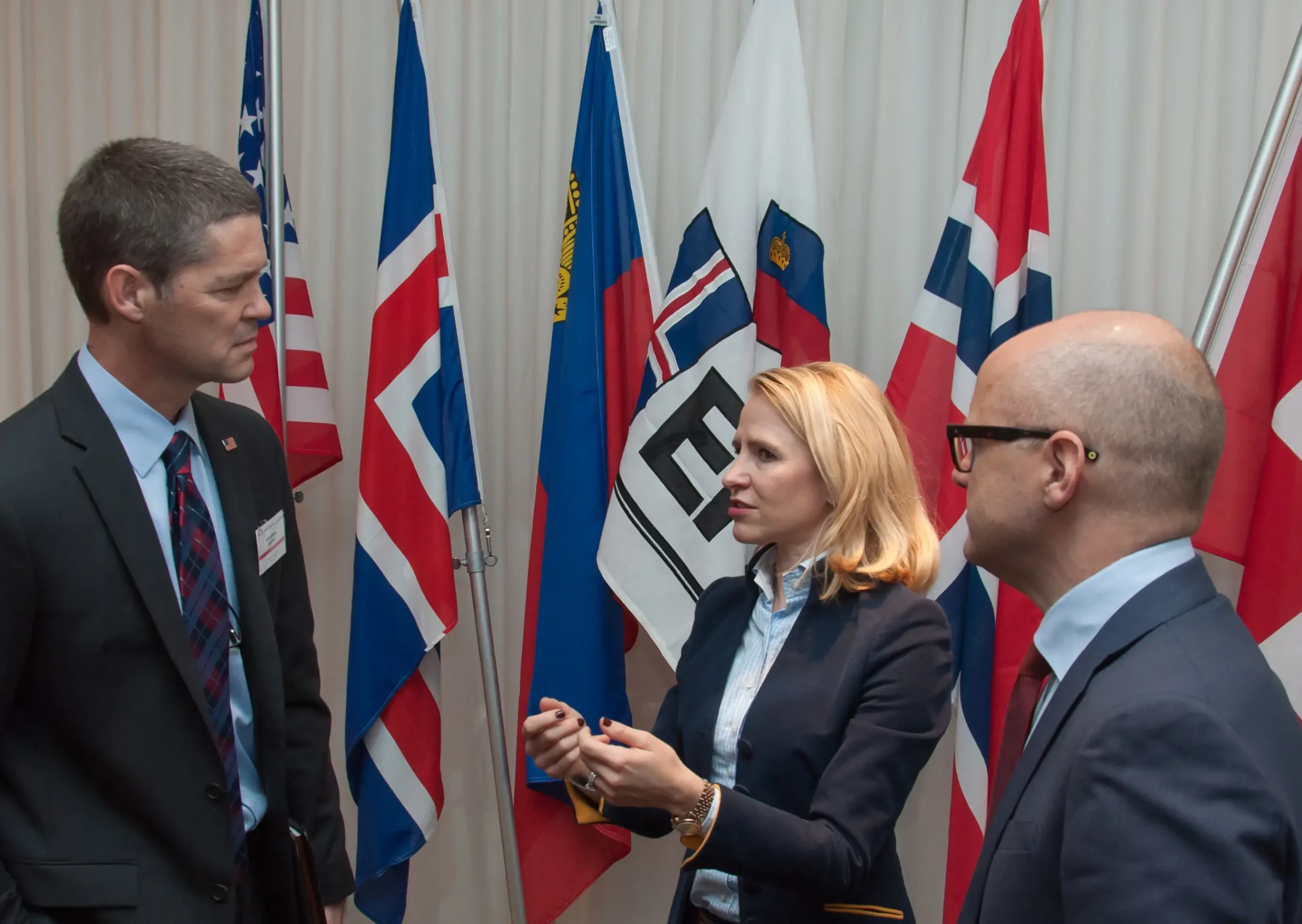
Image Source: EFTA Secretariat, non-commercial copyright free
Donations keep this site going. If you like what I’m doing here and think this work is important to the independence movement, consider a donation. One-off or monthly; as little or as much as you want. Click the links below, or full details are available here.
The EFTA is Europe’s second, lesser-known, free trade bloc.
Founded in 1960, as of 2025, its member states include Switzerland, Norway, Iceland and Liechtenstein.
Since its founding, several member nations have left the EFTA to join the EU.
That list includes the UK (a founding member of the EFTA), which left the EFTA in 1973 to join the European Economic Community (which would later become the European Union).
As of March 2025, the EFTA has free trade agreements with 33 countries1.
The EFTA has an agreement with the European Union to access the single market (European Economic Area/EEA). This means the EFTA has to abide by certain EU laws on how the single market works. The EFTA can’t make any decisions on these rules.
The EEA Agreement – which came into force in 1994 – covers the free movement of goods, people and money, as well as state aid rules, company law, consumer protections, the environment, social policy and statistics2. It also means EFTA states can take part in EU programmes like Erasmus+ (student exchange) and Horizon (science and research).
Similarities and Differences between the EFTA and EU
As mentioned, both have access to the European Single Market (EEA), meaning there’s free trade between EU and EFTA members*.
Both have courts to settle disputes.
Freedom of movement is allowed between all EU and EFTA states*.
Both have official statistics bodies.
Both have economic development grant schemes, which are available to all EEA states.
Both gave governing bodies consisting of the heads of government of member states (the EFTA Council and the European Council).
*In Switzerland’s case this is part of a separate agreement with the EU, not via EFTA membership, because it was rejected in a referendum.
The EU has an elected parliament to draft laws. The EFTA doesn’t have a parliament, only committees made up of representatives from national parliaments.
The EU is also a customs union, meaning goods can move freely between member states without checks or duties, with tariffs set at the EU level. The EFTA doesn’t have a customs union.
The EU has a central bank and currency (for eurozone members). EFTA members have separate currencies.
EFTA states can sign trade agreements with non-members by themselves (though in practice this doesn’t happen very often). EU member states have to act as a single bloc for trade.
The EU has sole or joint authority in certain policy areas (i.e. social policy, transport and farming). The EFTA is focused only on free trade.
The EU has a dedicated “government”/administration (European Commission).
You Might Also Like....
EFTA, “Free trade network”.
Agreement on the European Economic Area (1994). Parts II-V.
No AI tools were used to draft this post.