Image Source: Loz Pycock under Creative Commons Licence BY-SA-2.0
Donations keep this site going. If you like what I’m doing here and think this work is important to the independence movement, consider a donation. One-off or monthly; as little or as much as you want. Click the links below, or full details are available here.
What Happens Now?
Foreign policy isn’t devolved. Wales doesn’t have any formal diplomatic relations with other countries.
Foreign policy is decided and set by the UK Government. Political responsibility lies with the UK’s Foreign Secretary – considered one of the four “Great Offices of State” – who heads the UK’s Foreign, Commonwealth & Development Office (FCDO).
The FCDO – headquartered at Whitehall in London – is responsible for:
- Setting the UK’s foreign policy and promoting the UK’s interests abroad.
- International development/foreign aid.
- The British Overseas Territories.
- Oversight of the UK’s foreign intelligence service (MI6) and signals intelligence service (GCHQ).
- Oversight of FCDO Services (a company spun out of the foreign office to provide corporate support services, like cloud computing and security).
- Providing consular services to UK citizens via the UK’s network of diplomatic offices.
- Issuing travel advice and guidance.
The FCDO doesn’t have a presence in Wales, but does have a major office at East Kilbride in Scotland.
Although foreign policy is non-devolved, the Welsh Government does take part in what could be considered “international relations”. This is guided by the Welsh Government’s International Strategy.
Does This Work for Wales?
If you look at the work of the FCDO by itself, then much like foreign policy more generally it’s a case of being a bit of “yes” and a bit of “no”.
Travel advice issued by FCDO is useful and trustworthy. The UK’s consular network is extensive and (with some big missteps) foreign and international development policy is usually something even I’ll admit the UK has often managed well. But….
The fact that Unionist Labour-led Welsh governments have taken it upon themselves to set up their own overseas offices (which critics would call “nation-building”) to promote Welsh interests abroad suggests the FCDO has long had a blind spot to devolution. Or, FCDO isn’t seen as being a UK Government department the Welsh Government can make proper use of.
Technically, the FCDO don’t need to as foreign policy isn’t devolved, but the situation has room for improvement as it directly affects things like the Welsh economy.
Wales has had on-off positions in the Welsh Government dedicated to international relations, but in the absence of full control over foreign policy, it comes across as “playing pretend” at being a proper country.
A Welsh Foreign Office/Department: Pros & Cons
Holding the position of Welsh foreign minister (or equivalent) would provide vital government experience for anyone hoping to lead a Welsh Government one day.
We can set our foreign policy priorities based on our own interests and goals. We won’t have those priorities decided for us anymore.
Wales has well-respected academic departments for teaching international relations (Aberystwyth, Swansea, Cardiff). This may be useful in developing a diplomatic service.
Wales would have to establish a foreign department within the Welsh Government, likely creating several hundred new jobs at home.
Similarly, the establishment of a Welsh diplomatic service (or equivalent) would create lucrative posts abroad that wouldn’t normally be available to people living in Wales.
It would make teaching foreign languages at school and university more important (to train future diplomats).
We would be able to do a lot more in terms of attracting investment and building up international ties with full diplomatic relations with other countries.
Given the Welsh Government and Senedd’s track record of “gesture politics”, the chances of making a serious foreign policy blunder increase and would have real world consequences.
Foreign policy is a grown-up policy. As an “inexperienced” country on the world stage, there’s a risk Wales could be taken advantage of – including by countries we might consider to be friendly.
Wales may lack politicians with the necessary mix of experience and skill to serve as a foreign minister. Anyone appointed to the post would need to be boring, careful with what they say and do, and reliable.
The number of students studying modern foreign language GCSE and A-Levels in Welsh schools has long been in decline1.
Wales would no longer benefit from the UK’s reach and international “clout” – both in soft and hard power terms. We would be on our own (for the most part).
It can take years, even decades, to build up the local contacts and connections you need for diplomacy
What Do Other Countries Do?
![]()
- Has a stand-alone Department of Foreign Affairs & Trade.
- As of 2025, this is currently overseen at Cabinet level by the Irish equivalent of Deputy Prime Minister (Tánaiste), who also holds the role of Minister of Defence.
- There are two junior ministers responsible for European Affairs & Defence and International Development respectively.
- In 2023, there were 1,675 full-time and 433 part-time civil servants working for the department and as part of Ireland’s diplomatic service2.
![]()
- Has a stand-alone Ministry of Foreign Affairs & Trade.
- As of 2025, there are three full Cabinet-level ministerial positions tied to the Ministry. The Foreign Minister also has an Associate/Deputy Minister.
- Other ministerial roles include Minister for Trade & Investment and Minister for Climate Change. The high number of ministers is likely due to a coalition agreement between different political parties.
- As of March 2025, there were 1,189 full-time civil service roles within the Ministry3.
![]()
- Has a stand-alone Ministry of Foreign Affairs. The Ministry is also responsible for Estonia’s trade policy.
- As of 2025, there’s a single Cabinet-level Minister for Foreign Affairs. There are no junior ministers.
- It’s unclear how many civil servants are employed in foreign affairs.
![]()
- Has a stand-alone Ministry for Foreign Affairs.
- As of 2025, there are two Cabinet-level positions: Minister for Foreign Affairs and Minister for European Affairs.
- A Trade Council – tied to the Ministry – assists Danish companies to export alongside the Invest in Denmark agency which promotes Denmark for foreign investment.
- Around 3,000 people work for the Ministry globally4, with 1,000 of them based in Denmark.
What Options Does Wales Have?
The current Welsh Government has six departments/directorates. “International relations” falls under the Economy, Energy and Transport directorate5.
It’s safe to assume that after independence a government department dedicated to foreign policy would be set up, but it’s more about whether it would be stand-alone or bundled with other functions.
The department would be focused on foreign policy and foreign aid alone and running the Welsh diplomatic service. Related functions like trade and foreign investment would be handled by whatever Welsh Government department is responsible for the economy.
This could include taking responsibility for trade, foreign investment and tourism in addition to foreign policy and foreign aid/international development. Based on the examples from other countries this seems to be a common set-up.
This would bundle together the Cabinet ministers and functions of foreign affairs, international development, trade, foreign investment, tourism, defence and national security.
What's at Stake?
How Would This Be Run?
The department, and ministers, would be scrutinised by a “Senedd Committee for International Relations & Defence” or something similar.
As for who would decide Welsh foreign policy:
This would either be the First/Prime Minister of an independent Wales or a directly-elected President with executive powers (similar to France or the US).
There would be a risk that you would give too much power to them, but it would mean the rest of the Cabinet could focus on domestic affairs. It also might make it easier for other countries to deal with us if the person they’re dealing with is in overall charge.
This is what most countries do. It would mean a bigger Cabinet, but would properly spread policy portfolios around so nobody is doing too much by themselves.
This creates a Cabinet post responsible for foreign policy, but also some domestic policies. This could include defence, national security, managing the civil service and overseeing the drafting of laws.
No single minister or department would be responsible for foreign policy. Instead, each minister would be responsible for any foreign policy matters within their portfolio.
So on farming and food matters, the Welsh minister with that responsibility would handle trade deal negotiations when it comes to farming and food. A Welsh defence minsiter would deal with NATO etc.
How Much Will This Cost?
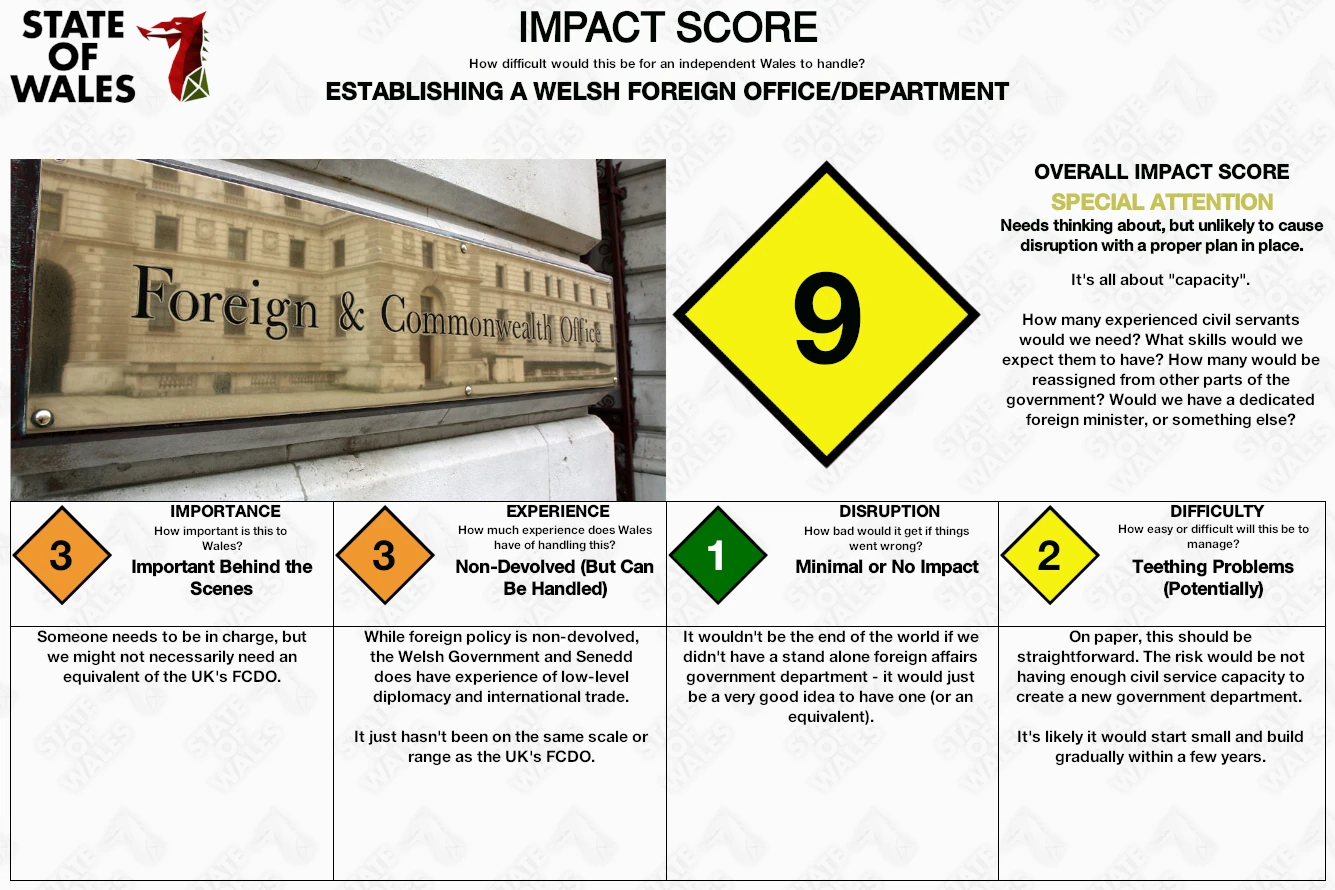
Headline: If we wanted to match Ireland’s foreign office spending (as a benchmark), then up to £280 million per year.
The actual figure would depend on how much we want to spend on our foreign policy goals and how big we would expect a Welsh diplomatic service to be.
In 2022-23, the UK Government’s total budget for “international services” for Wales was £393 million. This works out to 4.6% of all UK spending (in line with Wales’ share of the UK population). However, only £3 million of this was actually identified as being spent in relation to Wales6.
By its very nature, a lot of this money is spent outside the UK and can’t be said one way or another as being directly spent on Wales’ behalf – known as non-identifiable expenditure.
For want of a comparison, in 2025 Ireland is set to spend €321 million (£278 million) on “Advancing Ireland’s Foreign Policy Goals”7.
New Zealand’s foreign affairs budget (minus foreign aid) was NZ$929 million (£414 million) in 2023-248.
Would any new taxes need to be introduced?
No.
Who will pay for this?
General taxation (all taxpayers).
How Long Would This Take?
A Welsh foreign office (or equivalent) would likely be formed out of current Welsh Government staff and gradually build up over several years.
People & Work
Technically, everyone resident in Wales. It would be most relevant to politicians, the civil service, businesses based in Wales that do a lot of trade abroad and Welsh tourists.
You would expect current Welsh Government staff working within international relations or at overseas offices (from what I can tell around 40 staff) to be reassigned to the new department.
Staff from certain government agencies like Visit Wales, Business Wales, Hub Cymru Africa and Size of Wales (potentially Wales-based staff of the British Council too) would likely transfer as well.
The final number would depend on how many embassies and consulates an independent Wales would have.
Based on the Ireland, Denmark and New Zealand examples given earlier, you would expect anything between 800 and 1,500 foreign department posts to eventually be created in Wales and abroad compared to 0 FCDO posts in Wales now (British Council aside).
You Might Also Like....
British Council, “Language Trends Wales“.
Irish Government, Department of Foreign Affairs (December 2023). “Gender Pay Gap Report” (p5).
New Zealand Public Service Commission. “Workforce data – workforce size”.
Government of Denmark, Ministry of Foreign Affairs. “Career in the Ministry of Foreign Affairs” (translated into English).
Welsh Government (June 2025). “Organisation Chart”.
Office of National Statistics (7th June 2024). “Country and regional public sector finances expenditure tables, financial year ending 2023”.
Irish Government, Department of Public Expenditure, NDP Delivery and Reform. “Gross Expenditure Analysis, 2025”
New Zealand Government, New Zealand Treasury. “Vote Foreign Affairs 2023-24”.
No AI tools were used to draft this post.