Senedd Home
Oggy Bloggy Ogwr
State of Wales
Sunday, August 16, 2026
  • About & Contact
    • About State of Wales
    • Comments Policy
    • Complaints Policy
    • Contact
    • Disclaimer
  • Elections Centre
  • The Independence Index
    • The Independence Index (Full)
    • Foreign Policy
      • Relations with the former UK & Ireland
      • Relations with Europe
      • Foreign Policy (General)
      • International Organisations & Law
      • Overseas Aid
    • Defence
      • Defence Policy
      • NATO
      • Armed Forces
      • National Security
      • Civil Defence
    • Rules & Regulations
      • Safety & Standards
      • Intellectual Property
    • Economics & Money
      • Business & Economy
      • Currency
      • Tax & Spending
      • Transport & Infrastructure
    • Society
      • Communities & Housing
      • Culture & Sport
      • Education
      • Health
      • Media & Communications
      • Science & Technology
    • The State
      • Environment & Natural Resources
      • Justice
      • Local Government
  • Support & Donate
No Result
View All Result
  • About & Contact
    • About State of Wales
    • Comments Policy
    • Complaints Policy
    • Contact
    • Disclaimer
  • Elections Centre
  • The Independence Index
    • The Independence Index (Full)
    • Foreign Policy
      • Relations with the former UK & Ireland
      • Relations with Europe
      • Foreign Policy (General)
      • International Organisations & Law
      • Overseas Aid
    • Defence
      • Defence Policy
      • NATO
      • Armed Forces
      • National Security
      • Civil Defence
    • Rules & Regulations
      • Safety & Standards
      • Intellectual Property
    • Economics & Money
      • Business & Economy
      • Currency
      • Tax & Spending
      • Transport & Infrastructure
    • Society
      • Communities & Housing
      • Culture & Sport
      • Education
      • Health
      • Media & Communications
      • Science & Technology
    • The State
      • Environment & Natural Resources
      • Justice
      • Local Government
  • Support & Donate
No Result
View All Result
State of Wales
No Result
View All Result
Home Defence Armed Forces

What are the options for an independent Wales’ military?

Owen Donovan by Owen Donovan
November 26, 2025
in Armed Forces, Defence
What are the options for an independent Wales’ military?

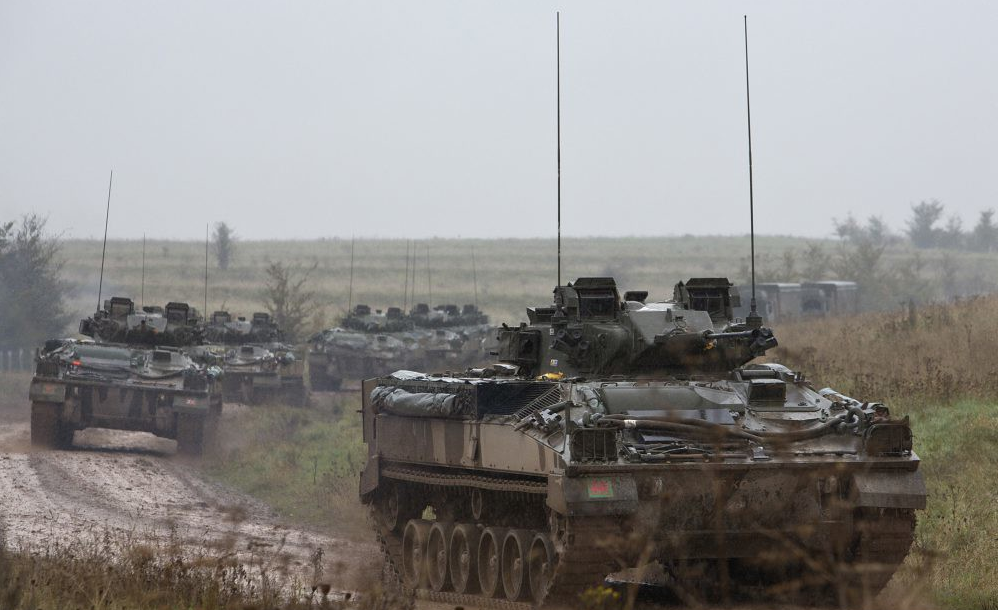
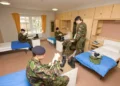
Defence Imagery via Flickr under Creative Commons Licence BY-SA-2.0

Share on FacebookShare on TwitterShare on RedditShare on BlueskyShare by email

Image Source: Defence Imagery via Flickr under Creative Commons Licence BY-SA-2.0

This site is best viewed in landscape mode on smartphones.
Support IndyWales? Support State of Wales!

Donations keep this site going. If you like what I’m doing here and think this work is important to the independence movement, consider a donation. One-off or monthly; as little or as much as you want. Click the links below, or full details are available here.

What Happens Now?

As of April 2025, the UK’s Armed Forces had around 147,000 regular/full-time personnel. Including reservists and other personnel, this rises to around 181,500.

Since 2012, UK armed forces personnel numbers have declined by 7% in the case of the Royal Navy, to up to 25% in the case of the army1. The UK armed forces headcount is roughly half the figure it was at the end of the 1960s.

Once broken down across the three main branches of the armed forces2, it looks like3:

British Army
Royal Navy & Royal Marines
Royal Air Force
British Army

78,740 regular/full-time*, 25,690 reservists, 4,740 other personnel.

  • 43x regular/full-time combat battalions (infantry) and regiments (armoured); 21x reserve.
  • 14x regular Royal Artillery regiments; 6x reserve.
  • 16x regular Royal Engineers regiments; 5x reserve.
  • 13x regular Royal Signals regiments; 4x reserve.
  • 4x regular Intelligence Corps regiments; 5x reserve.
  • 9x regular REME batallions; 3x reserve.
  • 13X regular Royal Logistics Corps battalions; 12x reserve.
  • 7x regular Army Air Corps regiments; 1x reserve.
  • 7x regular Royal Army Medical Corps regiments; 12x reserve.
  • 5x regular Royal Military Police regiments.
  • 27 NATO (x1), division (x6) and brigade (x20) headquarters.

*Includes the Gurhka Brigade, which is counted separately in MoD statistics.

Royal Navy & Royal Marines

32,150 regular/full-time, 3,240 reservists, 2,510 other personnel.

  • 10x Royal Navy Submarine Service vessels (6x nuclear-powered, 4x ballistic missile nuclear).
  • 57x Royal Navy Surface Fleet vessels (2x aircraft carriers, 2x landing platforms, 26x inshore and offshore patrol vessels, 17x destroyers and frigates, 7x minesweepers, 2x survey ships, 1x ice patrol ship).
  • 20x Royal Navy Fleet Air Arm squadrons.
  • 13x Royal Fleet Auxiliary vessels (tankers, hospital ships, supply ships).
  • 17x regular Royal Marines formations, including the Royal Marine Band (x5 formations), 3 Commando Brigade (10x formations), 1 Assault Group (1x formation) and HQ.
  • 13x regular Royal Navy diving squadrons.
  • 16x Royal Navy reserve and 4x Royal Marines reserve units.
Royal Air Force

30,450 regular/full-time, 2,980 reservists, 1,400 other personnel.

  • 43x Flying Support squadrons (including 9x air combat squadrons and 2x UAV/drone squadrons).
  • 3x Battlespace management & control squadrons.
  • 23x Air Security squadrons (including 11x RAF Police squadrons)
  • 24x Combat Support squadrons (engineering, logistics, intelligence, medical).
  • 33x Royal Auxiliary Air Force (reserve) squadrons (including 3x sponsored reserve squadrons made up of specialist professionals).

Does This Work for Wales?

You can look at it in different ways.

In terms of global power projection, the UK is arguably no longer a “top drawer” military power and probably hasn’t been for several decades.

Even the UK’s nuclear weapons programme is very much there for the sake of saving face.

However, within Europe, the UK remains a major player. France could make a strong case for being the #1 military power in Europe because it’s less reliant on the Americans and NATO command structures, though the UK and Germany would be a close second and third, respectively.

The issue for Wales is that we, proportionally, provide a great deal to the UK armed forces (particularly in terms of recruitment and funding-per-person), but get little back.

Only 1.7% of the British Army is based in Wales (set to increase to 2.4%)4. The only significant air force base is RAF Valley (the RAF’s fast jet and helicopter training facility), and Wales has no naval bases or stations of note.

There’s more success for the defence sector, with several major sites operated in Wales by major defence contractors and procurement spending in 2021-22 worth £744 million. This is said to support up to 5,400 jobs in the wider supply chain. However, the amount spent on military procurement per head in Wales (£240) was significantly lower than the UK average (£310) at that time.

Welsh Armed Forces & Independence: Pros & Cons

Pros of Independence
Cons of Independence
Pros of Independence

The defence strategy would be tailored to our specific foreign policy goals and defence/national security requirements. This includes the options of neutrality or full NATO membership.

Having additional Western-facing armed forces in the North Atlantic might improve sea security – particularly around undersea infrastructure – as there would be increased patrols by a Welsh navy (in addition to Ireland, England and the rest of NATO).

Bringing the likes of the Wales Air Ambulance, RNLI, mountain and cave rescue, and police air support units under the fold of a Welsh military (as reservists in some cases) would secure their future in a way which can’t be guaranteed now. They would no longer be reliant on charitable funding but would be funded directly by the Welsh Government (where applicable).

The Welsh Government would decide when and where to deploy Welsh military personnel, ultimately making Wales responsible for the safety of its own military. This will probably make it less likely that Welsh military personnel would be deployed to a questionable conflict (i.e. a repeat of the Iraq War).

Instead of having a small proportion of Welsh members of the armed forces based all around the UK and abroad (only 1.7% of the UK armed forces are stationed in Wales), 100% of the Welsh military would be based here (unless on deployment). This could provide an economic boost to local communities, particularly rural areas, if there were more permanent residents.

Wales would have control over immovable military assets in Wales, including training grounds, training operations and military bases.

An ambitious Wales could gradually build up a “21st century military capability”. There could be more emphasis on cyberwarfare, automation and using “big data” to predict or identify major domestic security or defence vulnerabilities, improving our ability to deal with them earlier.

Wales has the option of not having a traditional military and focusing on a civil force (with military-style training) tasked with civil defence, national security and search & rescue – saving a significant sum of money.

There’s an opportunity to support more local businesses in terms of defence procurement and service contracts – not just military equipment, but food/supplies and support services.

Creating a new military – even a small one – would create or replicate (potentially) thousands of jobs in Wales, which are currently based (mainly) in England.

Cons of Independence

The Welsh Government has no experience of defence and limited experience of foreign policy. The number of options may be overwhelming, and there’s a risk we make the wrong choices.

Stationing more military personnel closer to home in Wales would require a big investment in military housing (which could be considered a pro) and military bases/stations. This might not be done quickly enough to match the pace of recruitment, so it needs careful planning.

There’s a strong possibility that many Welsh residents serving in (what would become) the English armed forces wouldn’t want to transfer to a Welsh military. There may be experience and skills gaps that we would find much harder to fill from a smaller population and recruitment pool.

It’s likely that the development of a full Welsh military – capable of deployment overseas, if necessary – may take the best part of a decade. There would need to be an “interim/bare bones” Welsh military to cover the gap.

Additionally, we would have no national security/intelligence capability from the start (other than the police); this would have to be built up from scratch.

Should Wales significantly scale back its defence capability, we may be accused of “freeloading”. Ireland has often been accused of such (i.e. RAF patrols in Irish airspace due to a lack of an Irish fast jet capability).

Defence procurement – which will be looked at separately – is often difficult and expensive based on the UK’s troubled track record5. We complain about even small amounts of money being “wasted” in Wales, so if we wasted the kind of money the MoD has over the last few decades, it would cause serious political problems. We would need to get procurement right from the very start.

What Do Other Countries Do?

Ireland


As of 2025, the Irish Defence Forces had just under 7,500 full-time personnel6. In 2024, there were just over 1,500 reservists – the vast majority of these being army reserves7.

Irish Army
Irish Naval Service
Irish Air Corps
Irish Army

~6,000 regular/full-time personnel. Divided into two territorial combined-arms brigades, a headquarters brigade and the Defence Forces Training Centre. This is further broken down into:

  • 7x infantry (combined light and mechanised) battalions.
  • 3x artillery batteries.
  • A cavalry (armoured) corps.
  • An engineering corps.
  • A Communications & Information Systems (Signals) corps.
  • An ordnance corps.
  • A medical corps.
  • A transport/logistics corps.
  • Military Police Corps.
  • Army Rangers (special forces and reconnaissance), roughly company-strength (100-200 soldiers).
  • Equestrian and Music units.
Irish Naval Service

~730 regular/full-time personnel.

  • A naval headquarters unit.
  • Specialist Diving and Fisheries Protection units.
  • 6x Offshore Patrol Vessels.
  • 2x Inshore Patrol Vessels.
Irish Air Corps

~730 regular/full-time personnel.

  • A headquarters unit.
  • 9x Operations/Air Support squadrons, divided into 2 wings (one fixed-wing/planes, one helicopter-based). This includes police air support and the Irish air ambulance.
  • 7x Support squadrons (mainly engineering and logistics).
  • A communications and information systems squadron.

Denmark

In 2024, there were around 16,000 military personnel8, supported by 8,100 civilian staff.

Males are constitutionally obligated to complete military training as part of national service/conscription9, though as of 2025, females also receive conscription call-ups. There are a limited number of places available. These are drawn by lot. Conscripts make up around 4-5,000 military personnel. Conscription lasts up to 11 months as of 2025 and needs to be completed before someone can join the Danish military full-time.

Royal Danish Army
Royal Danish Navy
Royal Danish Air Force
Royal Danish Army

~Up to 9,000 full/time regular soldiers. Conscripts and reservists (Danish Home Guard) aren’t counted for personnel statistics.

  • 1x Army Command HQ and 2x brigade headquarters.
  • Danish Military Academy and Army Non-Commissioned Officer School.
  • 3x regular infantry regiments.
  • 1X regular armoured regiment.
  • 1x regular engineering regiment.
  • 1x regular intelligence regiment.
  • 1x regular signals regiment.
  • 1x regular logistics regiment.

Supported by:

  • A land-based special forces unit (“Hunter Corps”).
  • An Arctic special forces unit (“Sirius Patrol”)
Royal Danish Navy

~3,000 full-time/regular personnel, with the navy operationally divided into three naval squadrons.

  • 1x Navy Command HQ.
  • 8x frigates, two of which are anti-submarine warfare.
  • 9x offshore patrol vessels, 3 of which patrol the Arctic region.
  • 7x environmental protection and fisheries vessels.
  • 4x training and sailing vessels.
  • 2x ocean survey vessels.
  • A mine counter-measures unit.
  • 1x support ship.
  • Royal Yacht.

Supported by:

  • A maritime special forces unit (“Frogmen Corps”).
Royal Danish Air Force

~2,500-3,500 full-time/regular personnel.

  • 1x fighter wing squadron.
  • 1x heavy air transport squadron.
  • 1x transport unit supporting land and sea forces.
  • 3x helicopter squadrons.
  • 1X air control wing (surveillance and long-range radar).
  • 1x operations support wing.

Finland


There are around 25,000 “active” military personnel at any given time, supported by over 870,000 reservists.

Finland’s “full war strength” is around 280,000 personnel10. Why these numbers are so high for a country with Finland’s relatively low population is obvious, given who its neighbour to the east is.

Men need to complete between 6 months and 1 year of conscription and also spend most of their adult working life in a reserve unit.

Army
Navy
Air Force
Army

Total strength of just over 41,100. This is made up of ~4,400 full-time/regular soldiers, supported by 18,400 conscripts and 18,400 reservists.

  • 1x Command headquarters.
  • Army Academy.
  • At least 4x territorial infantry/combined arms brigades.
  • 1x urban warfare infantry regiment.
  • 1x armoured/mechanised infantry and electronic warfare brigade.
  • 1x special forces and airbourne regiment.
Navy

~1,200 full-time/regular personnel supported by around 3,500 conscripts.

  • 1x Command headquarters.
  • Naval Academy.
  • 1x Mine countermeasures squadron.
  • 2x Surface warfare squadrons.
  • 1x Surface support/supply squadron.
  • 2x Marines/amphibious warfare brigades.
Air Force

~2,000 full-time/regular personnel, supported by around 1,300 conscripts.

  • 1x Command headquarters.
  • Air Force Academy.
  • 2x fighter/air warfare wings.
  • 1x air support wing.

New Zealand


As of 2024, there were around 9,000 full-time/regular service personnel in the New Zealand Defence Forces and just under 3,200 reservists11.

New Zealand Army
Royal New Zealand Navy
Royal New Zealand Air Force
New Zealand Army

~6,400 personnel, made up of around 4,400 full-time/regulars and 2,000 reservists.

  • Land Forces HQ/Command
  • Training & Doctrine Command.
  • 2x regular/full-time infantry battalions; 3x reserve.
  • 1x armoured regiment.
  • 1x artillery regiment.
  • 1x engineering regiment.
  • 1x signals regiment.
  • 2x logistics battalions.
  • 1x special forces regiment (NZ Special Air Service).
  • Support unit made up of medical personnel and military police.
Royal New Zealand Navy

~2,200 regular personnel; 720 reservists.

  • 1x Naval Staff (HQ).
  • 1x frigate.
  • 2x offshore patrol vessels.
  • 2x inshore patrol vessels.
  • 1x supply vessel.
  • 1x sealift vessel.
  • At least 6x smaller workboats and training vessels.
  • 1x diving and hydrographic support unit.
  • 2x maritime drones.
Royal New Zealand Air Force

~2,400 regular personnel; 450 reservists.

  • 1x Air Staff (HQ), including engineering and logistics support.
  • 1x air surveillance squadron.
  • 1x air transport and airlift squadron.
  • 1x naval aviation squadron (supported by 8x Seasprite helicopters)
  • 1x helicopter support squadron.
  • 2x training squadrons.
  • 1x intelligence and signals squadron.

What Options Does Wales Have?

Two options will be looked at separately under the “Radical Wales” series: firstly, having no military at all. Secondly, a military that uses conscription/national service.

Radical Wales

How would an independent Wales manage data protection?
Featured

How would an independent Wales manage data protection?

July 6, 2026
What would independence mean for the Public Lending Right?
Featured

What would independence mean for the Public Lending Right?

July 6, 2026


The question around defence and independence has also been looked at in some detail by others.

If you want an alternative view then check out Siôn Jobbins’ book entitled “Phenomenon of Welshness“.

Also, Jeremy Brookman’s work on this, some of which was published at Bylines Cymru.


As for a conventional military, I’ve come up with four different levels of capability (similar to Ireland’s “Levels of Ambition”12). These range from a military focused solely on home defence, right through to becoming a full participant within NATO.

Level One would likely be what we start with on day one of independence. It should be enough to cover our immediate defence needs, but we can probably forget things like UN peacekeeping missions or joining NATO.

If we have ambitions of joining NATO, we should aim for at least Level 3. That means spending more on defence, including (proportionally) big spending on military equipment and recruitment within the first decade of independence.

Each level would require different levels of recruitment, different personnel numbers and different equipment. The budget implications are looked at later. In short, the higher the level, the more Wales would need to spend on defence (which within the UK totals around £2.84 billion a year at the moment).

Level One: Home Defence Focus

The primary focus at this level would be the security of Wales’ land, maritime, air and cyberspace territories – as well as critical infrastructure. Welsh troops would not be expected to be deployed overseas.

This would be a good starting point if we decided to introduce conscription/national service in Wales. In that scenario, although the full-time personnel would be relatively small (6,000), there may be four or five times that number (24,000-30,000) as conscripts and reservists.

Army
Navy
Air Corps
Army

Brigade-strength (~up to a max of 5,000 personnel).

  • 1x Army HQ & Training Centre.
  • At least 2x infantry battalions (some reserves).
  • 1x mechanised infantry battalion.
  • 1x air defence corps (surface-to-air missiles and drones).
  • 1x field engineering battalion (some reserves).
  • 1x signals & electronic warfare corps.
  • 1x logistics corps (some reserves).
  • 1x military intelligence company (mainly full-time, national security role).
  • 1x air defence corps (surface-to-air missiles and drones).
  • 1x medical corps (likely to be reserves).
  • 1x military police corps (probably combined with the infantry, with responsibility for policing secure locations).
  • State and ceremonial units (such as military music and horse units, likely 100% reservists).
Navy

Maybe no more than 500-600 full-time personnel, with the likes of the RNLI in Wales included as reservists.

  • 1x Navy HQ & Training Centre.
  • 2x inshore patrol vessels (Irish & Celtic sea focus).
  • 2x offshore patrol vessels or frigates (North Atlantic focus).
  • Auxiliary support vessels (small supply vessels, training vessels).
  • Coastguard (made up of former HM Coastguard and RNLI [as navy reservists]), responsible for inshore security and search & rescue.
  • Fisheries Protection Unit (using existing Welsh Government assets).
  • 1x squadron focused on specialist support (diving, undersea infrastructure security).
Air Corps

Its main role would be to provide air logistics support to civil authorities, the army and the navy. ~500-700 full-time personnel. Likely to be mainly helicopter-based.

  • 1x Air Corps HQ & Training Centre.
  • 1x squadron focused on civil support (search and rescue, Wales Air Ambulance, police air support service).
  • 1x squadron focused on army support.
  • 1x squadron focused on maritime support.
  • 1x squadron focused on air patrol, air security and early warning (radar).

Level Two: Armed Neutral Country (Irish Model)

Much like Level One, the focus is on home defence, but with the capability to be deployed overseas for peacekeeping operations.

Army
Navy
Air Force
Army

Likely two combined-arms brigades; one based in the north, one in the south (7,000-8,000 regulars, maybe 2,000 reservists).

  • 1x Army HQ & Training Service, 2x Brigade HQs.
  • 5-6 infantry companies.
  • 4-5 armoured and artillery squadrons/companies (at least one specialising in air defence).
  • Logistics corps (3-4 companies).
  • Engineering corps (2-3 companies).
  • Signals corps (2-3 companies, at least one specialising in cyberwarfare).
  • Medical corps (2-3 companies, at least one being a dedicated field hospital unit).
  • Special forces company.
  • Military intelligence company.
  • Military police service.
  • Ceremonial units (music, horses, VIP protection).
Navy

Up to 1,500 full-time personnel.

  • 1x Navy HQ & Training Centre.
  • Surface Fleet (2x inshore patrol vessels, 2x offshore patrol vessels, 1 or 2 frigates).
  • Auxiliary Fleet (at least 1x supply/sealift ship, training vessels, maritime drones).
  • Naval Specialist Support Service (diving, underwater engineering, undersea infrastructure security).
  • Coastguard (made up of former HM Coastguard and RNLI [as navy reservists]), responsible for inshore security and search & rescue.
  • Fisheries Protection Unit (using existing Welsh Government assets).
Air Force

Up to 1,500 full-time personnel.

  • 1x Air Force HQ & Training Centre.
  • 1x squadron focused on civil support (search and rescue, Wales Air Ambulance, police air support service).
  • 1 or 2 flights (fast jet interception/air-to-air warfare 4-8 jets).
  • At least one medium-to-long range patrol and surveillance aircraft/squadron.
  • 1x air logistics squadron (including army and navy support).
  • 1x engineering and logistics (ground) support.
  • 1x intelligence & signals unit.

Level Three: NATO Member, Specialist Capability

At this level, the Welsh armed forces would focus on specialising in one or two particular types of warfare (to support NATO).

Mountain/upland warfare would be a reasonable specialism for Wales to focus on, as would temperate woodland warfare, urban warfare and possibly amphibious warfare, given that we live on a peninsula (this would mean most Welsh land forces would be trained as “marines”).

Structure-wise, it would likely be similar to Level 2, but with more specialised units. Some elements of the navy and air forces would be more closely integrated with the army so they can work as one unit.

Army
Navy
Air Force
Army

Likely two specialist combined-arms brigades; one focused on (for argument’s sake) urban warfare, the other on amphibious/coastal warfare (7,000-8,000 regulars, maybe 2,000 reservists).

  • 1x Army HQ & Training Service, 2x Brigade Hqs
  • Military police service.
  • Military intelligence company.
  • Special forces company.
  • Medical corps.
  • Ceremonial units (music, horses etc.)

1st brigade (urban warfare)

  • 2-3x infantry companies.
  • 2-3x armoured companies.
  • 2x combat engineering companies.
  • 1-2x artillery companies.
  • 1-2x logistics companies.
  • 1x air support squadron (logistics and surveillance).
  • 1x air combat support squadron (missile helicopters and drones).
  • 1x signals and electronic warfare company.

2nd brigade (amphibious warfare)

  • 2-3x marine infantry companies.
  • 2-3x armoured and/or artillery companies.
  • 1x engineering company.
  • 1x signals company.
  • 1x combat drone company.
  • 1x air support squadron (logistics and surveillance).
  • 1x amphibious attack support squadron (landing craft, support vessels).
  • 1x fast attack squadron (fast patrol boats).
Navy

Up to 2,000 full-time personnel.

  • 1x Navy HQ & Training Centre.
  • Surface Fleet (2x inshore patrol vessels, 2x offshore patrol vessels, 1 or 2 frigates).
  • Auxiliary Fleet (at least 2x supply/sealift ship, training vessels, maritime drones).
  • Naval Specialist Support Service (diving, underwater engineering, undersea infrastructure security).
  • Coastguard (made up of former HM Coastguard and RNLI [as navy reservists]), responsible for inshore security and search & rescue.
  • Fisheries Protection Unit (using existing Welsh Government assets).
Air Force

Between 1,000 and 1,500 full-time personnel.

  • 1x Air Corps HQ & Training Centre.
  • 1x squadron focused on civil support (search and rescue, Wales Air Ambulance, police air support service).
  • 1 or 2 flights (fast jet interception/air-to-air warfare; 4-8 jets).
  • At least one medium-to-long range patrol and surveillance aircraft/squadron.
  • 1x engineering and logistics (ground) support squadron.
  • 1x intelligence & signals unit.

Level Four: NATO Member, Full Spectrum Capability (Danish Model)

This is the level of military capability NATO would expect from a “serious” small to medium-sized member state. So it would be similar to the likes of Denmark or Croatia.

Apart from during wartime or under conscription, this is probably the largest Welsh armed forces we could realistically expect to maintain (~15,000 full-time personnel and ~5,000-6,000 reservists).

Army
Navy
Air Force
Army

Likely three combined-arms brigades; one based in the north, one in the south, one in the west (10,000-12,000 regulars, maybe 4,000 reservists).

  • 1x Army HQ & Training Service, 3x Brigade HQs.
  • 3-4 infantry battalions (8-12 companies, some of which are mechanised infantry).
  • Up to 6 armoured and artillery squadrons/companies (at least one or two specialising in air defence).
  • Logistics corps (4-6 companies).
  • Engineering corps (4-6 companies).
  • Signals corps (4-6 companies, at least one specialising in cyberwarfare).
  • Special forces regiment (2-3 companies).
  • Medical corps (2-3 companies, at least one being a dedicated field hospital unit).
  • Military intelligence corps.
  • Military police corps.
  • Ceremonial units (music, horses etc.)
Navy

Up to 2,000-2,500 full-time personnel.

  • 1x Navy HQ & Training Centre.
  • Surface Fleet (2x inshore patrol vessels, 2-3 offshore patrol vessels, 2x frigates, possibly 1x destroyer).
  • Auxiliary Fleet (2-3 supply/sealift ships, training vessels, maritime drones).
  • Naval Specialist Support Service (diving, underwater engineering, undersea infrastructure security).
  • Coastguard (made up of former HM Coastguard and RNLI [as navy reservists]), responsible for inshore security and search & rescue.
  • Fisheries Protection Unit (using existing Welsh Government assets).
Air Force

Up to 2,000-2,500 full-time personnel.

  • 1x Air Corps HQ & Training Centre.
  • 1x air warfare squadron (3 flights of 4 jets each).
  • 1x air patrol squadron.
  • 1x air surveillance/radar squadron.
  • 1x air logistics squadron (including army and navy support).
  • 1x squadron focused on civil support (search and rescue, Wales Air Ambulance, police air support service).
  • 1x engineering and logistics (ground) support squadron.
  • 1x intelligence & signals unit.

What's at Stake?

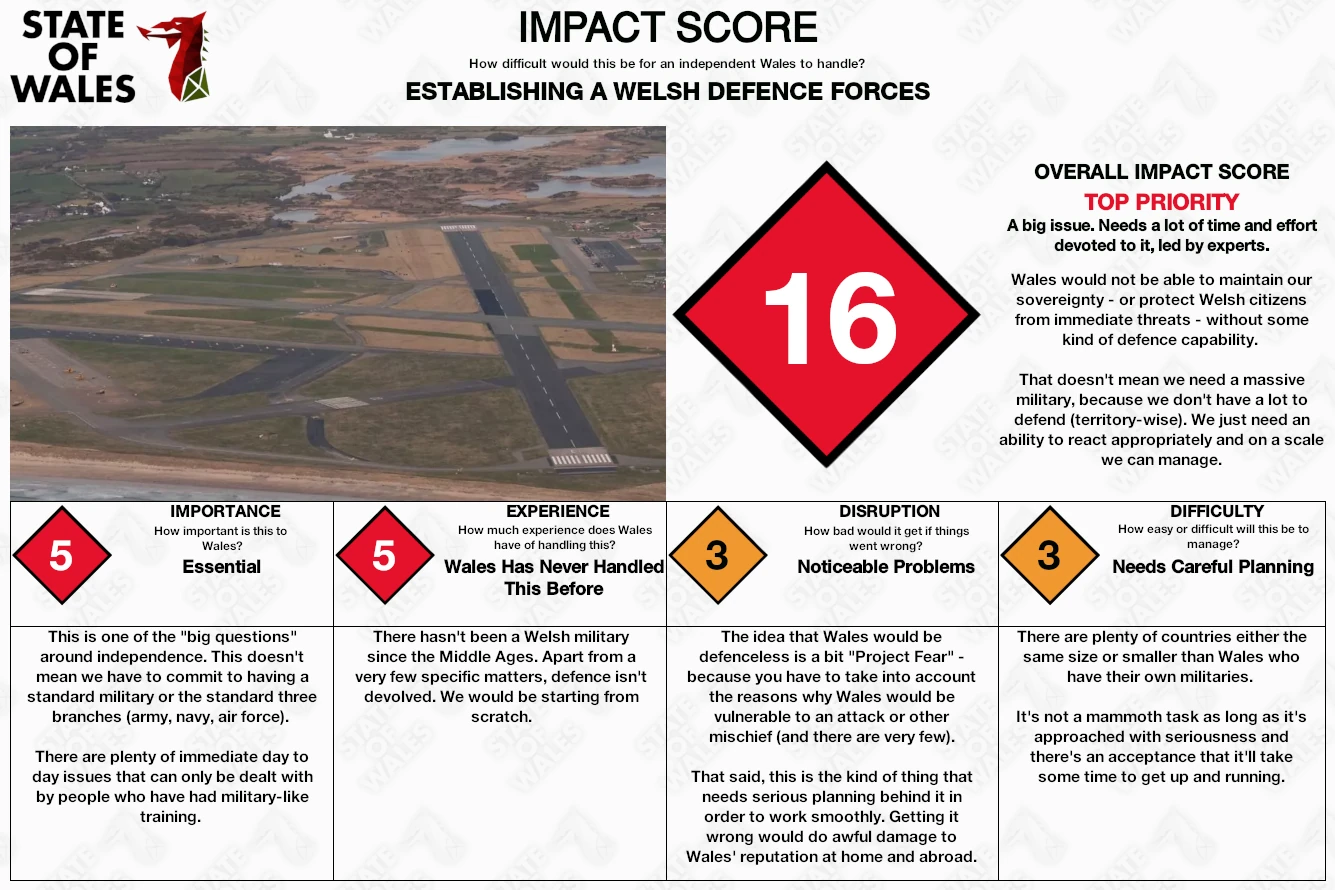
The overall score (out of 20) is the total of the scores for the four mini-categories (out of 5 each).

How Would This Be Run?

The options for a Welsh military command structure will be looked at in more detail separately.

As for political oversight, that would be for the Welsh equivalent of the Ministry of Defence. 

How Much Will This Cost?

Headline: See the tabs below.

Based on NATO averages13, defence budgets are split roughly this way:

  • 38% on personnel (i.e. pay and pensions).
  • 32% on equipment (NATO guidelines are for member states to spend up to 20% of their defence budgets on “major equipment”/capital expenditure).
  • 25% on operations, training, maintenance & research.
  • 5% on infrastructure (i.e. bases and construction).

The amount of money spent on each branch of the armed forces is tied to: their proportion of military personnel (and their pay scales), the cost of training, and the cost of maintaining equipment and estates (i.e. maintaining aircraft and naval vessels will be more expensive than land-based equipment). So it’s impossible to estimate accurately.

Using the “Levels of Capability” listed earlier, there are “low”, “medium” and “high” defence budget scenarios.

Low (similar spending-per-head as New Zealand)
Medium (match current NATO commitments)
High (maintain current [UK] defence spending)
Low (similar spending-per-head as New Zealand)

Level One (Home Defence Focus) to Level Two (Armed Neutrality).

Total defence budget of up to £1.1 billion per year, likely broken down into (at current prices):

  • £418 million per year on personnel*.
  • £352 million per year on equipment/capital spending.
  • £275 million on operations, training, maintenance and research.
  • £55 million on infrastructure.

*If the mean average annual armed forces salary was around £35,000 per year, and up to one third of the personnel budget was used to cover pensions and other personnel-related costs, this would potentially support a maximum of up to ~7,900 full-time equivalent staff and personnel.

Medium (match current NATO commitments)

Level Two (Armed Neutrality) to Level Three (Small NATO member)

Total defence budget of up to £1.9 billion per year, likely broken down into (at current prices):

  • £722 million per year on personnel*.
  • £608 million per year on equipment/capital spending.
  • £475 million on operations, training, maintenance and research.
  • £95 million on infrastructure.

*If the mean average annual armed forces salary was around £35,000 per year, and up to one third of the personnel budget was used to cover pensions and other personnel-related costs, this would potentially support a maximum of up to ~13,700 full-time equivalent staff and personnel.

High (maintain current [UK] defence spending)

Level Four (Full Spectrum Capability)

Total defence budget of up to £2.9 billion per year (roughly the same amount Wales currently pays towards the UK’s defence budget), likely broken down into (at current prices):

  • £1.1 billion per year on personnel*.
  • £928 million per year on equipment/capital spending.
  • £725 million on operations, training, maintenance and research.
  • £145 million on infrastructure.

*If the mean average annual armed forces salary was around £35,000 per year, and up to one third of the personnel budget was used to cover pensions and other personnel-related costs, this would potentially support a maximum of up to ~21,000 full-time equivalent staff and personnel.

Would any new taxes need to be introduced?

No.

Who will pay for this?

General taxation (all taxpayers).

How Long Would This Take?

Pre-independence/transition period
Years 1 to 5
Years 5 to 10
Year 10+
Pre-independence/transition period

Interim/provisional defence and security policy to ensure Wales has a military capable of basic home defence duties and is secure from civil threats (i.e. terrorism, extremism, organised crime).

Years 1 to 5

A strategy setting the medium-term ambitions for a Welsh military (i.e. whether Wales should join NATO and what level of capability we want the military to have).

Establishment of military training facilities and the recruitment and training of junior officers would likely be undertaken across the first 2 years (supported by reservists), with the first cohorts of full-time enlisted troops coming through during years 2-5.

By the end of this period, Wales should aim to have a military at least at “Level One”. An Armed Forces Act (or equivalent) and/or Veterans Act would be drafted and passed by the Senedd at this point if we decide we need a law change.

Years 5 to 10

Ensure Wales has a military to meet the level of capability we want (this is likely to be when most equipment purchases and recruitment would take place).

If we decided that Wales should join NATO, we would aim to be at least at Level Two or Level Three before the end of this period. It’s likely Wales would be able to take part in the first overseas deployments at this point (probably as UN peacekeepers).

Year 10+

Strategic Defence Review every 4-10 years. National Risk Register to be updated every 2-4 years.

People & Work

Who does this impact?

Technically, everyone, as it’s a defence matter.

Building a military capability from scratch will be hard work – probably one of the most difficult post-independence tasks. This would need to be led by the relevant government ministers and experienced military advisors/consultants (or full-time officers).

Would any jobs be created or lost?

Potentially, lots of jobs would be created in Wales. The range could be anywhere between 6,000-15,000+ (not including reservists), depending on what we want our defence capabilities to be. That compares to the 4,000 or so full-time, reserve and civilian UK personnel currently living and/or working in Wales as of 202414.

You could even make the case that establishing a Welsh armed forces would be one of the biggest job creation schemes directly tied to independence.

However, the number of posts in Wales may not match the total number of Welsh people serving in the UK armed forces overall (many of whom may decide to stay put anyway). Estimates of the number of Welsh personnel in the UK military have been quoted15 to be as high as 9%, which in 2025 would work out at around 16,300 regulars and reservists.

You Might Also Like....

Would an independent Wales have its own security service?
Defence

Would an independent Wales have its own security service?

by Owen Donovan
January 19, 2026
0

...

Read moreDetails
What would independence mean for war memorials and Remembrance events?

What would independence mean for war memorials and Remembrance events?

November 26, 2025
How could an independent Wales support veterans and service-leavers?

How could an independent Wales support veterans and service-leavers?

November 26, 2025
How would an independent Wales buy new military equipment?

How would an independent Wales buy new military equipment?

November 26, 2025
How would a Welsh military recruit & train new personnel?

How would a Welsh military recruit & train new personnel?

November 26, 2025
What could the command structure of a Welsh military look like?

What could the command structure of a Welsh military look like?

November 26, 2025
Veterans in Wales

Veterans in Wales

November 26, 2025
What would independence mean for existing MoD contracts with Welsh suppliers?

What would independence mean for existing MoD contracts with Welsh suppliers?

November 26, 2025
What defence assets might an independent Wales “inherit” from the UK?

What defence assets might an independent Wales “inherit” from the UK?

November 26, 2025
Military Law & Independence

Military Law & Independence

November 26, 2025
How and when would a Welsh armed forces be deployed?

How and when would a Welsh armed forces be deployed?

September 29, 2025
Would people from Wales serving in the British military have to join a Welsh armed forces?

Would people from Wales serving in the British military have to join a Welsh armed forces?

September 29, 2025
What military threats does Wales need defending from?

What military threats does Wales need defending from?

September 29, 2025
What makes the military unique?

What makes the military unique?

September 29, 2025
Hard Power & Soft Power

Hard Power & Soft Power

June 29, 2025
Load More
    1. UK House of Commons Library (30th June 2025). “UK defence personnel statistics” (p11-13)

    2. UK Government, Ministry of Defence (28th August 2025). “Quarterly service personnel statistics: 1 April 2025“

    3. UK Ministry of Defence (27th February 2025). “UK armed forces equipment and formations 2024”

    4. UK Ministry of Defence (2023-24), “Written Evidence submitted to (unspecified) Committee“.

    5. UK Parliament, Defence Committee (17th July 2023). “Defence Committee publishes highly critical report on UK defence procurement“.

    6. Oirachtas, Dail Eireann Debate (15th July 2025). “Written Question: Defence Forces“.

    7. Oirachtas, Dail Eireann Debate (17th October 2024). “Oral Question: Defence Forces“

    8. Danish Defence (2024). “Number of employees (translated from Danish)”.

    9. Constitutional Act of Denmark, Part VIII, Section 81.

    10. Finland Defence Forces. “Reserves (translated from Finnish)”.

    11. New Zealand Defence Forces (30th September 2025). “Our People”

    12. Oirachtas, Dail Eireann Debate (29th July 2025). “Oral Question: Defence Forces”

    13. NATO. “Defence expenditure of NATO countries 2014-2025,” (p14-15, Tables 8a-8b). Mean average percentage spending amongst NATO member states for each of the four categories.

    14. Welsh Government (14th January 2024). “Armed forces covenant, annual report 2022-23“.

    15. Nation.Cymru (5th October 2021). “Mark Drakeford calls for more Welsh troops to be based in Wales“

Use of AI

No AI tools were used to draft this post.

Donations Welcome
Tags: Airspace & Aviation SecurityConscriptionDenmarkDF 301Employment & SkillsFinlandGlobal SecurityIrelandMaritime PolicyMilitaryNational SecurityNATONew Zealand
Previous Post

Veterans in Wales

Next Post

What could the command structure of a Welsh military look like?

Owen Donovan

Owen Donovan

Archive

Categories

Copyright

Creative Commons Licence

State of Wales by Owen Donovan is licensed under a Creative Commons Attribution-NonCommercial-NoDerivatives 4.0 International License.

Subscribe by Email

Search

No Result
View All Result
No Result
View All Result
  • Go To Senedd Home
  • Go To Oggy Bloggy Ogwr
  • About & Contact
    • About State of Wales
    • Comments Policy
    • Complaints Policy
    • Contact & Subscribe by Email
    • Disclaimer
  • Features
    • After the UK
    • Chinny Reckon
    • Devil’s Advocate
    • How Wales Works
    • Road to Brexit
  • The Independence Index
    • The Independence Index (full)
    • Economics & Money
      • Business & Economy
      • Currency
      • Tax & Spending
      • Transport & Infrastructure
    • Society
      • Communities & Housing
      • Culture & Sport
      • Education
      • Health
      • Media & Communications
      • Science & Technology
    • The State
      • Environment & Natural Resources
      • Justice
      • Local Government
  • Elections Centre
  • Wales FAQ
    • How is Wales funded?
    • How are laws in Wales made?
  • Support & Donate