Senedd Home
Oggy Bloggy Ogwr
State of Wales
Sunday, August 16, 2026
  • About & Contact
    • About State of Wales
    • Comments Policy
    • Complaints Policy
    • Contact
    • Disclaimer
  • Elections Centre
  • The Independence Index
    • The Independence Index (Full)
    • Foreign Policy
      • Relations with the former UK & Ireland
      • Relations with Europe
      • Foreign Policy (General)
      • International Organisations & Law
      • Overseas Aid
    • Defence
      • Defence Policy
      • NATO
      • Armed Forces
      • National Security
      • Civil Defence
    • Rules & Regulations
      • Safety & Standards
      • Intellectual Property
    • Economics & Money
      • Business & Economy
      • Currency
      • Tax & Spending
      • Transport & Infrastructure
    • Society
      • Communities & Housing
      • Culture & Sport
      • Education
      • Health
      • Media & Communications
      • Science & Technology
    • The State
      • Environment & Natural Resources
      • Justice
      • Local Government
  • Support & Donate
No Result
View All Result
  • About & Contact
    • About State of Wales
    • Comments Policy
    • Complaints Policy
    • Contact
    • Disclaimer
  • Elections Centre
  • The Independence Index
    • The Independence Index (Full)
    • Foreign Policy
      • Relations with the former UK & Ireland
      • Relations with Europe
      • Foreign Policy (General)
      • International Organisations & Law
      • Overseas Aid
    • Defence
      • Defence Policy
      • NATO
      • Armed Forces
      • National Security
      • Civil Defence
    • Rules & Regulations
      • Safety & Standards
      • Intellectual Property
    • Economics & Money
      • Business & Economy
      • Currency
      • Tax & Spending
      • Transport & Infrastructure
    • Society
      • Communities & Housing
      • Culture & Sport
      • Education
      • Health
      • Media & Communications
      • Science & Technology
    • The State
      • Environment & Natural Resources
      • Justice
      • Local Government
  • Support & Donate
No Result
View All Result
State of Wales
No Result
View All Result
Home Foreign Policy

What kind of foreign aid policy would an independent Wales have?

Owen Donovan by Owen Donovan
September 2, 2025
in Foreign Policy, Overseas Aid
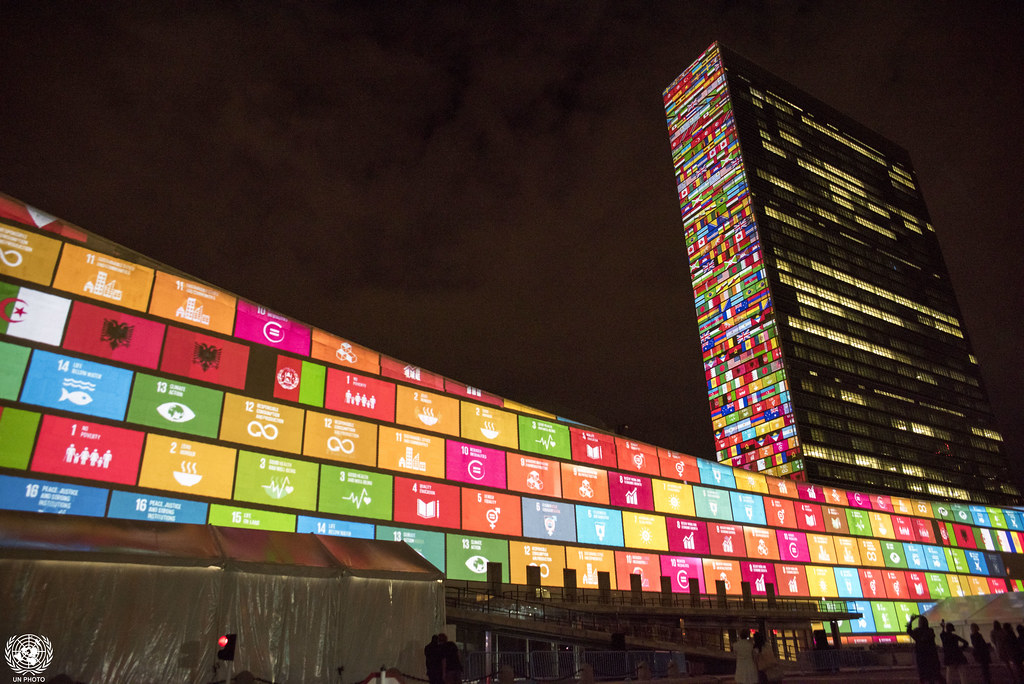
What kind of foreign aid policy would an independent Wales have?

United Nations via Flickr under Creative Commons Licence BY-NC-ND 2.0

Share on FacebookShare on TwitterShare on RedditShare on BlueskyShare by email

Image Source: United Nations via Flickr under Creative Commons Licence BY-NC-ND 2.0

This site is best viewed in landscape mode on smartphones.
Support IndyWales? Support State of Wales!

Donations keep this site going. If you like what I’m doing here and think this work is important to the independence movement, consider a donation. One-off or monthly; as little or as much as you want. Click the links below, or full details are available here.

What Happens Now?

The UK’s international development policy is led by the Foreign, Commonwealth & Development Office (FCDO), with the UK’s Foreign Secretary being the most senior Cabinet minister.

The Foreign & Commonwealth Office and Department for International Development merged in September 2020.

This means that there is no longer any standalone UK Cabinet-level minister responsible for foreign aid (previously the Secretary of State for International Development). However, the Minister of State for International Development still attends UK Cabinet meetings (as of 2025).

The UK’s international development strategy has been refreshed and/or updated several times over the past few years. As of July 20251, this strategy includes:

  • Repositioning the UK from being a “donor” to more of an economic development partner with countries that receive overseas aid.
  • Closer working with global organisations that have a proven track record of making the most of aid spending (such as the World Bank) and cutting spending on those with a poor record.
  • Greater focus on sharing expertise, particularly on climate change and health.
  • Continuing a separate reserve fund for humanitarian/emergency aid.

In 2024, total Official Development Assistance (ODA) spending by the UK was £14.1 billion, or 0.5% of Gross National Income (GNI)2. The UN target is for countries to spend 0.7% of GNI on overseas aid.

Foreign aid and international development are not devolved to Wales.

Despite this, to match the ambitions of the Wellbeing of Future Generations Act (and UN Sustainable Development Goals), in 2006 the Welsh Government launched a “foreign aid policy-lite” through the Wales & Africa programme, as well as standalone programmes such as Size of Wales.

Does This Work for Wales?

Compared to the rest of the world, the UK’s international overseas aid programme has long been one of the best. By default, that includes Wales.

However, in February 2025, the UK Government (under Labour) announced cuts to overseas aid spending, from 0.5% of Gross National Income to 0.3% from 20273, to part-fund an increase in UK defence spending.

It’s impossible to tell one way or another whether the UK’s overseas aid strategy “works for Wales” or not as it’s done on our behalf.

When UK aid makes a positive impact overseas, it will reflect well on Wales. Similarly, any hit to the UK’s reputation will reflect poorly on Wales.

Overseas Aid Policy & Independence: Pros & Cons

Pros of Independence
Cons of Independence
Pros of Independence

Wales would be able to shape our overseas aid policy to meet our own foreign policy and soft power goals – it wouldn’t be decided for us in London.

It would be an opportunity to start overseas aid policies from scratch with no baggage carried over from the UK. This could include (though I disagree with it personally) not having an international development policy at all and/or only offering humanitarian/disaster relief assistance.

It would be much easier for charities/third sector organisations and NGOs based in Wales to lobby for overseas aid policy changes at the Senedd (when compared to the UK Parliament) due to the closely-knit civic society and social networks.

We have the Wales and Africa programme (and related projects) as a starting base that can be gradually built up. Therefore, Wales already has contacts and networks in place to support broader development programmes in places like Uganda, Somaliland and Zambia.

We could develop an overseas aid policy by using the Wellbeing of Future Generations Act as a base/set of principles.

Some types of military spending count as part of a country’s overall foreign aid spending – such as UN/”blue helmet” missions.

Cons of Independence

While Wales has limited experience of overseas aid (such as Wales for Africa), some types of overseas aid are more complicated, with the Welsh civil service having little to no experience of handling them before.

There’s an argument that developing countries have become too dependent on overseas aid, which has made it harder to support themselves4. An overseas investment policy to grow/modernise developing economies may be better than a one-size-fits-all “aid” policy.

There’s a risk that the Welsh Government would be “led by the nose” by special interests in the charity sector to support certain communities and projects over others. This may not always be in the Welsh national interest, just a result of better lobbying and campaigning.

It would be unclear what obligations an independent Wales would “inherit” from the UK (i.e. a share of foreign debt).

Would we have the logistics to get aid to where it’s needed if we can’t rely on non-governmental organisations/NGOs?

What Do Other Countries Do?

Ireland
Iceland
Estonia
New Zealand
Denmark
Ireland

  • Ireland has a single international development agency (Irish Aid)5.
  • Policy is guided by the UN’s 17 Sustainable Development Goals.
  • Areas with a particular focus include “areas where Ireland has particular expertise in” including climate change, conflict resolution, gender equality and improving governance.
  • Ireland provides aid globally, but they have deeper bilateral development partnerships with 13 countries (including Palestine) and a programme to help small developing island states.
  • As a neutral country, Ireland’s military has traditionally played an important role as peacekeepers in Africa and the Middle East, which counts as a form of overseas aid.
Iceland

  • International development is considered one of the “pillars of Iceland’s foreign policy”6.
  • Iceland has international development strategies that last for 3 to 4 years.
  • Their approach is more theme-based, with four main focuses: gender equality & human rights, social infrastructure, climate change and humanitarian assistance.
  • Iceland has deeper development partnerships with Malawi, Sierra Leone and Uganda, but also works to deliver overseas aid through major multinational organisations like the World Bank and UNICEF.
  • The Icelandic Government actively works with civil society organisations and NGOs/charities to deliver projects on the ground.
Estonia

  • Estonia has an international development agency (EstDev)7, working to a six-year international development strategy.
  • Estonia works with “priority countries” in Eastern Europe (Ukraine, Moldova, Armenia, Georgia) to improve their chances of integrating with the EU. They also partner with four African countries (Kenya, Botswana, Namibia, Uganda) to improve governance and online services.
  • Improving e-governance and cybersecurity is one of four key areas for overseas development – something Estonia has expertise in. Other priority themes include supporting democracy, economic development and education. Reconstruction in Ukraine is a high priority separate from the others.
  • Estonia works closely with the European Union and OECD on development/aid programmes.
New Zealand

  • New Zealand’s international development policy8 is based on four key principles: being effective, addressing inequality, strengthening the environment & economy and delivering long-lasting progress.
  • New Zealand’s programme is focused on the Pacific Islands, but they also work closely with the Association of Southeast Asian Nations (ASEAN) and have programmes in the Caribbean, sub-Saharan Africa and Latin America.
  • New Zealand is a leading provider of disaster and humanitarian relief in the Pacific region.
  • Most projects are delivered on the ground through NGOs, companies, diaspora organisations and other public agencies (such as the military).
Denmark

  • “Danida” is the umbrella term for Denmark’s international development programme9.
  • Denmark has five focus areas: economic growth, response to conflict and irregular migration, climate change, democracy & human rights, and education & health.
  • The Danish Government sets annual priorities for Danida as part of a four-year strategy.
  • Denmark has developed partnerships with (at least 16) countries based on Denmark’s economic interests. Denmark believes the European Union is best placed to improve trading conditions in developing countries.
What Options Does Wales Have?

Based on the examples given earlier, there are certain things most smaller developed countries do when it comes to overseas aid strategies:

  • They work towards the UN’s Sustainable Development Goals and/or a small number of priority areas – they don’t try to do everything.
  • Humanitarian/emergency aid is usually handled separately from aid focused on economic and social development.
  • Civil society and NGOs/charities are actively involved in delivering projects (in Wales, this already happens as part of Wales for Africa).
  • There’s a mix of bilateral development partnerships (working with countries one-on-one) and working through major international development organisations (like the World Bank, UNICEF, etc). Countries often spend the majority of their overseas aid budget on bilateral aid.

So, in terms of an overall overseas aid policy, the possible options for an independent Wales might include:

Option One: React to Events
Option Two: Partner Countries (Bilateralism)
Option Three: Partner Organisation (Multilateralism)
Option Four: Mixed/Balanced Approach
Option Five: Outsource to NGOs
Option One: React to Events

Wales only provides aid when needed or requested, placing more weight on humanitarian aid and disaster relief. We work with any country (within reason) and won’t focus on prevention or long-term economic or social development.

Option Two: Partner Countries (Bilateralism)

Wales works closely with a small number of carefully selected partner countries (maybe up to a dozen). The development work could be based on the wellbeing goals in the Future Generations Act. We wouldn’t put as high a priority on working with multinational organisations.

This may mean that we can put real effort into improving living conditions and local economies, but it would be limited to only a few countries.

Option Three: Partner Organisation (Multilateralism)

The opposite of the bilateral approach. Instead of working with partner countries, Welsh overseas aid policy would focus more towards working almost exclusively through multinational organisations like the UN, World Health Organisation and World Bank.

In this case, Wales would provide funding, material support and expertise that could be used anywhere in the world.

Option Four: Mixed/Balanced Approach
This is what most countries do, though often leaning more towards bilateralism.

Wales works closely with a small number of partner countries (four to six) but also plays a full part in multinational organisations. Most of the resources would be focused on bilateral support (two-thirds to three-quarters), with the remainder going to multinational organisations.
Option Five: Outsource to NGOs

The Welsh Government provides funding to NGOs for development projects. Wales wouldn’t play a direct part in any international development projects. The Welsh Government would award grant funding based on the strength of the bid compared to what we would expect that money or aid to achieve.

The downside is that NGOs have no democratic legitimacy, and they are, at heart, private companies that pursue their own agendas.

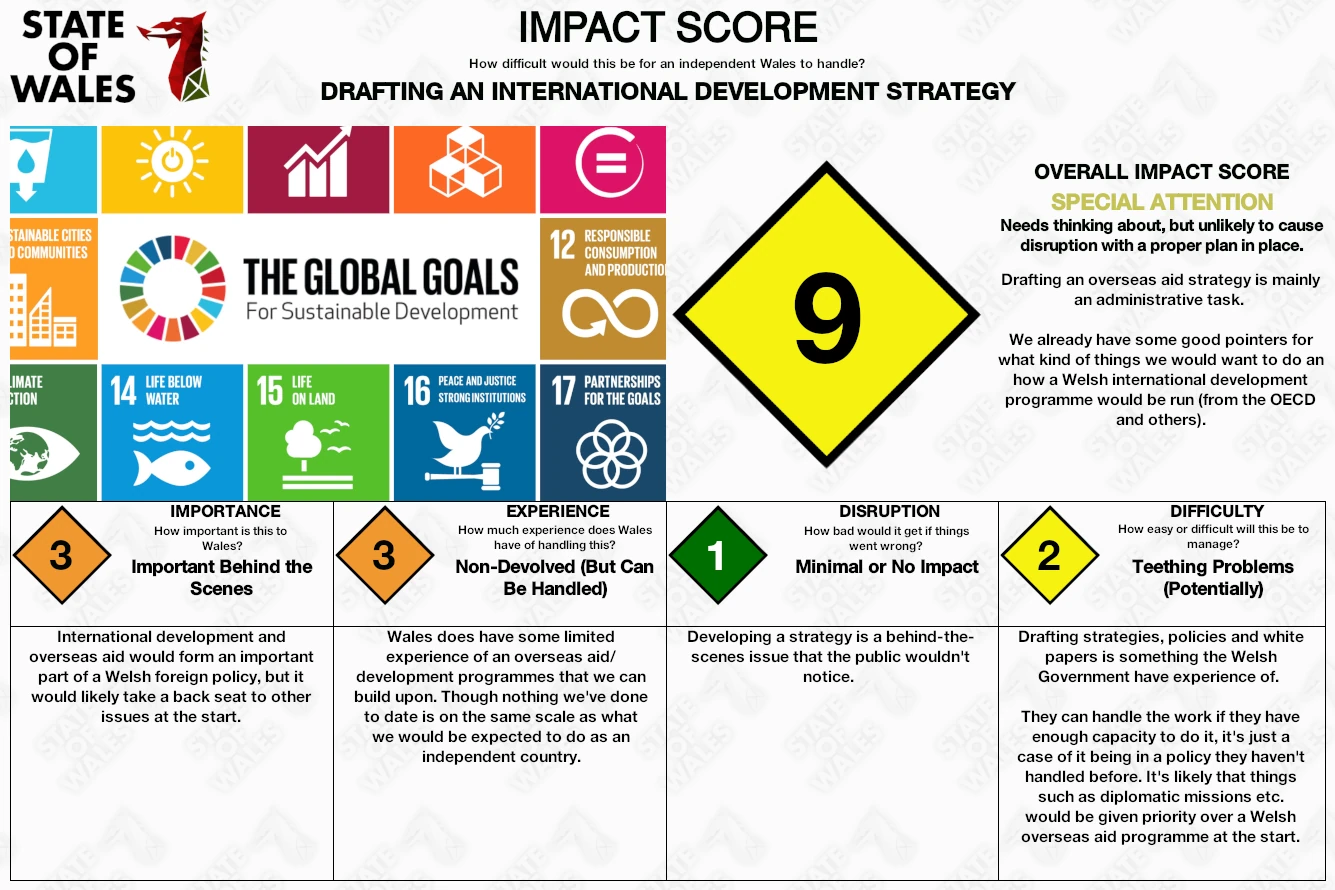
What's at Stake?

The overall score (out of 20) is the total of the scores for the four mini-categories (out of 5 each).

How Would This Be Run?

Politically, whoever is responsible for foreign policy would likely shape Wales’ overseas aid programme (if we have one). There may be an argument for a junior (non-Cabinet) minister to be responsible for international development.

Their work would be scrutinised by the relevant Senedd committee with responsibility for foreign affairs.

More broadly, the options might include: 

Option One: Run directly by the Welsh Government
Option Two: A arms-length Overseas Development Agency
Option Three: Hands off (NGO-led)
Option One: Run directly by the Welsh Government

Ministerial management with full accountability to the Senedd. This is what usually happens in most countries, though overseas development may be overseen by a separate internal government department (a bit like Cadw).

Option Two: A arms-length Overseas Development Agency

The Welsh Government sets up an arms-length agency to manage overseas development (something like the old WDA but in reverse). This may make it easier to gather expertise and involve people and organisations from outside of government, but it means the Welsh Government would have less hands-on control.

Option Three: Hands off (NGO-led)

The Welsh Government takes a back seat and only provides funding without thinking too much about how or where it’s being spent. This may mean that any money or material aid provided by Wales is used by people with better experience on the ground, but it could easily be misused.

How Much Will This Cost?

Headline: No direct costs, but the international development strategy would help the Welsh Government decide how much an independent Wales would spend on overseas aid each year.

The only direct costs in developing an international development strategy, by itself, would be the time worked by civil servants and any partner organisations brought in (such as NGOs and charities).

If we decided to set up an arms-length overseas development agency, then an equivalent body in Wales – the Education Workforce Council – had annual running costs of just over £12 million in 2023-2410.

Would any new taxes need to be introduced? 

No, though charities/NGOs working in international development and operating in Wales would be subject to Welsh charity laws and tax rules.

Who will pay for this?

A mix of general taxation (all taxpayers), corporate donations and individual fundraising.

How Long Would This Take?

An overseas aid policy would likely be developed alongside a more general foreign policy.

It’s more a question of how often we refresh an overseas aid strategy.

We could have one that doesn’t change much for a long period (i.e a 10-year strategy).

Or we allow the Welsh Government to update it more regularly and make changes on the fly (updated annually or every 2-4 years).

A longer-term strategy sets clear goals but is more “rigid”; a shorter-term strategy would be more flexible but would make it harder to plan for the long-term and build proper development partnerships in countries that receive aid.

People & Work

Who does this impact?

The people in the countries and regions that would potentially receive overseas aid from Wales.

Within Wales, it would directly impact those working in the Welsh foreign department (or equivalent), civil society organisations that promote overseas aid, and charities with a presence in Wales that work in overseas development and aid delivery (i.e Red Cross, DEC, Oxfam).

Would any jobs be created or lost?

A certain number of jobs created when a Welsh foreign department is set up would likely be set aside for international development. You would expect a Welsh foreign department to have between 800 and 1,500 staff.

Some of these positions would be based overseas at Welsh diplomatic missions, and a number of jobs would likely be created for citizens of countries that receive aid (i.e. community liaison officers, business administrators, local experts).

You Might Also Like....

How would we know if Welsh overseas aid is making a difference?
Foreign Policy

How would we know if Welsh overseas aid is making a difference?

by Owen Donovan
September 2, 2025
0

...

Read moreDetails
What impact would independence have on current UK and Welsh aid projects?

What impact would independence have on current UK and Welsh aid projects?

September 2, 2025
How much could an independent Wales spend on overseas aid?

How much could an independent Wales spend on overseas aid?

September 2, 2025
Devolution & Overseas Aid

Devolution & Overseas Aid

September 1, 2025
Would an independent Wales join the Commonwealth?

Would an independent Wales join the Commonwealth?

July 29, 2025
Load More
    1. UK Government, Foreign Commonwealth & Development Office (22nd July 2025). “Modernised aid budget will focus on impact, value for money and transparency”.

    2. UK Foreign, Commonwealth & Development Office (22nd July 2025). “Annual Report & Accounts 2024-25” (p273).

    3. UK House of Commons Library (28th February 2025). “UK to reduce aid to 0.3% of gross national income from 2027”. 

    4. Cherkaoui N., Policy Centre for the New South (July 2022). “The Sovereignty of Developing Countries: The Challenge of Foreign Aid”

    5. Irish Government. “Irish Aid: What we do”.
    6. Government of Iceland. “International Development Cooperation“

    7. Government of Estonia. “Estonian Development Cooperation”.

    8. Government of New Zealand, Ministry for Foreign Affairs & Trade. “New Zealand’s International Development Principles“.

    9. Government of Denmark, Ministry of Foreign Affairs. “Danida”.

    10. Education Workforce Council. “Annual Report & Accounts for 2023-24”.

Use of AI

No AI tools were used to draft this post.

Donations Welcome
Tags: Charities & Third SectorCivil ServiceDenmarkDiplomacyEstoniaForeign AffairsFP 501Government SpendingIcelandInternational DevelopmentInternational OrganisationsIrelandNew ZealandUK Government
Previous Post

Devolution & Overseas Aid

Next Post

How much could an independent Wales spend on overseas aid?

Owen Donovan

Owen Donovan

Archive

Categories

Copyright

Creative Commons Licence

State of Wales by Owen Donovan is licensed under a Creative Commons Attribution-NonCommercial-NoDerivatives 4.0 International License.

Subscribe by Email

Search

No Result
View All Result
No Result
View All Result
  • Go To Senedd Home
  • Go To Oggy Bloggy Ogwr
  • About & Contact
    • About State of Wales
    • Comments Policy
    • Complaints Policy
    • Contact & Subscribe by Email
    • Disclaimer
  • Features
    • After the UK
    • Chinny Reckon
    • Devil’s Advocate
    • How Wales Works
    • Road to Brexit
  • The Independence Index
    • The Independence Index (full)
    • Economics & Money
      • Business & Economy
      • Currency
      • Tax & Spending
      • Transport & Infrastructure
    • Society
      • Communities & Housing
      • Culture & Sport
      • Education
      • Health
      • Media & Communications
      • Science & Technology
    • The State
      • Environment & Natural Resources
      • Justice
      • Local Government
  • Elections Centre
  • Wales FAQ
    • How is Wales funded?
    • How are laws in Wales made?
  • Support & Donate