Senedd Home
Oggy Bloggy Ogwr
State of Wales
Monday, August 17, 2026
  • About & Contact
    • About State of Wales
    • Comments Policy
    • Complaints Policy
    • Contact
    • Disclaimer
  • Elections Centre
  • The Independence Index
    • The Independence Index (Full)
    • Foreign Policy
      • Relations with the former UK & Ireland
      • Relations with Europe
      • Foreign Policy (General)
      • International Organisations & Law
      • Overseas Aid
    • Defence
      • Defence Policy
      • NATO
      • Armed Forces
      • National Security
      • Civil Defence
    • Rules & Regulations
      • Safety & Standards
      • Intellectual Property
    • Economics & Money
      • Business & Economy
      • Currency
      • Tax & Spending
      • Transport & Infrastructure
    • Society
      • Communities & Housing
      • Culture & Sport
      • Education
      • Health
      • Media & Communications
      • Science & Technology
    • The State
      • Environment & Natural Resources
      • Justice
      • Local Government
  • Support & Donate
No Result
View All Result
  • About & Contact
    • About State of Wales
    • Comments Policy
    • Complaints Policy
    • Contact
    • Disclaimer
  • Elections Centre
  • The Independence Index
    • The Independence Index (Full)
    • Foreign Policy
      • Relations with the former UK & Ireland
      • Relations with Europe
      • Foreign Policy (General)
      • International Organisations & Law
      • Overseas Aid
    • Defence
      • Defence Policy
      • NATO
      • Armed Forces
      • National Security
      • Civil Defence
    • Rules & Regulations
      • Safety & Standards
      • Intellectual Property
    • Economics & Money
      • Business & Economy
      • Currency
      • Tax & Spending
      • Transport & Infrastructure
    • Society
      • Communities & Housing
      • Culture & Sport
      • Education
      • Health
      • Media & Communications
      • Science & Technology
    • The State
      • Environment & Natural Resources
      • Justice
      • Local Government
  • Support & Donate
No Result
View All Result
State of Wales
No Result
View All Result
Home Foreign Policy

How much could an independent Wales spend on overseas aid?

Owen Donovan by Owen Donovan
September 2, 2025
in Foreign Policy, Overseas Aid
How much could an independent Wales spend on overseas aid?

UK Government via Flickr under Creative Commons Licence BY-SA-2.0

Share on FacebookShare on TwitterShare on RedditShare on BlueskyShare by email

Image Source: UK Government via Flickr under Creative Commons Licence BY-SA-2.0 (taken in 2015)

This site is best viewed in landscape mode on smartphones.
Support IndyWales? Support State of Wales!

Donations keep this site going. If you like what I’m doing here and think this work is important to the independence movement, consider a donation. One-off or monthly; as little or as much as you want. Click the links below, or full details are available here.

What Happens Now?

Overseas Development Assistance (ODA) is an agreed definition – set by the OECD – of what counts as part of a country’s overseas aid and development programme1.

In short, to count as official overseas aid, it has to be:

  • Provided by an official agency (i.e. government or a government agency).
  • Has to promote economic development or welfare in the country that’s receiving the aid.
  • Has to have a concession (i.e. a certain proportion of a loan is given as a non-repayable grant).

There are some additional definitions. These include2:

  • ODA only counts if it’s awarded to a country that features on a list of low and middle-income countries, or as a financial contribution to certain international organisations3.
  • Certain types of peacekeeping missions count as ODA (though military aid that increases a country’s military capacity isn’t counted).
  • Development of civilian nuclear energy.
  • Building up the “cultural capacities of recipient countries”.
  • Costs associated with supporting refugees and asylum seekers for their first year of stay in their host country (this is called In-Donor Refugee Costs).

The United Nations set a target for countries (which can afford to) to spend 0.7% of Gross National Income (GNI) on Official Development Assistance.

Provisional figures for 20244, show that the UK spent just under £14.1billion on ODA, the equivalent of 0.5% of GNI and is set to be cut to 0.3% by 2027. This is despite the 0.7% target being legally-binding on the UK Government5.

Of this, 80% was bilateral aid (donated to a specific country or region, including humanitarian aid), while the remaining 20% was multilateral (granted to a multinational organisation to spend how they see fit).

Does This Work for Wales?

It’s not so much a question of whether it works for Wales, but whether it works for the countries and regions receiving aid. That will be looked at separately.

Aside from programmes run by the Welsh Government, Wales has no say in what type of aid or development assistance goes where. So there’s a general point about not having a voice or influence over it.

The Format of Overseas Aid & Independence: Pros & cons

Pros of Independence
Cons of Independence
Pros of Independence

We would have full control over what kind of aid we deliver, where we deliver it, and how much to spend.

A Welsh international development policy would support our soft power goals and reputation overseas.

We have the Wales and Africa programme (and related projects) as a starting base that can be gradually built up. Therefore, Wales already has contacts and networks in place to support broader development programmes in places like Uganda, Somaliland and Zambia.

It would be much easier for charities/third sector organisations and NGOs based in Wales to lobby for overseas aid policy changes at the Senedd (when compared to the UK Parliament) due to the closely-knit civic society and social networks.

There would be procurement and secondment opportunities for specialist Wales-based companies and experts.

Cons of Independence

There would be damage to Wales’ international reputation if we were deemed to be spending too little on overseas aid – even if it made more of an impact on the ground.

Similarly, any attempt to hit the 0.7% of GNI aid spending target, without improving the Welsh economy beforehand, would be very unpopular with the public. Ireland is now one of the world’s leading aid donors, but only after it improved their economy during the “Celtic Tiger” period6.

There’s something ironic about one of the Welsh Government’s most successful reforestation projects being in Uganda, not Wales. Should we be trying to do things overseas that we can’t do successfully here?

There has been criticism of how overseas aid is defined. Therefore, we shouldn’t take the OECD’s guidelines as gospel. We might need to “do what we think is right” instead of worrying about definitions and targets.

It would be unclear what obligations an independent Wales would “inherit” from the UK (i.e. a share of foreign debt).

Would we have the logistics to get aid to where it’s needed if we can’t rely on non-governmental organisations/NGOs?

What Do Other Countries Do?

Ireland
Iceland
Estonia
New Zealand
Denmark
Ireland

As of 20237:

  • Ireland spent €2.6 billion (£2.26 billion) in total on ODA.
  • This was the equivalent of 0.67% of Gross National Income (6th in the OECD). The average since 2000 has been around 0.4% of GNI, but the increase was driven mainly by in-donor refugee costs for Ukrainian refugees.
  • 76% was bilateral (Ireland-to-country) aid; 24% was multilateral aid (through international organisations).
  • The top five aid recipients were Ethiopia, Palestine, Ukraine, Mozambique and Tanzania.
Iceland

As of 20248:

  • Iceland provided just under $112 million (£83 million) in ODA.
  • This was the equivalent of 0.33% of Gross National Income (16th in the OECD), with the Icelandic Government aiming to increase this to 0.48% by 2028.
  • 79% of aid was bilateral (Iceland-to-country); 21% was multilateral aid (through international organisations).
  • The top five aid recipients were Ukraine, Malawi, Uganda, Sierra Leone and Afghanistan.
Estonia

As of 20249:

  • Estonia provided just under $83 million (£61 million) in ODA.
  • This was the equivalent of 0.2% of Gross National Income (27th in the OECD), but it was one of the OECD nations spending the highest proportion of ODA on Ukrainian refugees.
  • 54.3% of aid was bilateral (Estonia-to-country); 45.7% was multilateral aid (through international organisations).
  • The top five aid recipients were Ukraine, Georgia, Kenya, Moldova and Namibia.
New Zealand

As of 202410:

  • New Zealand provided just under $781 million (£581 million) in ODA.
  • This was the equivalent of 0.32% of Gross National Income (17th in the OECD).
  • 83.8% of aid was bilateral (New Zealand-to-country); 16.2% was multilateral aid (through international organisations).
  • The top five aid recipients were Samoa, Fiji, Tonga, Niue and Solomon Islands.
Denmark

As of 202411:

  • Denmark provided $3.2 billion (£2.4 billion) in ODA.
  • This was the equivalent of 0.71% of Gross National Income (4th in the OECD). Denmark has hit the UN’s 0.7% target for over 40 years.
  • 70.3% of aid was bilateral (Denmark-to-country); 29.7% was multilateral (through international organisations).
  • The top five aid recipients were Ukraine, Ethiopia, Kenya, Syria and Somalia.
What Options Does Wales Have?

As this topic focuses on spending, it’ll be returned to later.

What's at Stake?

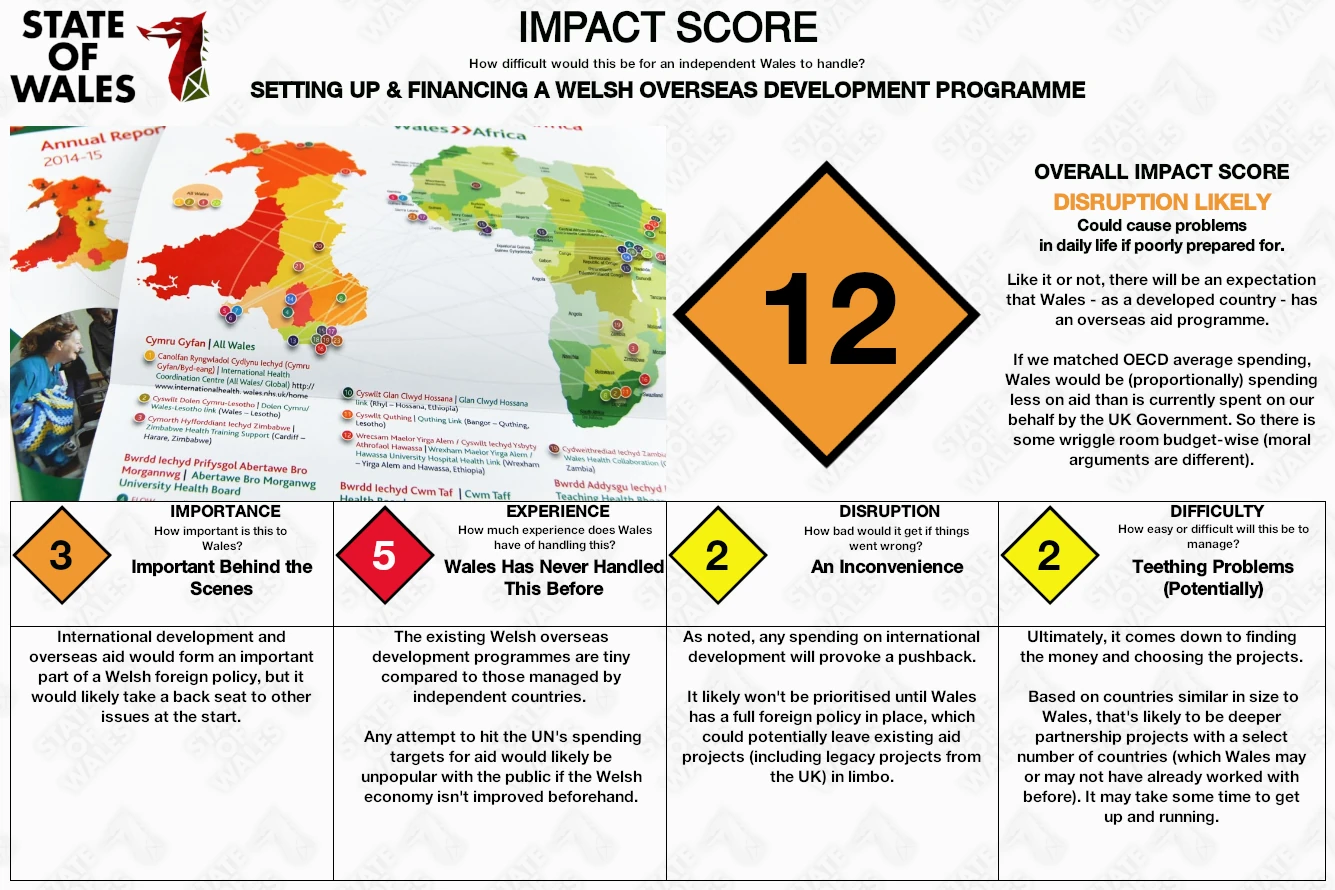
The overall score (out of 20) is the total of the scores for the four mini-categories (out of 5 each).

How Would This Be Run?

Politically, whoever is responsible for foreign policy would likely shape Wales’ overseas aid programme (if we have one). There may be an argument for a junior (non-Cabinet) minister to be responsible for international development.

Their work would be scrutinised by the relevant Senedd committee with responsibility for foreign affairs.

More broadly, the options might include: 

Option One: Run directly by the Welsh Government
Option Two: A arms-length Overseas Development Agency
Option Three: Hands off (NGO-led)
Option One: Run directly by the Welsh Government

Ministerial management with full accountability to the Senedd. This is what usually happens in most countries, though overseas development may be overseen by a separate internal government department (a bit like Cadw).

Option Two: A arms-length Overseas Development Agency

The Welsh Government sets up an arms-length agency to manage overseas development (something like the old WDA but in reverse). This may make it easier to gather expertise and involve people and organisations from outside of government, but it means the Welsh Government would have less hands-on control.

Option Three: Hands off (NGO-led)

The Welsh Government takes a back seat and only provides funding without thinking too much about how or where it’s being spent. This may mean that any money or material aid provided by Wales is used by people with better experience on the ground, but it could easily be misused.

How Much Will This Cost?

Headline: Based on OECD averages, a “Welsh international development budget” would be between £269-318 million per year. This would save Wales around £400 million a year compared to our (proportional) share of UK ODA spending at present (around £700 million).

I haven’t been able to find any Gross National Income (GNI) figures for Wales. GNI is similar to GDP (the total value of all goods and services produced in a country), but it takes into account money earned abroad.

So instead of GNI, I’ve had to use Gross Value Added (GVA). This is what Cardiff University used to estimate Wales’ financial contribution to the EU (which uses GNI) in 201612.

Wales’ Gross Value Added was £81.5 billion in 202313 ($101 billion at 2023 average exchange rate).

In every estimated scenario below, except for a “Generous” aid programme, an independent Wales would spend less on overseas aid than we currently (proportionally) do as part of the UK.

So, theoretically, an independent Wales could meet the UN overseas aid target whilst spending less money. The moral and foreign policy arguments around that are separate.

Do Minimum: Less than 0.1% of GNI
Low: 0.2% of GNI
OECD Median: 0.33% of GNI
OECD Mean Average: 0.39% of GNI
OECD Top Half: 0.5% of GNI
UN Target: 0.7% of GNI
Generous: 1% of GNI
Do Minimum: Less than 0.1% of GNI

Wales would spend at most £81.5 million. This would put us in the bottom four or five OECD donors. If we matched Hungary’s spending, it would be just £73 million.

Low: 0.2% of GNI

Approximately £163 million. This is a similar proportion spent by the United States and Estonia.

OECD Median: 0.33% of GNI

Approximately £269 million.

OECD Mean Average: 0.39% of GNI

Approximately £318 million.

OECD Top Half: 0.5% of GNI

Approximately £408 million.

UN Target: 0.7% of GNI

Approximately £571 million.

Generous: 1% of GNI

Anything at or above £815 million per year. This would put Wales amongst the top three OECD donors.

Would any new taxes need to be introduced?

No, though charities/NGOs working in international development and operating in Wales would be subject to Welsh charity laws and tax rules.

Who will pay for this?

General taxation (all taxpayers). Corporate donations and individual fundraising likely won’t be counted towards ODA figures.

How Long Would This Take?

An overseas aid policy would likely be developed alongside a more general foreign policy.

The budget for overseas development itself would be set year to year as part of the normal budget process at the Senedd. 

People & Work

Who does this impact?

The people in the countries and regions that would potentially receive overseas aid from Wales.

Within Wales, it would directly impact those working in the Welsh foreign department (or equivalent), civil society organisations that promote overseas aid and charities with a presence in Wales that work in overseas development and aid delivery (i.e Red Cross, DEC, Oxfam).

Would any jobs be created or lost?

A certain number of jobs created when a Welsh foreign department is set up would likely be set aside for international development. You would expect a Welsh foreign department to have between 800 and 1,500 staff.

Some of these positions would be based overseas at Welsh diplomatic missions and several jobs would likely be created for citizens of countries that receive aid (i.e. community liaison officers, business administrators, local experts).

Charities and NGOs working in overseas aid may wish to set up satellite offices in Wales in order to lobby the Senedd and Welsh Government. This would create a small number of jobs in the third sector and public relations.

You Might Also Like....

How would we know if Welsh overseas aid is making a difference?
Foreign Policy

How would we know if Welsh overseas aid is making a difference?

by Owen Donovan
September 2, 2025
0

...

Read moreDetails
What impact would independence have on current UK and Welsh aid projects?

What impact would independence have on current UK and Welsh aid projects?

September 2, 2025
What kind of foreign aid policy would an independent Wales have?

What kind of foreign aid policy would an independent Wales have?

September 2, 2025
Devolution & Overseas Aid

Devolution & Overseas Aid

September 1, 2025
Would an independent Wales join the Commonwealth?

Would an independent Wales join the Commonwealth?

July 29, 2025
Load More
    1. OECD, “Official Development Assistance”.

    2. OECD, “Official development assistance – definition and coverage”

    3. OECD, “ODA recipients: countries, territories, and international organisations”

    4. UK Government, Foreign Commonwealth & Development Office (April 2025). “Statistics on International Development, Provisional UK ODA spend 2024”

    5. International Development (Official Development Assistance Target) Act 2015.

    6. Irish Aid, “Irish Aid History“.

    7. Government of Ireland, Irish Aid (2nd October 2024). “Irish Aid: Annual Report 2023”

    8. OECD (2024). “Development Cooperation Profiles: Iceland“

    9. OECD (2024). “Development Cooperation Profiles: Estonia“

    10. OECD (2024). “Development Cooperation Profiles: New Zealand“

    11. OECD (2024). “Development Cooperation Profiles: Denmark”

    12. G Ifan, RW Jones, EG Poole (May 2016). “Estimating Wales’s Net Contribution to the European Union” (p 10-12).

    13. Welsh Government (25th April 2025). “Regional gross domestic product and gross value added: 1998 to 2023”

Use of AI

No AI tools were used to draft this post.

Donations Welcome
Tags: Charities & Third SectorDenmarkEstoniaForeign AffairsFP 502Government SpendingIcelandImmigrationInternational DevelopmentInternational OrganisationsIrelandNew ZealandOECDRefugees & AsylumUK GovernmentUnited Nations
Previous Post

What kind of foreign aid policy would an independent Wales have?

Next Post

What impact would independence have on current UK and Welsh aid projects?

Owen Donovan

Owen Donovan

Archive

Categories

Copyright

Creative Commons Licence

State of Wales by Owen Donovan is licensed under a Creative Commons Attribution-NonCommercial-NoDerivatives 4.0 International License.

Subscribe by Email

Search

No Result
View All Result
No Result
View All Result
  • Go To Senedd Home
  • Go To Oggy Bloggy Ogwr
  • About & Contact
    • About State of Wales
    • Comments Policy
    • Complaints Policy
    • Contact & Subscribe by Email
    • Disclaimer
  • Features
    • After the UK
    • Chinny Reckon
    • Devil’s Advocate
    • How Wales Works
    • Road to Brexit
  • The Independence Index
    • The Independence Index (full)
    • Economics & Money
      • Business & Economy
      • Currency
      • Tax & Spending
      • Transport & Infrastructure
    • Society
      • Communities & Housing
      • Culture & Sport
      • Education
      • Health
      • Media & Communications
      • Science & Technology
    • The State
      • Environment & Natural Resources
      • Justice
      • Local Government
  • Elections Centre
  • Wales FAQ
    • How is Wales funded?
    • How are laws in Wales made?
  • Support & Donate