Senedd Home
Oggy Bloggy Ogwr
State of Wales
Sunday, August 16, 2026
  • About & Contact
    • About State of Wales
    • Comments Policy
    • Complaints Policy
    • Contact
    • Disclaimer
  • Elections Centre
  • The Independence Index
    • The Independence Index (Full)
    • Foreign Policy
      • Relations with the former UK & Ireland
      • Relations with Europe
      • Foreign Policy (General)
      • International Organisations & Law
      • Overseas Aid
    • Defence
      • Defence Policy
      • NATO
      • Armed Forces
      • National Security
      • Civil Defence
    • Rules & Regulations
      • Safety & Standards
      • Intellectual Property
    • Economics & Money
      • Business & Economy
      • Currency
      • Tax & Spending
      • Transport & Infrastructure
    • Society
      • Communities & Housing
      • Culture & Sport
      • Education
      • Health
      • Media & Communications
      • Science & Technology
    • The State
      • Environment & Natural Resources
      • Justice
      • Local Government
  • Support & Donate
No Result
View All Result
  • About & Contact
    • About State of Wales
    • Comments Policy
    • Complaints Policy
    • Contact
    • Disclaimer
  • Elections Centre
  • The Independence Index
    • The Independence Index (Full)
    • Foreign Policy
      • Relations with the former UK & Ireland
      • Relations with Europe
      • Foreign Policy (General)
      • International Organisations & Law
      • Overseas Aid
    • Defence
      • Defence Policy
      • NATO
      • Armed Forces
      • National Security
      • Civil Defence
    • Rules & Regulations
      • Safety & Standards
      • Intellectual Property
    • Economics & Money
      • Business & Economy
      • Currency
      • Tax & Spending
      • Transport & Infrastructure
    • Society
      • Communities & Housing
      • Culture & Sport
      • Education
      • Health
      • Media & Communications
      • Science & Technology
    • The State
      • Environment & Natural Resources
      • Justice
      • Local Government
  • Support & Donate
No Result
View All Result
State of Wales
No Result
View All Result
Home Foreign Policy

How would we know if Welsh overseas aid is making a difference?

Owen Donovan by Owen Donovan
September 2, 2025
in Foreign Policy, Overseas Aid
How would we know if Welsh overseas aid is making a difference?

wallpaperflare.com, public domain

Share on FacebookShare on TwitterShare on RedditShare on BlueskyShare by email

Image Source: wallpaperflare.com, public domain

This site is best viewed in landscape mode on smartphones.
Support IndyWales? Support State of Wales!

Donations keep this site going. If you like what I’m doing here and think this work is important to the independence movement, consider a donation. One-off or monthly; as little or as much as you want. Click the links below, or full details are available here.

What Happens Now?

The UK’s international development policy is led by the Foreign, Commonwealth & Development Office (FCDO), with the UK’s Foreign Secretary being the most senior Cabinet minister.

The UK Parliament is responsible for holding the UK Government to account for its overseas aid spending.

In addition to the UK Parliament, the Independent Commission for Aid Impact (ICAI) provides more detailed reports on UK overseas aid spending. ICAI reports directly to the UK Parliament’s International Development Committee.

The OECD’s Development Assistance Committee leads on many aspects of overseas aid. It has a detailed monitoring system which allows anyone to compare overseas development and aid spending by different OECD member states.

Does This Work for Wales?

ICAI doesn’t scrutinise overseas aid provided by the Welsh and Scottish governments.

As international development isn’t devolved, and the Welsh and Scottish programmes are small compared to the UK, there isn’t much value in them doing so.

However, it does mean – technically – there’s less oversight of this kind of spending by the Welsh Government (via programmes like Wales and Africa) than the UK Government. So from that perspective, the current system doesn’t work for Wales.

Independence & Assessing Aid Impact: Pros & Cons

Pros of Independence
Cons of Independence
Pros of Independence

Wales would be able to set our own guidelines, targets and goals for overseas aid based on our foreign policy objectives.

Having a proper oversight/audit procedure in place for overseas aid may boost confidence in Welsh overseas aid spending, seeing as we have limited experience of doing so to date.

As mentioned, the OECD’s Development Assistance Committee provides a detailed monitoring system for aid that Wales could use as a full OECD member state. This would help the Welsh Government, Senedd and charity sector work out what we’re doing right and what we’re doing wrong.

It would be much easier for charities/third sector organisations and NGOs based in Wales to lobby for overseas aid policy changes at the Senedd (when compared to the UK Parliament) due to the smaller civic society and social networks.

Cons of Independence

There’s a moral argument to provide aid for its own sake without considering whether it “provides value for money”.

There has been criticism of how overseas aid is defined. Therefore, we shouldn’t take the OECD’s guidelines as gospel. We might need to “do what we think is right” instead of worrying about definitions and targets.

That said, if Wales had weak controls on overseas development and aid spending, it opens the doors to corruption, poor use of public money and may result in us doing more harm than good.

Similarly, getting bogged down in details and over-supervising international development spending may block aid from being spent where it’s really needed and make the process less efficient for the sake of accounting.

What Do Other Countries Do?

Ireland
Iceland
Estonia
New Zealand
Denmark
Ireland

An independent Audit Committee appointed by the head civil servant of the Irish Foreign Department undertakes most of this work. They meet with the Irish Comptroller and Auditor General annually1.

Foreign Affairs Department’s spending is subject to a separate annual audit.

Iceland

Internal and external evaluations of specific development projects are undertaken within the Icelandic Ministry of Foreign Affairs. The aim is to ensure aid projects meet OECD’s guidelines for development evaluation2.

Estonia

The Estonian Government sets specific objectives for their international development work in partner countries. These goals are based on the UN’s Sustainable Development Goals. Progress towards meeting these objectives is closely monitored as part of Estonia’s international development strategy3.

New Zealand

New Zealand’s aid policy is described as being “results-based”, with “all activities monitored while they’re being implemented so we can see how they’re tracking towards…outcomes”. Similarly to Iceland, New Zealand’s Ministry of Foreign Affairs and Trade commissions independent evaluations of specific projects to determine if they are delivering as intended or need improvement4.

Denmark

Danida (Danish Aid Agency) has a dedicated Evaluations Department whose work is based on OECD evaluation guidelines5.

On average, between 5 and 7 evaluation reports are published each year. Information about specific aid projects is published on the OpenAid platform.
What Options Does Wales Have?

The OECD has guidelines for how member states should evaluate how well their aid/development projects are doing. There are six categories6:

  • Relevance – Is the project doing the right thing in the right way?
  • Coherence – Does it fit/complement other projects in the same country?
  • Effectiveness – Is the project meeting its objectives?
  • Efficiency – Are resources being used properly?
  • Impact – What difference has the project made?
  • Sustainability – Will the benefits last?

As for how this could be done:

Overseas aid to be audited exclusively by the Auditor General
Mixing internal audits with external audit by the Auditor General
An independent aid audit commission
Overseas aid to be audited exclusively by the Auditor General

This would happen by default as examining the Welsh Government’s spending is part of Audit Wales’ remit7. You would expect Audit Wales to undertake evaluations based on the OECD’s evaluation guidelines.

Mixing internal audits with external audit by the Auditor General

Aid and development spending would effectively be double checked: internally by an audit team in the Welsh equivalent of the Foreign Office, and externally by Audit Wales. While this may allow for more detailed scrutiny, there’s also a risk of duplicating work.

An independent aid audit commission

Wales creates something similar to the UK’s Independent Commission for Aid Impact (ICAI) and gives it the remit of independently evaluating Welsh aid spending. While this may focus attention on one specific area of the Welsh budget, it may not be the best use of resources when Audit Wales already does most of this work.

What's at Stake?

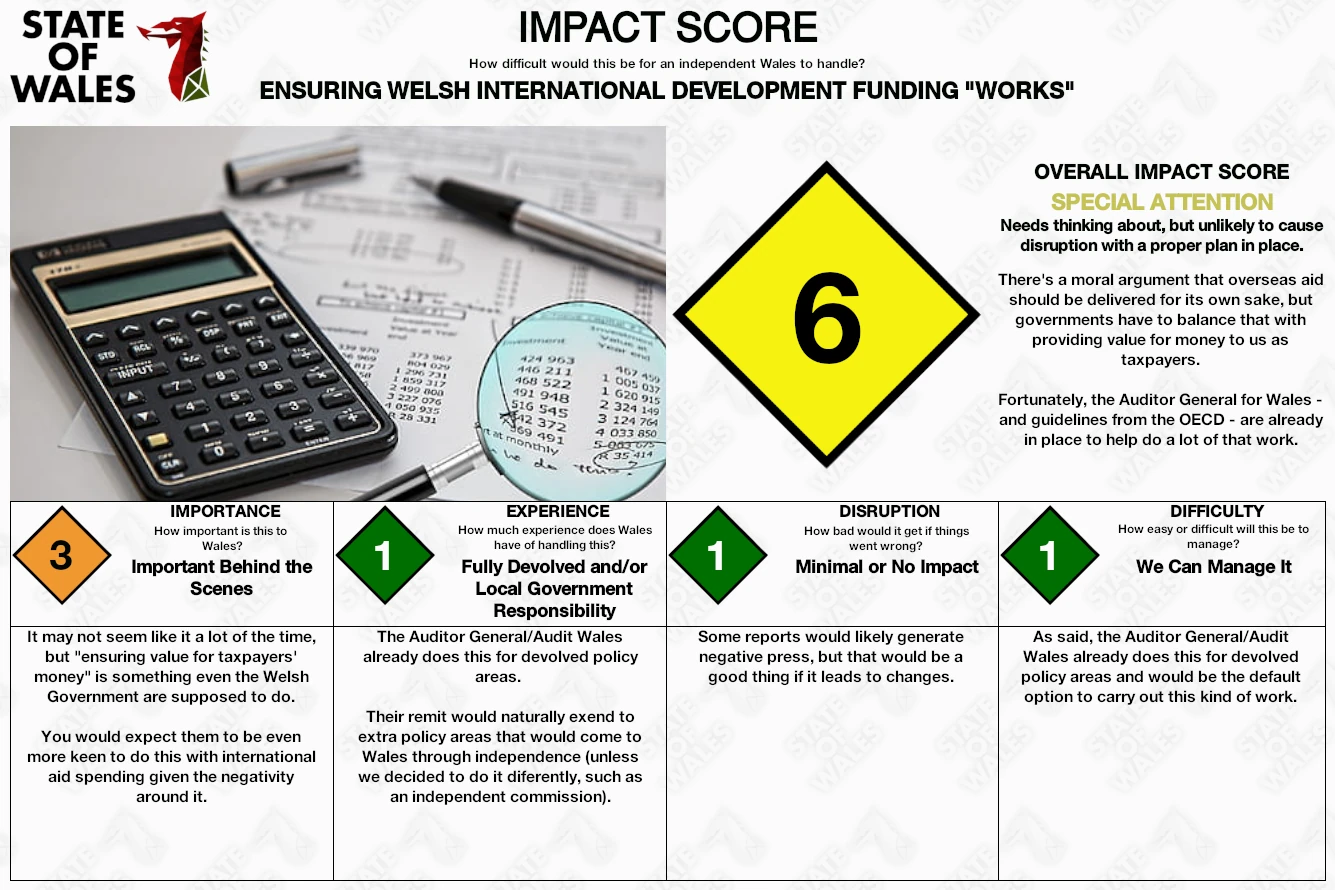
The overall score (out of 20) is the total of the scores for the four mini-categories (out of 5 each).

How Would This Be Run?

Politically, whoever is responsible for foreign policy would likely shape Wales’ overseas aid programme (if we have one). There may be an argument for a junior (non-Cabinet) minister to be responsible for international development.

Their work would be scrutinised by the relevant Senedd committee with responsibility for foreign affairs. The OECD would also – as noted several times – play a pretty big role in monitoring Welsh development programmes.

This was looked at separately. 

How Much Will This Cost?

A proper audit programme would ensure Welsh aid and international development money is spent properly. So it’s more about making the best use of aid spending than being a direct cost.

Should Audit Wales take on the role of auditing Welsh overseas aid/development spending, there would be a proportional increase in their running costs. It’s hard to estimate a figure because it’s hard to tell how much extra audit work would be created.

Would any new taxes need to be introduced?

No, though charities/NGOs working in international development and operating in Wales would be subject to Welsh charity laws and tax rules.

Who would pay for this?

General taxation (all taxpayers).

How Long Would This Take?

An overseas aid policy would likely be developed alongside a more general foreign policy.

The budget for overseas development itself would be set year to year as part of the normal budget process at the Senedd.

Scrutinising international development spending would automatically be included as pat of the Auditor General/Audit Wales’ remit7. 

People & Work

Who does this impact?

The people in the countries and regions that would potentially receive overseas aid from Wales.

Within Wales, it would directly impact those working in the Welsh foreign department (or equivalent), civil society organisations that promote overseas aid and charities with a presence in Wales that work in overseas development and aid delivery (i.e Red Cross, DEC, Oxfam).

Would any jobs be created or lost?

If Audit Wales’ workload increased, you would expect a small number of auditor or trainee/apprentice auditor positions to be created to cover overseas aid. These are often graduate-level roles.

You Might Also Like....

What impact would independence have on current UK and Welsh aid projects?
Foreign Policy

What impact would independence have on current UK and Welsh aid projects?

by Owen Donovan
September 2, 2025
0

...

Read moreDetails
How much could an independent Wales spend on overseas aid?

How much could an independent Wales spend on overseas aid?

September 2, 2025
What kind of foreign aid policy would an independent Wales have?

What kind of foreign aid policy would an independent Wales have?

September 2, 2025
Devolution & Overseas Aid

Devolution & Overseas Aid

September 1, 2025
Would an independent Wales join the Commonwealth?

Would an independent Wales join the Commonwealth?

July 29, 2025
Load More
  1. Government of Ireland, Department of Foreign Affairs. “Audit Committee”.

  2. Government of Iceland, Ministry of Foreign Affairs. “Evaluation Policy 2024-2028”.

  3. Government of Estonia, EstDev. “Strategy for Development Cooperation & Humanitarian Aid 2024-2030”.

  4. Government of New Zealand, Ministry of Foreign Affairs & Trade, “Aid & development: evaluation & research”.

  5. Government of Denmark, Danida. “Evaluation of Development Assistance”.

  6. OECD, Development Cooperation Directorate (11th December 2019). “Evaluation Criteria: Adapted Definitions & Principles of Use”.

  7. Government of Wales Act 2006, Part 5, Section 135.

Use of AI

No AI tools were used to draft this post.

Donations Welcome
Tags: Auditor General & Audit WalesCharities & Third SectorDenmarkEstoniaFP 504Government SpendingGovernment TransparencyIcelandInternational DevelopmentInternational OrganisationsIrelandNew ZealandOECDUnited Nations
Previous Post

What impact would independence have on current UK and Welsh aid projects?

Next Post

What makes the military unique?

Owen Donovan

Owen Donovan

Archive

Categories

Copyright

Creative Commons Licence

State of Wales by Owen Donovan is licensed under a Creative Commons Attribution-NonCommercial-NoDerivatives 4.0 International License.

Subscribe by Email

Search

No Result
View All Result
No Result
View All Result
  • Go To Senedd Home
  • Go To Oggy Bloggy Ogwr
  • About & Contact
    • About State of Wales
    • Comments Policy
    • Complaints Policy
    • Contact & Subscribe by Email
    • Disclaimer
  • Features
    • After the UK
    • Chinny Reckon
    • Devil’s Advocate
    • How Wales Works
    • Road to Brexit
  • The Independence Index
    • The Independence Index (full)
    • Economics & Money
      • Business & Economy
      • Currency
      • Tax & Spending
      • Transport & Infrastructure
    • Society
      • Communities & Housing
      • Culture & Sport
      • Education
      • Health
      • Media & Communications
      • Science & Technology
    • The State
      • Environment & Natural Resources
      • Justice
      • Local Government
  • Elections Centre
  • Wales FAQ
    • How is Wales funded?
    • How are laws in Wales made?
  • Support & Donate