Image Source: BBC
Donations keep this site going. If you like what I’m doing here and think this work is important to the independence movement, consider a donation. One-off or monthly; as little or as much as you want. Click the links below, or full details are available here.
What Happens Now?
According to the 2021 Census, Wales has a high proportion of residents who’ve served in the British military – up to 4.5% of the adult population (around 115,000 people). This is higher than both England (3.8% of the adult population)1 and Scotland (3.9%)2.
Of these, 88,000 served in the regular/full-time armed forces, with a further 27,000 serving either exclusively as reservists or as both.
8.1% of all households in Wales had at least one resident who had served in the armed forces, compared to 7% in England.
The Office of Veterans’ Affairs – part of the UK’s Ministry of Defence – is politically responsible for service leavers.
The UK Government’s latest Veterans’ Strategy was published in November 20253. The specific proposals include:
- Introducing a digital Veteran Card (as proof of veteran status).
- Improvements to the commemoration of women veterans.
- Continue with a veteran-specific employment programme (Op ASCEND) and increase the number of employers recognised as having veteran-friendly employment policies (Employer Recognition Scheme).
- Encourage more veterans to volunteer with cadets. Also, consider what’s described as a “zig-zag career” where veterans can move in and out of regular service.
Although defence isn’t devolved, some measures, particularly in terms of housing and health (physical and mental), are the responsibility of the Welsh Government and local councils.
Does This Work for Wales?
The only people qualified to answer this question are veterans themselves. Their experiences will vary from person to person.
Some issues commonly affecting veterans were looked at in this piece. These include problems concerning recognition of qualifications/transferable skills, mental health support, and accessing suitable housing and jobs once leaving the armed forces.
Contrary to popular belief, both veterans and serving armed forces personnel are currently considered a top priority for social housing in Wales4. Homelessness rates amongst veterans also appear to be low; though the idea of veterans sleeping rough, regardless of how many do, will be a focus of people’s attentions.
In addition to charities working with veterans, there’s a dedicated Veterans’ Commissioner for Wales working under the UK Government’s Office for Veterans’ Affairs.
Nearly all public authorities in Wales have signed the Armed Forces Covenant. This is an agreement/principle that armed forces members and their families shouldn’t be disadvantaged when accessing public services. The Senedd Commission (the body which runs the Senedd) was one of the latest organisations to sign it, having done so in November 20255.
Independence & Veterans’ Services: Pros & Cons
It may be easier and more efficient to provide a joined-up service and policy for veterans in Wales if defence and (currently devolved) support services were provided by the Welsh Government. One area in which this would be particularly useful is qualifications gained through military training, which may improve civilian job prospects for service leavers.
We would be able to decide for ourselves who qualifies as a veteran. For example, we might want to restrict veteran status to people who have been on active deployment (as is the case in Denmark and New Zealand). This may better target support where it’s most needed, as deployment appears to be an important factor in issues like poor mental health.
It would be easier to pass laws strengthening the rights of veterans at the Senedd compared to the UK Parliament (fewer stages, fewer processes, quicker overall) – if that’s something we decide we want to do. Some areas we might want to improve include access to rehabilitation and mental health services (similar to New Zealand).
Adding a Veterans’ Commissioner (or equivalent) to the other public commissioners (Older People’s Commissioner, Children’s Commissioner) should be straightforward – and is something MSs have called for in the past (nothing is stopping them from doing this under devolution). Wales was the first part of the UK to take this approach to oversight in some cases.
In principle, the Royal British Legion and other armed forces charities would face no barriers to continuing to work or fundraise in Wales. This is because Welsh charity law would probably remain the same as in England (at least until the Senedd decides differently).
We could overhaul the pay and pensions package. For example, raising salaries for senior NCOs (corporals, petty officers, sergeants) and junior officers to encourage both the retention of skilled military personnel and ongoing professional training.
The “bounty” for reservists could also be increased to boost personnel numbers and the number of people with military training (without introducing conscription/national service).
There are cost implications to increasing support offered to service leavers (i.e. building more social housing and greater investment in NHS veterans’ services). Similarly, any cuts to services would be strongly opposed.
The pay and pensions for the armed forces are best left alone (to a great extent), as you could make an argument for cutting pay for armed forces personnel (particularly junior ranks) if they’re not expected to be as active as the UK military.
Informal veteran support structures (social groups, societies, friendships) may break down if the Welsh military were cleaved off from the rest of the UK. New social support structures would take their place, but they wouldn’t be the same.
Changing/restricting the definition of a veteran – even if that’s what many countries do – could be controversial and unpopular. People leaving the armed forces who have not been deployed have served their country as much as anyone else.
Similarly, there would be the issue of how to handle Welsh (nationality) service personnel leaving the English armed forces (after independence) and deciding to resettle at home. There would be an expectation of equal treatment to Welsh military service leavers (even if such support would be hard to justify as they would be, by definition, foreign veterans).
What Do Other Countries Do?
![]()
- The Organisation of National Ex-Servicemen is the main charitable organisation advocating on behalf of ex-armed forces personnel (an equivalent of the Royal British Legion)6. There are at least 15 veteran support centres and over 30 local branches. They play an important role in finding housing for homeless veterans.
- There are other charitable and representative organisations covering retired commissioned officers and veterans of UN missions.
- An Office of Veterans’ Affairs within the Irish Ministry of Defence was established in November 2025. A senior civil servant holds responsibility for veterans’ affairs within the Department of Defence.
- Ireland has a “stolen valour” law. It’s a criminal offence for someone to “falsely represent themselves” by wearing a Defence Forces uniform or any part of it (including medals).
![]()
- A person qualifies as a veteran in Denmark if they’ve served in at least one international operation. It’s estimated there are 39,000 veterans living in Denmark (far fewer than in Wales because of the specific definition)7.
- Veterans are issued a card proving their status. The card also provides them with discounts.
- The Danish Ministry of Defence has a Veteran Centre which coordinates local services provided to veterans and their families. The Centre also provides certain mental health services directly if they are linked to deployments.
- There are clear protocols for how personnel should be supported immediately before, during and after deployment.
- It’s illegal to wear a military uniform without authorisation or to give a false impression of having public power (i.e. impersonating a military officer).
![]()
- Finland has mandatory conscription, meaning veteran status is almost exclusively held by older generations who fought in a war on behalf of Finland.
- Finland’s War Veterans’ Association closed during 2024, as the number of people who have actively served in a war involving Finland (the last one being the Second World War) numbered under 2,0008.
- Most of the work supporting veterans has now passed to heritage groups to ensure the legacy of veterans is honoured (Tammenlehvän Perinneliitto).
- It’s a criminal offence to wear a military uniform without permission or without entitlement to wear it. Rules are relaxed around wearing unearned medals (though it’s considered socially unacceptable to do so).
![]()
- New Zealand service personnel qualify for veteran status if they are operationally deployed in a way that puts them at risk of harm (as decided by New Zealand’s Ministry of Defence)9.
- New Zealand’s Parliament passed the Veterans’ Support Act in 2014. This law lays out the legal entitlements veterans have to access certain support, pension and rehabilitation services.
- The New Zealand Government has a minister with responsibility for veterans.
- Veterans’ Affairs New Zealand is an arms-length government agency tasked with applying the Veterans Support Act, including handling support applications.
- It’s a criminal offence for someone to wear an unearned medal (except as a relative of a deceased service member), or a medal awarded to them by a foreign government (unless granted permission to do so).
What Options Does Wales Have?
As a starting point, you would expect the Welsh military to keep pay scales largely as they were immediately before and following independence. It would also be a good idea not to mess around with the Armed Forces Pension Scheme too much.
The only reason to do so would be if something better or easier to administer was brought forward, such as folding armed forces pensions into the Civil Service Pension Scheme. That’s an entire issue in its own right and would be better looked at alongside occupational pensions more generally.
The most important roles in the armed forces are likely to be senior non-commissioned officers (sergeants, flight sergeants, warrant officers, petty officers), as they have longevity and experience that junior commissioned officers don’t. They will be the personnel you want to keep on as mentors to junior officers, and also to improve the quality of training and instruction.
So if salaries in the Welsh military were to be increased, it would be better to focus any pay increases on NCOs ranked at corporal (or equivalent) and above and mid-rank commissioned officers (captains, majors in the case of the army). Pay could probably be cut for senior commissioned officers (because there will be fewer of them, proportionally, in a Welsh military anyway).
If we want to increase the number of reservists, then the obvious choice would be to either increase the day rates reservists are paid, or their annual lump sum “bounty”.
At present, anyone who’s served in the UK armed forces (particularly regular/full-time) meets the definition of “veteran”. This is the simplest way to do it and broadens the definition as widely as possible, but it also means that veterans may be entitled to support that they might not necessarily need compared to others.
The other option is to do something similar to New Zealand and Denmark. This would mean restricting veteran status to Welsh military personnel (including those who’ve served in the British armed forces before independence) who’ve been on deployment that placed them under threat.
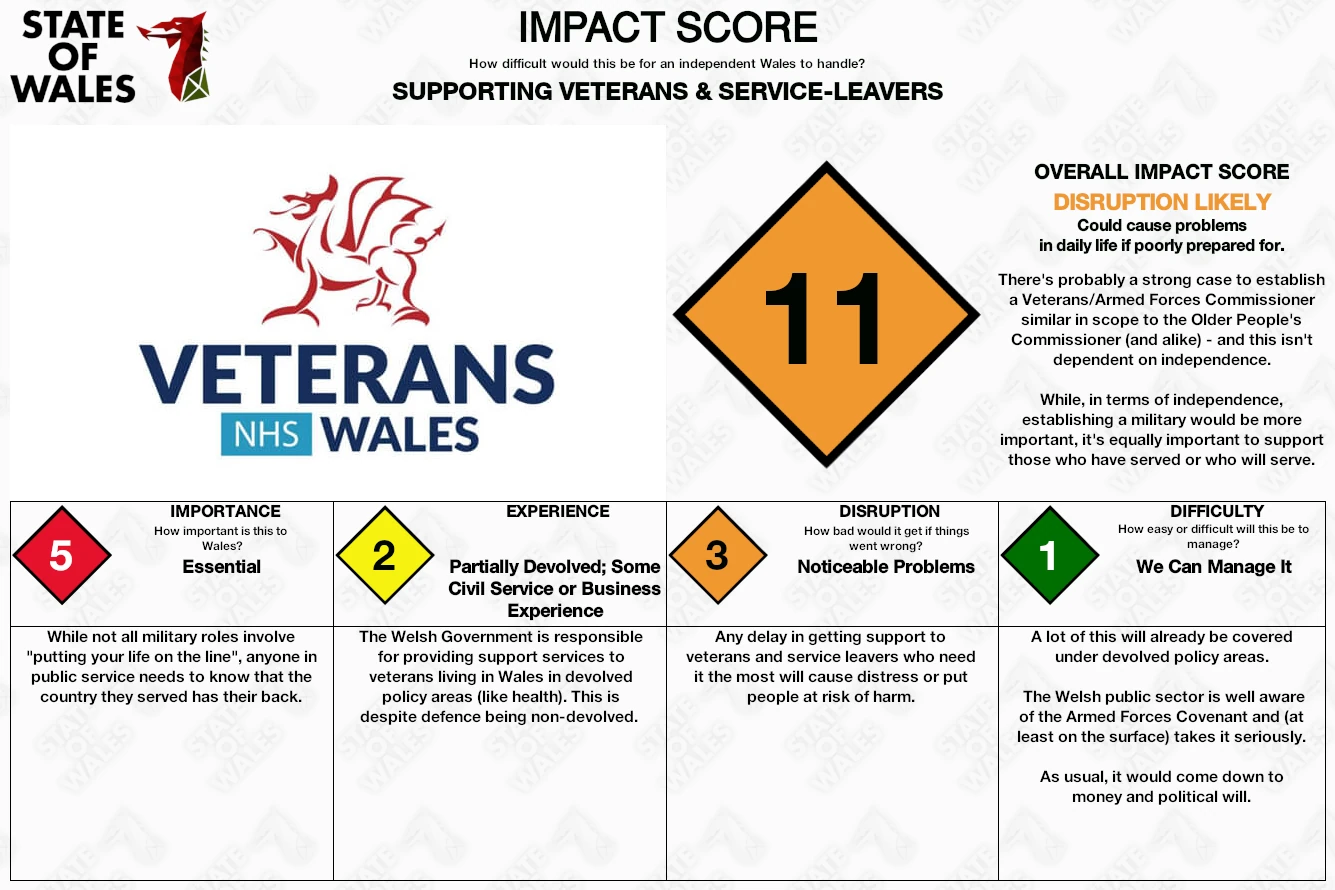
The ex-armed forces community is large enough in Wales to justify a dedicated post similar to those of the Children’s Commissioner or Older People’s Commissioner. Such a post has been suggested in the past by Senedd Members and technically exists as part of the UK Government’s Office of Veterans’ Affairs.
Wales already has a veteran service within the NHS, so after independence, it may be worth considering similar services in housing and employment (two areas of concern to veterans).
This could include establishing a housing scheme catering to service-leavers and their immediate families (perhaps run jointly by existing housing associations) in the same way that some housing developments are aimed at the over-50s. Other options would include a rent guarantee scheme or an enhanced “Help to Buy” scheme.
Other possible options (some of which have either been introduced or piloted) include a guaranteed job interview for service leavers (similar to those used for disabled job applicants), fast-tracking of service leavers into certain public sector roles, conversion courses for military qualifications or being given first refusal for public sector jobs.
It’s difficult to picture Wales needing a separate dedicated military hospital. Despite that, a unit specifically dealing with military injuries and rehabilitation could be established at an existing hospital, funded out of the defence budget.
Considering the proximity to major air bases (for air evacuations), that would either be Llandough Hospital or Ysbyty Gwynedd. As Llandough no longer has an A&E department and offers specialist rehabilitation services, it’s probably the best bet.
Wearing a military uniform without authority to do so is a criminal offence in the UK. The law is more lenient, or non-existent, when it comes to false claims of military service.
There is a high-profile (Welsh) case involving an alleged “fake admiral” who attended a remembrance parade in Llandudno in November 2025.
The US takes “stolen valour” more seriously. In the UK, it’s treated more as attention-seeking behaviour (such people often being called “Walts/Walter Mittys”), unless it’s used as part of a fraud scheme.
What's at Stake?
The overall score (out of 20) is the total of the scores for the four mini-categories (out of 5 each).
How Would This Be Run?
A Welsh equivalent of the Ministry of Defence. This was looked at separately.
How Much Will This Cost?
Headline: Establishing a dedicated veteran support/advocacy services could cost at least £6.3 million per year, based on existing Welsh and international examples.
The costs related to military personnel were looked at separately and would depend on the size and structure of a Welsh armed forces.
On average, NATO member states spend up to 40% of their military budgets on personnel (including pay & pensions).
If we wanted to establish a post of Veterans’ Commissioner, then based on an equivalent post (Welsh Language Commissioner), the running costs would be anything up to £3.5 million per year10.
Establishing a stand-alone dedicated government agency for veterans – similar to Veterans’ Affairs New Zealand – may cost at least £6.3 million at current prices (based on New Zealand’s spending11). The exact cost would depend on the number of people the agency would expect to support, as well as the number of support applications they receive.
Would any new taxes need to be introduced?
No, though any charities supporting veterans in Wales would need to comply with Welsh charity law.
Who will pay for this?
General taxation (all taxpayers), plus charitable donations (where applicable).
How Long Would This Take?
Establishing a Veterans’ Commissioner or agency for veterans may require a new law/Veterans Act (or equivalent).
Alongside that, you could include any necessary changes to the law around: the rights of veterans, “stolen valour”, the procedure for discharge from the armed forces, armed forces compensation, bereavement and injury-in-service benefits and pensions.
Better still, there could be a single “Armed Forces Act”. This could cover the law as it relates to to veterans, as well as the general legal principles a military needs: military law, the laws of war, recruitment, military code of conduct etc.
Either way, it would probably take between 9 months and a year to get a law through the Senedd.
In terms of timing, it would probably be best to introduce a Bill around the same time that the medium to long-term structure of a Welsh armed forces is being finalised (within the first 5 years of independence).
People & Work
The estimated 115,000 or so ex-service personnel living in Wales (as things stand). Though these numbers will fall naturally due to demographic changes, as well as falls in military recruitment.
Veteran status would likely cover any Welsh resident who served in the British armed forces before independence and has been honourably discharged (including ex-Gurkhas) and anyone who serves in the Welsh armed forces after independence.
This would mean that anyone from Wales who joins the English military after independence would not qualify for veteran status or support in Wales unless there were special circumstances involved (in the same way that foreign military veterans don’t qualify for support from the government of the country they move to).
A good veteran support service may increase employment rates amongst former service personnel – though generally speaking, ex-service personnel are more likely to be employed anyway.
It’s those who end up “falling through the cracks” or are unable to properly transition from military to civilian life who need extra support.
A standalone office/ombudsman of Veterans’ Commissioner would create some jobs – maybe up to 40 based on the number of people employed by an equivalent office (Welsh Language Commissioner).
A dedicated veterans agency – that has a direct role in processing applications for support from ex-service personnel – would probably create more jobs than a Commissioner. Veterans Affairs New Zealand employs around 90 people12.
You Might Also Like....
Welsh Government. “UK Armed Forces veterans in Wales, Census 2021.”
Scottish Government (13th June 2024). “Scotland’s Census 2022 – UK Armed Forces veterans”
UK Government, Ministry of Defence, Office of Veterans’ Affairs (10th November 2025). “Policy Paper: Veterans Strategy“
Shelter Cymru. “What is priority need?: Armed forces personnel“
Senedd Commission (11th November 2025). “Senedd Commission signs Armed Forces Covenant“
Organisation of National Ex-Service Personnel, “Our Services”
Government of Denmark, Ministry of Defence. “Veterans in Denmark“
Yle News (4th June 2024). “War veteran’s association to cease operations”
Veterans’ Affairs New Zealand. “Eligibility: Qualifying Service“
Welsh Language Commissioner. “Annual Report 2023-24” (p109-110).
New Zealand Defence Forces. “Annual Report 2025, Departmental Annual Appropriations” (p5). Currency converted from NZ dollars to pounds.
Veterans Affairs New Zealand (24th November 2023). “Briefing to the Incoming Minister for Veterans” (p4)
No AI tools were used to draft this post.