Senedd Home
Oggy Bloggy Ogwr
State of Wales
Sunday, August 16, 2026
  • About & Contact
    • About State of Wales
    • Comments Policy
    • Complaints Policy
    • Contact
    • Disclaimer
  • Elections Centre
  • The Independence Index
    • The Independence Index (Full)
    • Foreign Policy
      • Relations with the former UK & Ireland
      • Relations with Europe
      • Foreign Policy (General)
      • International Organisations & Law
      • Overseas Aid
    • Defence
      • Defence Policy
      • NATO
      • Armed Forces
      • National Security
      • Civil Defence
    • Rules & Regulations
      • Safety & Standards
      • Intellectual Property
    • Economics & Money
      • Business & Economy
      • Currency
      • Tax & Spending
      • Transport & Infrastructure
    • Society
      • Communities & Housing
      • Culture & Sport
      • Education
      • Health
      • Media & Communications
      • Science & Technology
    • The State
      • Environment & Natural Resources
      • Justice
      • Local Government
  • Support & Donate
No Result
View All Result
  • About & Contact
    • About State of Wales
    • Comments Policy
    • Complaints Policy
    • Contact
    • Disclaimer
  • Elections Centre
  • The Independence Index
    • The Independence Index (Full)
    • Foreign Policy
      • Relations with the former UK & Ireland
      • Relations with Europe
      • Foreign Policy (General)
      • International Organisations & Law
      • Overseas Aid
    • Defence
      • Defence Policy
      • NATO
      • Armed Forces
      • National Security
      • Civil Defence
    • Rules & Regulations
      • Safety & Standards
      • Intellectual Property
    • Economics & Money
      • Business & Economy
      • Currency
      • Tax & Spending
      • Transport & Infrastructure
    • Society
      • Communities & Housing
      • Culture & Sport
      • Education
      • Health
      • Media & Communications
      • Science & Technology
    • The State
      • Environment & Natural Resources
      • Justice
      • Local Government
  • Support & Donate
No Result
View All Result
State of Wales
No Result
View All Result
Home Defence

How would an independent Wales join NATO (if we wanted to)?

Europe's main military alliance.

Owen Donovan by Owen Donovan
October 27, 2025
in Defence, NATO
How would an independent Wales join NATO (if we wanted to)?

NATO

Share on FacebookShare on TwitterShare on RedditShare on BlueskyShare by email

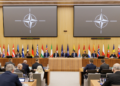
Image Source: NATO

This site is best viewed in landscape mode on smartphones.
Support IndyWales? Support State of Wales!

Donations keep this site going. If you like what I’m doing here and think this work is important to the independence movement, consider a donation. One-off or monthly; as little or as much as you want. Click the links below, or full details are available here.

What Happens Now?

The UK is a founding member of the NATO military alliance, having been one of the original signatories of the North Atlantic Treaty (1949).

The latest Strategic Defence Review1 positions the UK as a leading NATO member. The UK Government takes (what they describe as) a “NATO-first” approach, accepting that the UK is unable to fight another major power by itself.

The UK has long acted as a “bridge” between Europe and the United States, with the UK and US cooperating closely on nuclear weapons under a mutual defence treaty dating back to the 1950s2.

As of 2025, the UK has the second-highest defence budget in the alliance after the United States. The UK is also one of only three NATO member countries to have consistently met the alliance’s commitment to spend at least 2% of GDP on defence every year since at least 20143 – the others being Greece and the US.

While defence policy is non-devolved, NATO member states (mainly the US Air Force) routinely use the British military estate in Wales for training – perhaps the most commonly-used one being the “Mach Loop” Tactical Training Area in southern Gwynedd, which is used for low-level flight training.

Exercise Joint Warrior – a major annual training exercise involving a large number of NATO members – has made use of the Castlemartin live-fire range in Pembrokeshire.

Does This Work for Wales?

The current situation is that Wales is a member of NATO through the UK, and the UK is a major player – there’s no point denying it.

Whether that serves Welsh interests or our defence requirements is another matter, as would the wider question of whether Wales would join NATO. There’s no such thing as “must” in that regard.

We would have to weigh up the pros and cons ourselves – but it should be our decision to make.

More specifically, Wales doesn’t have any say in who uses military training facilities here, which in the past has included the Saudi Air Force.

There’s a long-standing issue of low-level training flights by fast jets leading to the loss of livestock, with a compensation scheme run by the UK Ministry of Defence.

NATO Membership: Pros & Cons

Pros of Independence
Cons of Independence
Pros of Independence

NATO is the most important military alliance in Europe. Almost every country in Europe is either a full member of NATO or has a high-level partnership with the alliance (Partnership for Peace).

Through NATO membership, Wales would benefit from the alliance’s collective defence policies. This means if Wales is attacked directly or feels threatened, we would (in principle) be able to call on the support of other NATO members. This provides strength in numbers and would mean Wales would be protected by NATO’s “nuclear umbrella”.

NATO has acted as a counterweight to Russia since its founding. 15-20 years ago, it would’ve seemed as though NATO had outlived its purpose, but Russia is once again a major destabilising force in Europe and is likely to be so for the foreseeable future.

NATO sets high standards and minimum expectations for member states, with full membership forcing Wales to take defence and national security seriously.

A Welsh military would take part in NATO training exercises (or could host them, as we would have control over the military estate). This would help complement their basic and technical training, help address any weaknesses, test new reforms and improve how the Welsh military works with other NATO forces.

NATO has a clear military and political command structure. This can help deal with emerging threats such as cyberwarfare, as well as more long-standing ones like terrorism.

There’s a diplomatic element to NATO through summits (which Wales hosted, to great fanfare, in 2014) and the North Atlantic Council.

Under NATO rules, member states can band together to buy new equipment.

Cons of Independence

NATO has long been, and remains, overly reliant on the United States. The position of Supreme Allied Commander has always been held by a senior American military officer. The US also makes up around 60% of all NATO military spending3. Given the Americans’ turn towards isolationism (again), it’s unclear how reliable they’ll be in the long term and what that means for NATO more generally. The EU might not be ready to take its place.

NATO membership would rule out Wales being a neutral country (if that’s what we wanted to do) and would mean accepting the principle of nuclear deterrence.

NATO membership would be a move towards more militarism in Wales, which has been criticised in the past by peace campaigners and those campaigning on specific issues such as military recruitment in schools. NATO membership may be “overkill” compared to Wales’ realistic defence needs.

In addition to meeting NATO defence spending commitments, Wales would have to contribute towards NATO’s running costs.

There are examples of countries having close defence partnerships with NATO without being full members. This includes neutral countries taking part in the Partnership for Peace programme, or other countries having Individually Tailored Partnership Programmes.

There would be a lot of diplomatic work needed during the process of joining (explained in more detail later). NATO members with secessionist movements (i.e. Spain, Turkey) may block or delay Welsh membership.

In recent years – particularly in light of Russian provocations and the Ukraine War – NATO has not been very proactive in pushing back. It seems a very high bar has been set for “collective defence” to be triggered, with NATO often resorting to “strongly worded letters” and disagreeing internally on the way forward – which plays into Russia’s hands.

What Do Other Countries Do?

Ireland
Iceland
Finland
Switzerland
Denmark
Ireland

  • Ireland is recognised as a neutral country and isn’t a member of NATO.
  • Ireland takes part in NATO’s Partnership for Peace programme, and has taken part in NATO-led peacekeeping missions in the past (notably in Kosovo).
  • In 2024, Ireland agreed an Individually Tailored Partnership Programme with NATO to improve the security of undersea infrastructure4.
  • There’s an agreement between the Irish and UK Governments that the RAF can take action in Irish airspace to deal with an immediate threat due to Ireland’s lack of fast-jet capability. The US has also (controversially) made use of Irish airports in the past for defence and national security reasons.
Iceland

  • Iceland is a founding member of NATO, despite not having a conventional military.
  • Defence was effectively outsourced to the United States during the Cold War, though the Icelandic Coast Guard acts as a maritime law enforcement agency.
  • Keflavik Air Base is one of the most strategically important bases in the entire alliance and is routinely used by NATO members.
  • A major annual NATO training exercise (Exercise Northern Viking) is held annually.
Finland

Finland applied to join NATO in May 2022 and officially joined in April 2023, abandoning its previous position of armed neutrality. Before this, Finland took part in the Partnership for Peace.

Switzerland

  • Switzerland is officially a neutral country and isn’t a member of NATO.
  • Switzerland is a member of the Partnership for Peace and, like Ireland, has taken part in NATO-led peacekeeping missions.
  • There are enhanced bilateral agreements between Switzerland and NATO on technology and science5, while Switzerland has also made its training facilities available under the Partnership for Peace.
Denmark

  • Denmark is a founding member of NATO.
  • Greenland – an autonomous country within Denmark – is strategically important and houses a US Space Force base (Pituffik) as part of a bilateral agreement with the United States.
  • The Faroe Islands are strategically important concerning access to the North Sea and the Atlantic, while Denmark itself is important concerning access to/from the Baltic Sea.
  • Denmark has taken part in most major NATO operations of the 21st Century, including Afghanistan, Iraq and Libya.
What Options Does Wales Have?

Don't join NATO
Join the Partnership for Peace
Agree a Tailored Partnership Programme (ITPP)
Apply for full NATO membership
Don't join NATO

Wales leaves NATO by default the moment we become independent.

If we wanted to keep it that way, we could then adopt neutrality or be an officially pacifist state (up to and including writing it into our constitution). It’s one less thing to concern ourselves with, but it would have consequences; at the very least, Wales would probably be accused of not taking defence seriously, and we may be taken advantage of because of that.

Join the Partnership for Peace

The Partnership for Peace is a co-operation agreement between NATO and non-NATO members in Europe. It’s not a military alliance. It’s more of a discussion forum which allows NATO and non-NATO members to work more closely together on defence issues.

It would be odd for an independent Wales not to join it at the very least. Also, joining it wouldn’t have an impact on whether Wales becomes a neutral or pacifist country (or whatever alternative model for defence you can think of).

Agree a Tailored Partnership Programme (ITPP)

This could be considered a first step towards NATO membership. It basically means that NATO and a partner country (in our case, Wales) cooperate on specific defence matters and agree on a plan of action to improve weaknesses.

Regardless of whether Wales joins NATO as a full member, this may be a good idea as we build up our own defence capabilities.

Apply for full NATO membership

Self-explanatory. NATO has what is described as an “open door” policy on membership6.

Even if Wales opted not to have a conventional military, we may still be able to join NATO based on Iceland’s example. Though it’s likely NATO would expect Wales to have a military capability before joining due to our size.

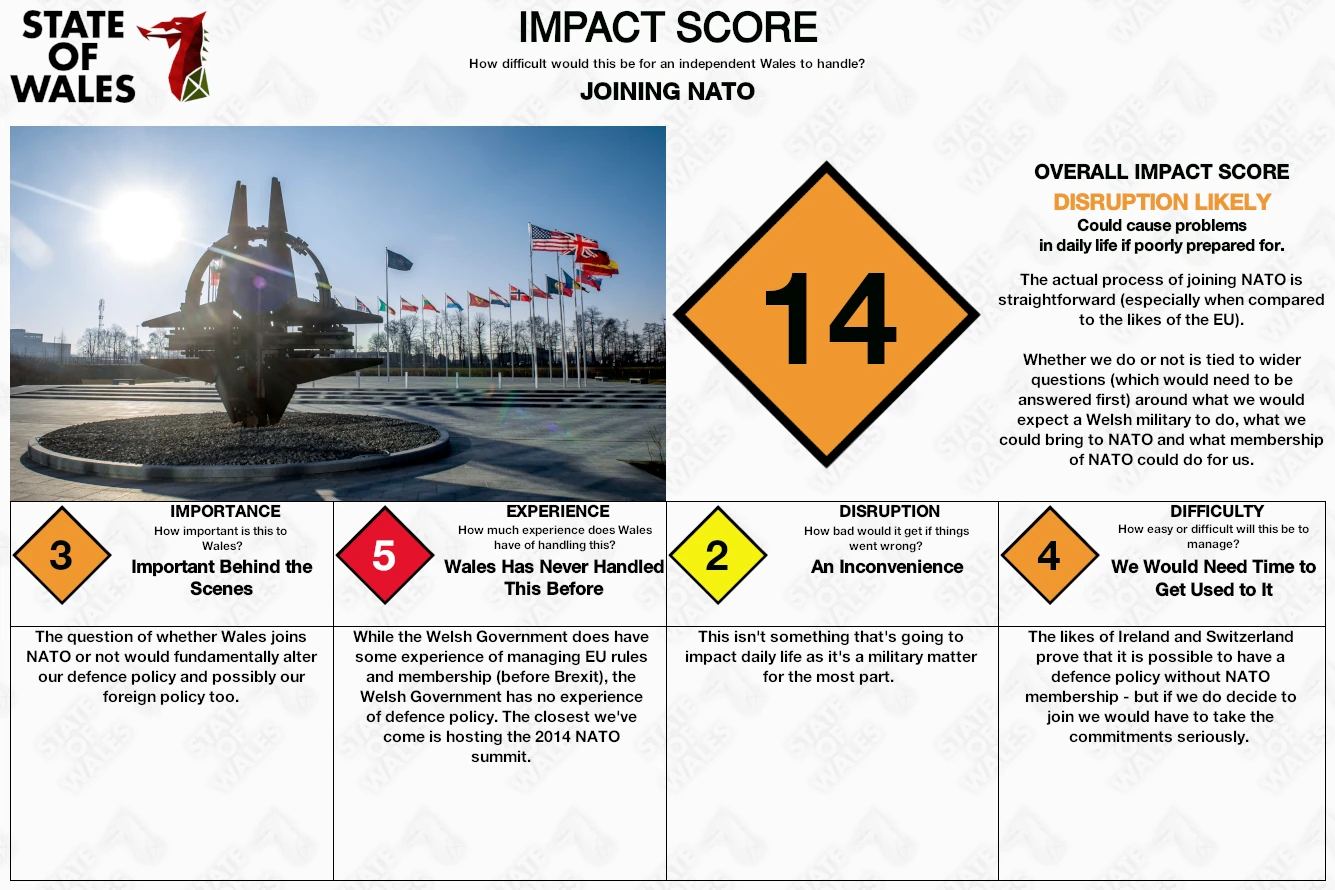
What's at Stake?

The overall score (out of 20) is the total of the scores for the four mini-categories (out of 5 each).

How Would This Be Run?

North Atlantic Council (NAC)
Military Committee (MC)
Allied Command
North Atlantic Council (NAC)

Day-to-day management of the alliance is the responsibility of NATO’s Secretary-General, who is appointed by member states for a four-year term.

NATO’s political decision-making body is the North Atlantic Council (NAC)7, made up of one representative from each member state. Decisions are made by consensus; there are no votes.

As a full NATO member, Wales would send a delegation/permanent representative to represent our interests at NATO.

Military Committee (MC)

NATO’s Military Committee consists of senior military officers from member states. They discuss military matters. When NATO forces are in active operation, they advise the North Atlantic Council on the military situation.

Allied Command

The strategic integrated NATO military command in Europe. This is where senior military officers make decisions and plans for operations.

As noted earlier, the Supreme Allied Commander in Europe has always been an American officer, with their deputies coming from either the British (post-independence, English) or German militaries. France doesn’t take part.

Each member state sends a senior military officer to act as its military representative.

How Much Will This Cost?

Headline: NATO membership would cost Wales around £11 million per year (at current prices, not counting commitments to defence spending).

NATO member states contribute to the alliance’s direct running costs through a cost-share agreement, where each member contributes a certain percentage of the running costs based on the size of their economies8.

If Wales were a NATO member today, and our contribution matched countries with a similar GDP per head to Wales (Slovenia is one of the closest), it would be around 0.23% (of a €5.6 billion budget). In 2026, this works out to €12.3 million (£10.6 million).

NATO also sets defence spending targets for member states. Before 2025, this was 2% of GDP, which in Wales’ case works out to around £1.86 billion. By 2035, NATO expects member states to spend the equivalent of 3.5% of GDP on defence, and a further 1.5% on national security.

NATO also sets a guideline that 20% of national defence budgets should be spent on equipment and research.

Would any new taxes need to be introduced?

No.

Who will pay for this? 

General taxation (all taxpayers).

How Long Would This Take?

NATO outlines the full process for joining6. 

Membership requirements
Assession talks
Treaty changes & formal invite
Membership requirements

There are no formal membership requirements. However, before being invited to join NATO, countries need to prove that they are stable democracies and show a willingness to contribute to NATO’s military operations. They also need to have no ongoing disputes or be at war.

Assession talks

Meetings take place between NATO and the prospective member to iron out any defence, security or legal issues or requirements. Wales would then send a letter of intent to NATO’s Secretary-General. This letter would include timescales for any reforms that are agreed are needed (Membership Action Plan).

Treaty changes & formal invite

The North Atlantic Treaty is altered to include the prospective member, then accepted and ratified by each NATO member state. Once this process is completed, the Secretary-General offers a formal invitation for the country to join NATO.

For the two most recent NATO members – Finland and Sweden – it took around a year for Finland to join and just under two years for Sweden. The process was delayed due to opposition from Turkey over both countries’ support for Kurds and from Hungary due to criticism of their government from within the EU.

In Wales’ case, Turkey may seek to delay for the same reason as some members of the Senedd have expressed support for Kurdish political leaders in the past. The Senedd has also formally recognised the Armenian Genocide.

People & Work

Who does this impact?

Indirectly, everyone because it’s a defence matter.

Directly, NATO membership would influence the structure of a Welsh military and defence procurement. So it would be a key part of the jobs of senior military officers and civil servants working in defence.

It would also play a part in Welsh foreign policy. The requirement for each NATO member to approve Wales joining the alliance would force a lot of diplomatic work to make sure it goes smoothly.

Would any jobs be created or lost?

A Welsh permanent delegation to NATO could likely create between 20-40 posts. This would be made up of the NATO ambassador and their staff, representatives from the Welsh equivalent of the Foreign Office and MoD and senior military officers.

This is based on examples of similarly sized countries such as Lithuania and Croatia9.

You Might Also Like....

Would an independent Wales share security intelligence with other countries?
Defence

Would an independent Wales share security intelligence with other countries?

by Owen Donovan
January 19, 2026
0

...

Read moreDetails
How would an independent Wales buy new military equipment?

How would an independent Wales buy new military equipment?

November 26, 2025
What could the command structure of a Welsh military look like?

What could the command structure of a Welsh military look like?

November 26, 2025
What are the options for an independent Wales’ military?

What are the options for an independent Wales’ military?

November 26, 2025
Could NATO membership commit Wales to taking part in military operations we don’t agree with?

Could NATO membership commit Wales to taking part in military operations we don’t agree with?

October 26, 2025
NATO

NATO

October 26, 2025
How and when would a Welsh armed forces be deployed?

How and when would a Welsh armed forces be deployed?

September 29, 2025
Would people from Wales serving in the British military have to join a Welsh armed forces?

Would people from Wales serving in the British military have to join a Welsh armed forces?

September 29, 2025
What military threats does Wales need defending from?

What military threats does Wales need defending from?

September 29, 2025
What makes the military unique?

What makes the military unique?

September 29, 2025
Load More
    1. UK Government, Ministry of Defence (2nd June 2025). “Strategic Defence Review 2025″.

    2. UK-US Mutual Defence Agreement (1958).

    3. NATO. “Defence Expenditure of NATO Countries (2014-2025)” Tables 2 & 3.

    4. The Journal (9th February 2024). “Ireland in new agreement with Nato to counter potential threats to undersea infrastructure“.

    5. NATO (2nd May 2025). “Relations with Switzerland“.

    6. NATO (3rd October 2024). “Enlargement & Article 10“.

    7. NATO (21st October 2024). “North Atlantic Council (NAC)“.

    8. NATO (3rd September 2025). “Funding NATO“.

    9. NATO (22nd April 2024). “National delegations to NATO“.

Use of AI

No AI tools were used to draft this post.

Donations Welcome
Tags: Airspace & Aviation SecurityDenmarkDF 201DiplomacyFinlandGlobal SecurityIcelandInternational OrganisationsIrelandMaritime PolicyMilitaryNational SecurityNATORussiaSwitzerlandUSAWMDs
Previous Post

Could NATO membership commit Wales to taking part in military operations we don’t agree with?

Next Post

Would an independent Wales need to host nuclear weapons as a NATO member?

Owen Donovan

Owen Donovan

Archive

Categories

Copyright

Creative Commons Licence

State of Wales by Owen Donovan is licensed under a Creative Commons Attribution-NonCommercial-NoDerivatives 4.0 International License.

Subscribe by Email

Search

No Result
View All Result
No Result
View All Result
  • Go To Senedd Home
  • Go To Oggy Bloggy Ogwr
  • About & Contact
    • About State of Wales
    • Comments Policy
    • Complaints Policy
    • Contact & Subscribe by Email
    • Disclaimer
  • Features
    • After the UK
    • Chinny Reckon
    • Devil’s Advocate
    • How Wales Works
    • Road to Brexit
  • The Independence Index
    • The Independence Index (full)
    • Economics & Money
      • Business & Economy
      • Currency
      • Tax & Spending
      • Transport & Infrastructure
    • Society
      • Communities & Housing
      • Culture & Sport
      • Education
      • Health
      • Media & Communications
      • Science & Technology
    • The State
      • Environment & Natural Resources
      • Justice
      • Local Government
  • Elections Centre
  • Wales FAQ
    • How is Wales funded?
    • How are laws in Wales made?
  • Support & Donate