Image Source: Dafydd Phillips via Youtube
Donations keep this site going. If you like what I’m doing here and think this work is important to the independence movement, consider a donation. One-off or monthly; as little or as much as you want. Click the links below, or full details are available here.
What Happens Now?
Military bases in the UK are routinely used for NATO training or as operational headquarters.
These include the likes of Blandford Camp, RNAS Yeovilton and Northwood Headquarters (which is the British military’s main operational command HQ and doubles up as the HQ for NATO’s maritime operations).
The only NATO member that maintains permanent bases in the UK is the United States. These are either shared with the RAF or are almost exclusively used by the Americans (such as RAF Lakenheath in Suffolk, England).
The US previously had a permanent presence at RAF Brawdy (now Cawdor Barracks) in Pembrokeshire.
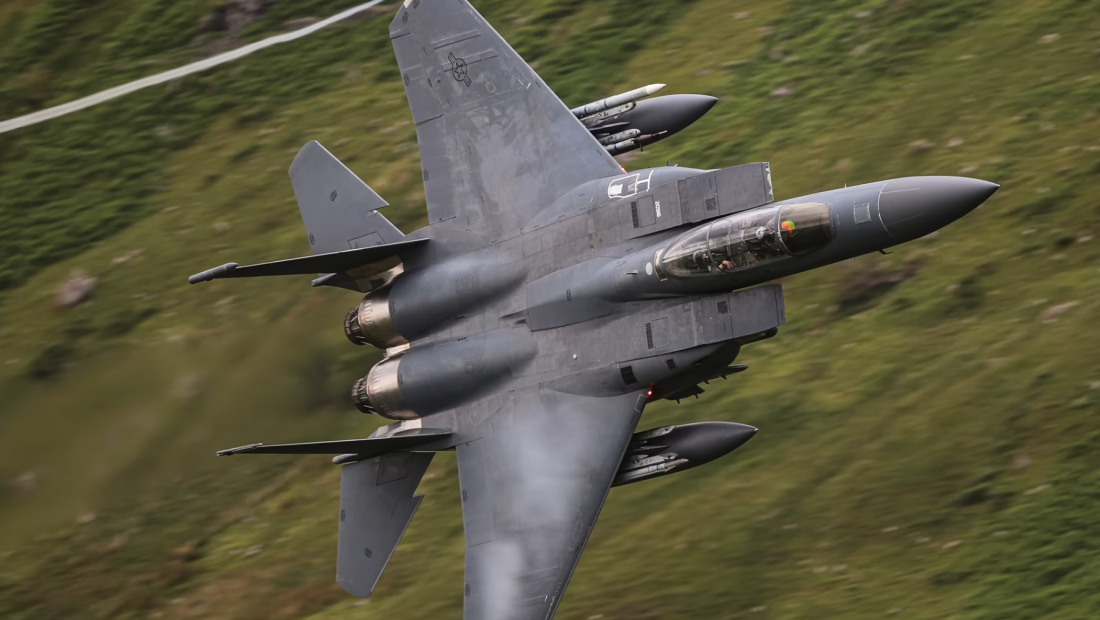
The US Air Force regularly uses the low-level jet training area (” Mach Loop”). Other NATO forces have used training facilities in Wales in the past. This includes the Castlemartin Training Area, used by the German Army until the 1990s.
Does This Work for Wales?
As defence isn’t devolved, Wales doesn’t have any control over the defence estate. So, technically, the current arrangement doesn’t work for our interests at all.
Independence & NATO in Wales: Pros & Cons
The general pros of NATO membership apply here.
We would have a say over who can or cannot use the military estate. Presently, these decisions are made on our behalf in London or by the military.
Wales could potentially put a Welsh base forward as a centre of excellence or a NATO command headquarters. For example, if Wales becomes independent at any point beyond 2028, the proposed DARC radar facility at Cawdor Barracks in Pembrokeshire (to track objects in space) would potentially come under our jurisdiction.
 Any cons of NATO membership apply here.
Even if we have control over the military estate, as a NATO member, there would probably be an expectation that we would let NATO allies use them for training at the very least.
The possible increased use of the military estate – if an independent Wales joined NATO – means more noise and movements, affecting nearby residents.
What Do Other Countries Do?
NATO forces are currently stationed in eastern member states bordering Russia, Belarus and Ukraine (“Operation Eastern Sentry” and “Operation Baltic Sentry”).
NATO forces are often stationed temporarily in a host country when conducting exercises.
What Options Does Wales Have?
England and the US may want, at the very least, a rolling right of access to certain parts of the Welsh military estate (those which can’t be easily replicated elsewhere) if not a permanent base. This might include the proposed DARC radar station, fast jet training at RAF Valley, or the use of the Infantry Training Schools in southern Powys.
That can be negotiated separately and wouldn’t be entirely dependent on Welsh NATO membership. Wales could also rule out hosting nuclear weapons on Welsh territory.
As noted, as a NATO member, there would be an expectation that Wales makes its military facilities available at the very least for training exercises.
What's at Stake?
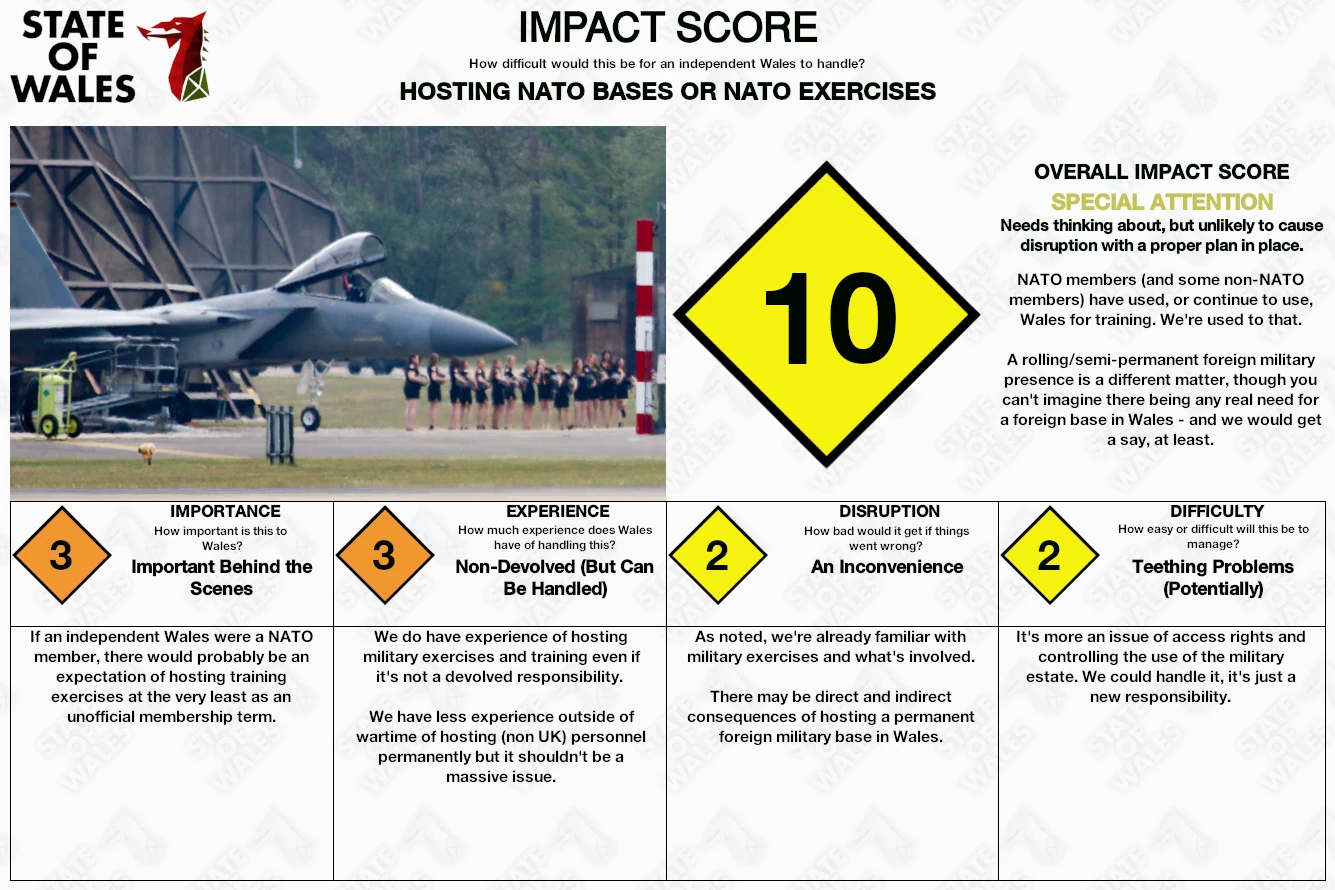
The overall score (out of 20) is the total of the scores for the four mini-categories (out of 5 each).
How Would This Be Run?
A Welsh equivalent of the Ministry of Defence would be responsible for the defence estate in Wales.Â
How Much Will This Cost?
Headline:Â Maintenance of military bases in Wales would come out of a Welsh defence budget.
We may be able to raise some additional funding if bases were leased out to another NATO member state.
In 2022, contracts to manage facilities for US bases in the UK – via the MoD’s Defence Infrastructure Organisation – were worth £171 million1.
Would any new taxes need to be introduced?
No.
Who will pay for this?
General taxation (all taxpayers). Though we may be able to charge facilities or service fees in some cases, generating income.
How Long Would This Take?
The process of joining NATO was looked at separately.
Any individual agreements would take however long they take (no set timescale); some may be easier to negotiate and finalise than others.Â
People & Work
Anyone potentially living close to a military facility assigned to, used by, or stationing NATO forces.
Day-to-day, those most directly impacted would be senior military officers.
Some jobs could potentially be created.
For the sake of giving an example, if an existing mothballed or long-closed military base were reopened and redeveloped for use by a NATO ally, then some support and service roles could be created for local civilians (much as some civilians work at RAF Lakenheath, which is a US base in all but name).
You Might Also Like....
- UK Government, Ministry of Defence, Defence Infrastructure Organisation (1st December 2022). “Facilities management contracts worth £117m to support US Visiting Forces come into action“.
No AI tools were used to draft this post.