Image Source: via Youtube
Donations keep this site going. If you like what I’m doing here and think this work is important to the independence movement, consider a donation. One-off or monthly; as little or as much as you want. Click the links below, or full details are available here.
What Happens Now?
The UK has its own nuclear weapons capability. While the UK can decide to use it, the missiles themselves (Trident II) can only be maintained by the US Navy.
The UK’s nuclear submarine fleet is currently maintained at Faslane in Scotland.
While there’s nothing in the North Atlantic Treaty that specifically mentions nuclear weapons, NATO considers its nuclear capabilities to be a core part of its defence – particularly the United States’ strategic nuclear weapons, which are considered to be “the supreme guarantee of the security of the Alliance”1.
NATO membership, therefore, means accepting the principle of nuclear weapons being used on behalf of all members if the alliance is attacked in kind.
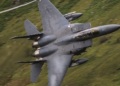
A core element of this is the principle that NATO member states can host US nuclear weapons or have aircraft that can deploy them. This policy is known as nuclear sharing.
The other NATO nuclear-armed states, France and the UK, don’t have a similar policy, though France is reportedly considering it2, and both reportedly agreed to closer cooperation around their respective nuclear arsenals3.
Nuclear stationing is when the host country has no involvement in (and may not even be told about) the deployment of nuclear weapons.
Does This Work for Wales?
Strategically, as the UK is a NATO member, its nuclear policies apply to Wales by default. We have to accept the principle of nuclear deterrence and nuclear sharing because the UK Government decides for us whether we want it or not.
As far as I’m aware, no nuclear weapons have ever been stationed in Wales. The closest we’ve come to any involvement is the former ordnance factory in Llanishen, Cardiff, which made components for UK nuclear warheads and closed in 1997.
NATO's Nuclear Policy & Independence: Pros & Cons
Nuclear sharing and stationing are voluntary and are based on one-to-one agreements with the United States. Wales would have to want to take part or make a request. You can only picture that happening in a dire emergency (i.e. the days before an imminent nuclear war in Europe).
It could be considered hypocritical to want to join an alliance which has nuclear deterrence at the heart of its defence policy without accepting the principle of (at some point) hosting nuclear weapons. The SNP already has a political problem with this. Taking part in nuclear sharing may prove to sceptics that Wales is serious about defence and NATO.
Taking part in nuclear sharing may boost military co-operation between Wales and NATO’s three nuclear-armed states (US, France and [presumably] England).
As a NATO member, Wales would have to accept the principle of nuclear deterrence and NATO’s nuclear doctrine. Those with pacifist sympathies will strongly oppose this, and it could become an ongoing debate in post-independence Welsh politics (much as it already is in Scotland).
There could be a scenario where political and diplomatic pressure is put on Wales to accept hosting nuclear weapons or nuclear-capable aircraft.
If Wales were to host nuclear-capable aircraft (like the F-16 or F-35), it may lock us into expensive procurement and maintenance contracts.
Taking part in nuclear sharing would increase the risk of nuclear accidents, while bases where weapons are (known to be) stored may be a target for spying and sabotage.
The details of agreements like these are almost always kept secret, even if their existence is known.
What Do Other Countries Do?
NATO members that have nuclear sharing arrangements with the US include Germany, Italy, Belgium, the Netherlands and Turkey.
The US also maintains nuclear-capable aircraft at RAF Lakenheath and historically stationed nuclear-capable cruise missiles at the former RAF Greenham Common in Berkshire.
What Options Does Wales Have?
We either take part (in nuclear sharing) or we don’t.
As noted, it’s hard to picture a scenario in which Wales (as a potential NATO member) would want to take part in nuclear sharing.
There’s a broader moral argument about nuclear weapons and nuclear deterrence, which, at heart, cycles back to the debate on whether an independent Wales should join NATO or not.
What's at Stake?
The overall score (out of 20) is the total of the scores for the four mini-categories (out of 5 each).
How Would This Be Run?
If we don’t take part, this bit is irrelevant – though by being a NATO member, Wales would have to accept the principle of nuclear weapons potentially being used on our behalf.
Nuclear sharing agreements are usually negotiated between the host country and the United States. France and England may do something similar in the future.
How Much Will This Cost?
Headline: No direct costs, though existing nuclear sharing agreements may have costs that are kept confidential.
There may be indirect costs associated with nuclear sharing. These might include additional training and security.
Would any new taxes need to be introduced?
No.
Who will pay for this?
No direct cost implications, but any costs would come out of the defence budget, funded by all taxpayers.
How Long Would This Take?
If we wanted to take part in nuclear sharing, however long it takes to negotiate an agreement (the details of which would likely remain secret).
People & Work
The people living closest to where nuclear weapons are stored (because of possible heightened security and more vehicle movements etc.) and the people working there.
Probably not. There may be a small number of technical roles created if, for whatever reason, Wales had a nuclear sharing agreement.
You Might Also Like....
NATO (29th June 2022). “NATO 2022 Strategic Concept” (p8)
J. Ataman, J Yeung, CNN (6th March 2025). “France to consider protecting European allies with its nuclear arsenal, Macron says.”
NPR (12th July 2025). “Why France and the UK have a new nuclear sharing agreement“
No AI tools were used to draft this post.