
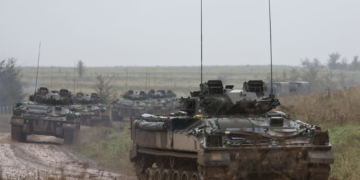
Image Source: Herman Van Rompuy via Flickr under Creative Commons Licence BY-NC-ND 2.0
Donations keep this site going. If you like what I’m doing here and think this work is important to the independence movement, consider a donation. One-off or monthly; as little or as much as you want. Click the links below, or full details are available here.
What Happens Now?
Article 5 of the North Atlantic Treaty states that “an armed attack against one or more” NATO member states, in either Europe or North America, “should be considered an attack against them all”.
Resultingly, if Article 5 is triggered, then NATO members are obligated to “take such action as it deems necessary, including the use of armed force, to restore and maintain the security of the North Atlantic area”.
This action doesn’t end until the UN Security Council has “taken the measures necessary to restore and maintain international peace and security”.
This doesn’t strictly mean that if Article 5 is triggered, all NATO members go to war. “Such action as it deems necessary” can have different meanings. This could include taking action short of war, such as imposing no-fly zones, increasing intelligence gathering or offering logistical or technical support to a single NATO member to take defensive action by themselves.
Article 4 of the Treaty states that any NATO member can request consultations when it believes their territory or security is threatened.
Does This Work for Wales?
As the UK is a NATO member, this already applies to Wales by default.
Any decisions relating to Article 5, if triggered, would be taken by the UK Government on our behalf.
While Welsh MPs would likely have a say, it’s only a small number of voices in the UK Parliament. Regardless of what the Senedd and MSs might think, what they do say on foreign policy and defence matters carries no weight whatsoever.
What would independence mean (Wales as a NATO member)?
Articles 4 & 5 are cornerstones of the NATO alliance. The main pro is that, as a NATO member, an independent Wales would be “protected” under the treaty and would have a say at any discussions at the NATO level (instead of the UK speaking on our behalf).
That also means being obligated to come to the aid of fellow alliance members if Article 5 is triggered – but we would be able to decide for ourselves (to a certain extent) what form that aid takes.
The alliance is useless without “collective defence” carrying meaning. It’s therefore highly likely that Russia may try to test this at some point in the future.
What Do Other Countries Do?
Article 5 has only ever been triggered once – at the request of the United States following the 11th September terrorist attacks in 2001. To support US operations against Afghanistan, 13 NATO members supplied aircraft1, though the Afghan War itself was independent of NATO.
Article 4 (defence and security consultations) has been activated nine times2. The most recent activation of Article 4 – at the time of posting – was in response to Russian drone and aircraft incursions into Estonia and Poland during September 2025.
What Options Does Wales Have?
If Wales joins NATO, then Article 4 and Article 5 would apply to us.
If an independent Wales remains outside of NATO, NATO member states wouldn’t be obligated to come to our aid if we were attacked or threatened. This could be overcome through mutual defence and security agreements negotiated between Wales and a single partner country.
What's at Stake?
The overall score (out of 20) is the total of the scores for the four mini-categories (out of 5 each).
How Would This Be Run?
The details of how NATO is run were looked at in more detail separately.
Based on what happened following the 9/11 attacks, the North Atlantic Council (NATO’s main political decision-making body) would decide to trigger Article 51.
If Wales were a NATO member, we would take part in these discussions in our own right. NATO’s decisions are made by consensus – a position agreed unanimously by all alliance countries – rather than by votes.
How Much Will This Cost?
Headline: No direct costs. Though if Wales were a NATO member, triggering Article 5 could lead to budget changes here.
This could, for example, lead to increased operational costs for the military or increased spending on national security.
It may also lead to sudden changes to how and where the Welsh military is deployed.
Would any new taxes need to be introduced?
No.
Who will pay for this?
General taxation (all taxpayers).
How Long Would This Take?
The only time Article 5 has been triggered (to date) happened within 24 hours of the 9/11 attacks1. You would expect a similar timeframe.
As a NATO member, any Welsh military personnel or assets assigned to NATO’s Allied Reaction Force at the time – and have gone through the necessary training exercises – may be deployed within two to three days of Article 5 being triggered3.
People & Work
If Wales is a NATO member, anyone serving in the armed forces at the time “Article 5” is triggered would be most keenly affected.
Article 5 being triggered would likely involve an international crisis. This would increase the workload for civil servants, diplomats and senior politicians – as it would for governments across Europe, both NATO and non-NATO alike.
Depending on the circumstances in which “Article 5” is triggered, it’s safe to say there would be bigger things to worry about than jobs.
You Might Also Like....
NATO (4th July 2023). “Collective defence & Article 5”
NATO (23rd September 2025). “The consultation process and Article 4“.
NATO (3rd April 2025). “Readiness Action Plan“
No AI tools were used to draft this post.