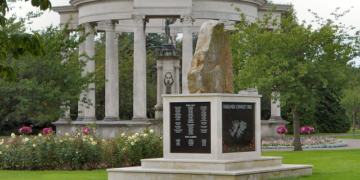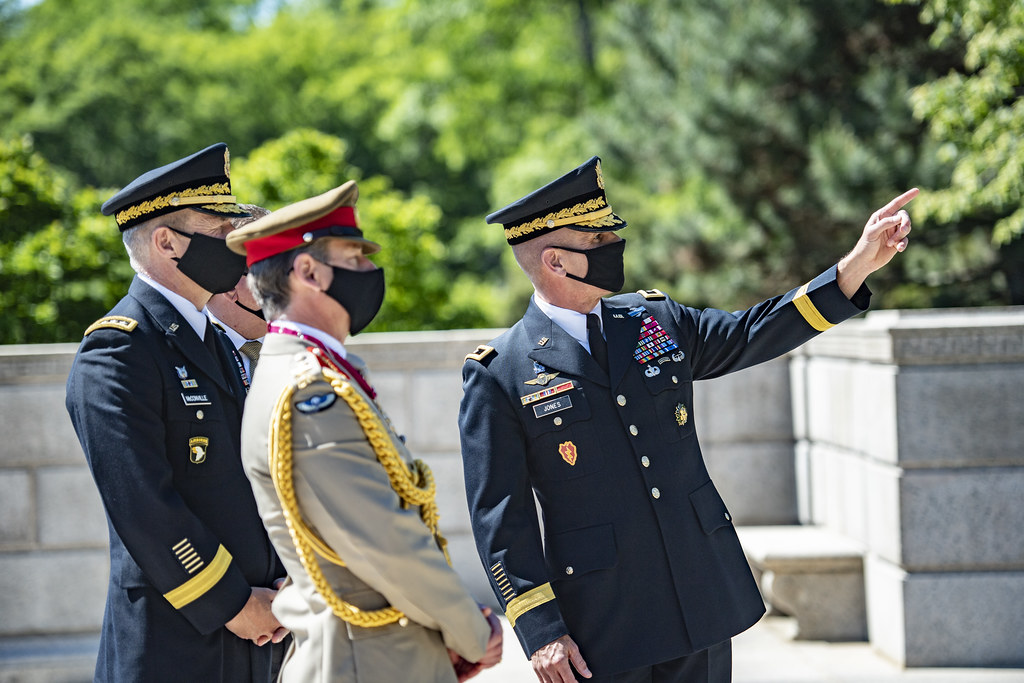
Image Source: Arlington National Cemetery via Flickr, Public Domain
Donations keep this site going. If you like what I’m doing here and think this work is important to the independence movement, consider a donation. One-off or monthly; as little or as much as you want. Click the links below, or full details are available here.
What Happens Now?
Defence is non-devolved. Political responsibility for defence lies with the UK Ministry of Defence.
In terms of the military command structure, the most important body is the Defence Council. This is responsible for the command and administration of the UK’s armed forces1.
The Defence Council is made up of the relevant UK Government ministers and their senior civil servants, as well as the Chief of Defence Staff (the most senior military officer in the UK) and the most senior military officer in each branch of the UK Armed Forces: First Sea Lord (Royal Navy), Chief of Air Staff (RAF), Chief of General Staff (Army). A senior officer covering special operations and cyberwarfare is also included and can come from any of the three branches.
There’s also a Chief of Staff Committee made up exclusively of the senior military officers. This focuses on operational matters. Each of the three main branches has a management/administration committee: the Army Board, the Air Force Board, and the Admiralty Board.
Similar to other UK institutions, military authority comes from the Crown and is run by the UK Government by royal prerogative (the UK Government uses the monarch’s powers on the monarch’s behalf).
The reigning monarch is Head of the Armed Forces (the equivalent of “Commander-in-Chief” in other countries). They are also the Head of the Armed Forces in some Commonwealth Realms (Commonwealth countries which retain the UK monarch as head of state).
While the monarch retains a lot of personal control over the UK’s armed forces constitutionally, in practice, those powers would only be used with the consent of ministers.
More junior members of the UK royal family are often given the ceremonial title of Colonel-in-Chief of certain regiments and corps.
Does This Work for Wales?
While Wales has a “regional” army command (operationally focused on reserves and cadets) – the 160th (Welsh) Brigade – there’s currently no Wales-specific representation on the Defence Council.
The Welsh Government has no involvement in defence matters as it’s non-devolved, though the Welsh Government are the lead authority for some types of civil emergency (which may involve working with the military/Ministry of Defence).
In the unlikely event that Wales and a different part of the UK (for argument’s sake, east coast of England) were attacked at the same time, we can’t guarantee that Wales can rely on the UK military having enough resources (or a plan) in place locally to protect Wales to the same level as more strategically important parts of England and Scotland.
The administration of the military is another example of the convoluted way the UK constitution works, with lots of gentlemen’s agreements and conventions maintained for the sake of “tradition”.
What would independence mean?
The western half of Great Britain and the territorial waters and airspace would likely be far better defended than they are now, when the strategic defence priorities are likely to be focused on the seas north of Scotland and the eastern half of England.
We would need to develop our own defence doctrine based on our own strengths and weaknesses, which may currently be a complete afterthought within the UK.
It would be (in principle) far easier for Welsh military officers to be promoted than it would be for them to be promoted within the UK military. In the longer term, this may result in increased numbers of Welsh people with military leadership and strategic thinking skills. This would filter through into civilian life, possibly improving public service delivery.
The Welsh Government would decide when and where to deploy Welsh military personnel, ultimately making Wales responsible for the lives and safety of the Welsh military. This will probably make it less likely that Welsh military personnel would be deployed to a questionable conflict (i.e. a repeat of the Iraq War).
Wales would have control over immovable military assets in Wales, including training grounds, training operations and military bases.
If we were ambitious, Wales could gradually build a “21st century military capability” from the ground up, with heavy emphasis on cyberwarfare, automation and using “big data” to predict or identify major domestic security or defence vulnerabilities and deal with them early.
Creating a new military – even a small one – would create or replicate (potentially) thousands of jobs in Wales, which are currently based (mainly) in England.
If Wales becomes a republic, a Welsh head of state would likely become the (ceremonial) “Commander-in-Chief”. Likewise, retaining the monarchy (as head of state and “Head of the Welsh Armed Forces”) would retain a “family” link with England (at least) in the same way as other Commonwealth realms.
Even if we managed to hire experienced military officers as advisors, we would be building a military from scratch. The most experienced military officers currently serving (physically) in Wales are likely to be senior officers in the Army Reserve.
There’s a strong possibility that many Welsh residents serving in (what would become) the English armed forces wouldn’t want to transfer to a Welsh military. There may be experience and skills gaps that we would find much harder to fill from a smaller population and recruitment pool.
At the moment, there are only two military commands covering Great Britain & Ireland; that would potentially increase to 4 (or 5), making things a bit more confusing.
“Ease of promotion” is a two-edged sword. While it may be easier to get promoted, as it would be like “being a big fish in a small pond”, it could quite easily mean being promoted too quickly just to fill gaps.
It’s likely that the development of a full Welsh military – capable of deployment overseas, if necessary – may take the best part of a decade. There would need to be an “interim/bare bones” Welsh military to cover the gap.
Additionally, we would have no national security/intelligence capability from the start (other than the police); this would have to be built up from scratch.
If Wales retains the monarchy, the “Head of the Welsh Armed Forces” would be a head of state based in a foreign country (even if it’s next door).
What Do Other Countries Do?
![]()
- The Supreme Commander of the Irish Defence Forces is the President of Ireland. This is a largely ceremonial role, with political control lying with the Irish Government.
- Ireland’s military command is led by the Chief of Staff’s department. The Chief of Staff can come from any branch of the armed forces, but has usually been appointed from the Irish Army.
- There are several committees coordinating work between the Irish Defence Forces and the Irish Government, including the Defence Forces Board (the equivalent of the UK’s Defence Council), National Security Council and Office of Emergency Planning.
![]()
- The reigning monarch of Denmark acts as (ceremonial) Commander-in-Chief of the Danish Armed Forces (Forsvaret).
- Military and operational command is led by a Chief of Defence (the country’s most senior military officer) and a joint Defence Command.
- The Defence Command is made up of the Chief of Defence and the commanders of the various branches of the armed forces. In addition to the three main branches (army, navy, air force), there are positions related to Denmark’s Arctic Command (Faroe Islands and Greenland) and Special Operations/Special Forces.
![]()
- The President of Finland acts as Commander-in-Chief and has the constitutional power to authorise the mobilisation of the armed forces and to also set general military policies.
- Day-to-day operations are led by the joint Defence Command, headed by a Chief of Defence – though this is answerable to Finland’s Ministry of Defence.
- The Defence Command has 10 divisions covering operations, administration, personnel, training, intelligence and logistics (amongst others).
![]()
- As a Commonwealth Realm, the Commander-in-Chief of the New Zealand Defence Forces is the Governor-General, while the (ceremonial) Head of the Armed Forces is the reigning monarch of New Zealand. These are largely ceremonial roles, with political control lying with the New Zealand Government.
- The main branches of the New Zealand Defence Forces share a single operational headquarters. There’s a Chief of Defence Force (“Chief of Staff”) who oversees the Chief of Operations and the commanding officer of each of the main branches of the armed forces (army, navy, air force).
What Options Does Wales Have?
If Wales becomes a republic, then the Commander-in-Chief of the Welsh armed forces would be the elected president. Whether they would have a hands-on role in the military would depend on what type of president they would be: ceremonial, semi-presidential (similar to France) or executive (as in the USA).
If Wales retains the monarchy, then the (ceremonial) Head of the Welsh Armed Forces would likely be the reigning monarch at any given time. Another option – assuming the title still exists – would be for the Prince(ss) of Wales to take on the role.
This was partially covered separately (How and when would a Welsh armed forces be deployed?). Day-to-day operations, training exercises, routine orders and special operations would be administered by the military themselves in consultation with the Welsh equivalent of the Defence Minister.
The Welsh Government would likely have the exclusive authority to deploy the Welsh military at home (i.e. to support civil authorities or as an act of self-defence).
In circumstances where the Welsh military may be deployed abroad in a situation that would potentially result in the Welsh military sustaining casualties, the Senedd could be asked to authorise it.
Working With Government
It seems to be common practice in most countries to have a committee that acts as a bridge between the government and the military. This would be made up of the relevant ministers, senior civil servants and the most senior military officers (Defence Command). This would take the lead on administrative matters and defence policy. The UK equivalent is the Defence Council.
They would likely meet at least two to three times a year, or more regularly if needed.
The functions of the defence council are combined with a Cabinet-level committee focusing on national security issues (intelligence, border controls, counter-terrorism, organised crime, cybersecurity). This means that the police and any Welsh equivalent of the security services would also be involved.
They would likely meet more regularly than a stand-alone Defence Council – either monthly or every two months.
Operational/Military Command
Wales would have a single Chief of Staff/Chief of Defence selected from one of the main branches. They would act as the most senior military officer. They would oversee operations. If Wales were a NATO member, the Chief of Staff would likely be Wales’s senior military representative to NATO.
The senior/commanding officer of each of the branches would be involved as deputies, as would the commanding officers responsible for training, logistics, personnel and legal matters (an equivalent of the Judge Advocate General’s Office). It’s also common practice for special operations/special forces to be managed directly at this level.
The other option would be for each branch of the Welsh military to be operationally separate, with the Defence Committee overseeing joint working where needed. This kind of arrangement usually only works when the country has a very large military, and it was how the UK ran things until the 1960s.
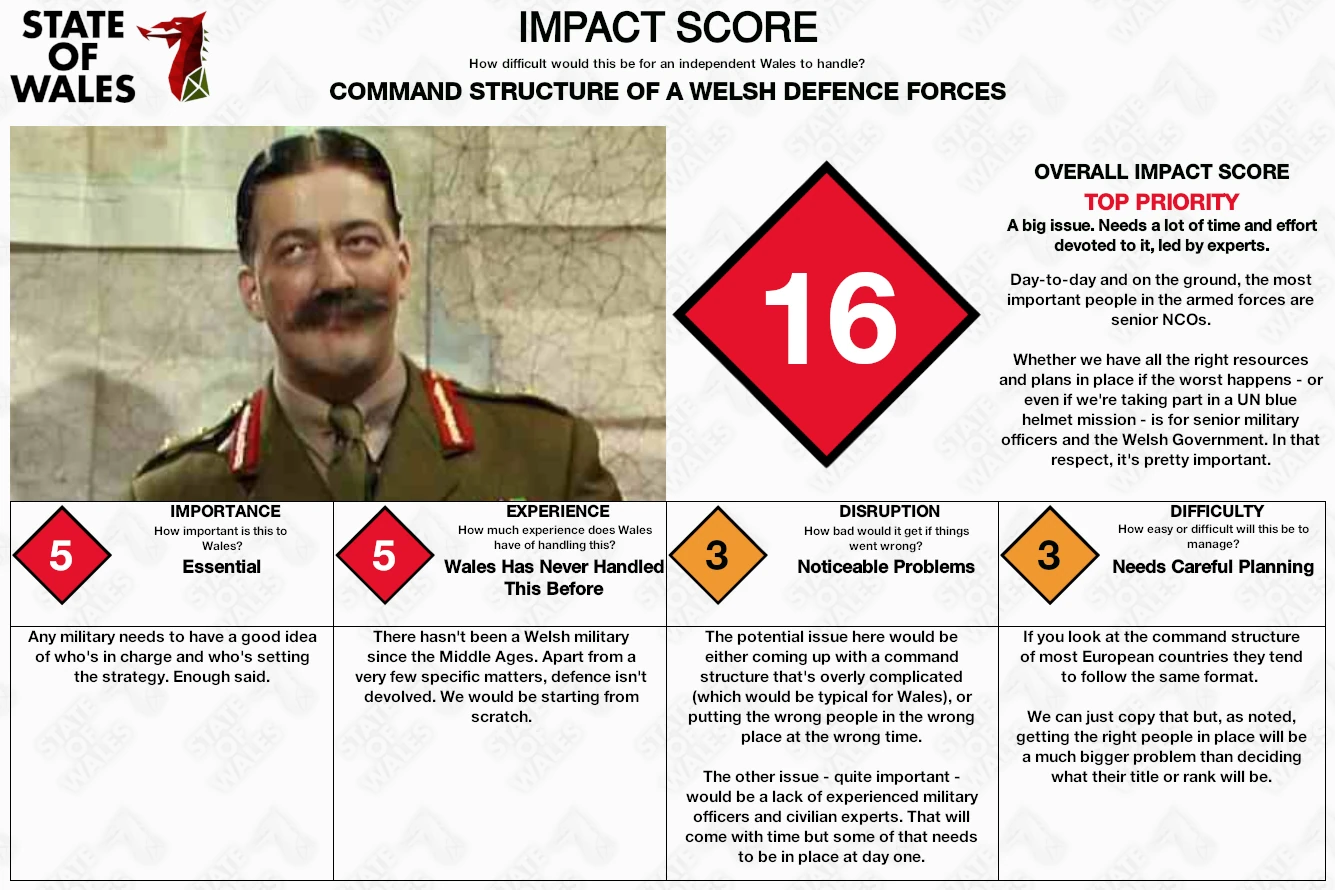
What's at Stake?
The overall score (out of 20) is the total of the scores for the four mini-categories (out of 5 each).
How Would This Be Run?
Not applicable as this entire piece is about “how things would be run”.
How Much Will This Cost?
Funding would likely be top-sliced from the defence budget (a mix of spending on personnel and operations), but it’s unlikely to cost very much in itself.
The military officers involved would be the highest-ranked amongst the Welsh armed forces and would almost certainly be earning six-figure salaries. If there were 5 or 6 of them involved, that’s maybe up to £1-2 million in personnel costs alone, taking their salaries and the salaries of supporting civilian staff into account.
Would any new taxes need to be introduced?
No.
Who will pay for this?
General taxation (all taxpayers).
How Long Would This Take?
Establishing a command structure would probably be one of the first tasks undertaken as the Welsh military is gradually assembled.
People & Work
The most senior military officers, politicians and civil servants involved in defence policy.
A few posts would be created – some of them (in the case of the military) likely to be the highest-paid public sector roles in Wales. In the grand scheme of things, it would be very few (40-50), and most of the people involved will likely be civilian staff supporting senior military officers.
You Might Also Like....
UK Government, Ministry of Defence. “Our governance“.
No AI tools were used to draft this post.