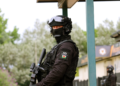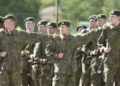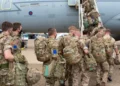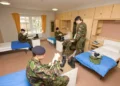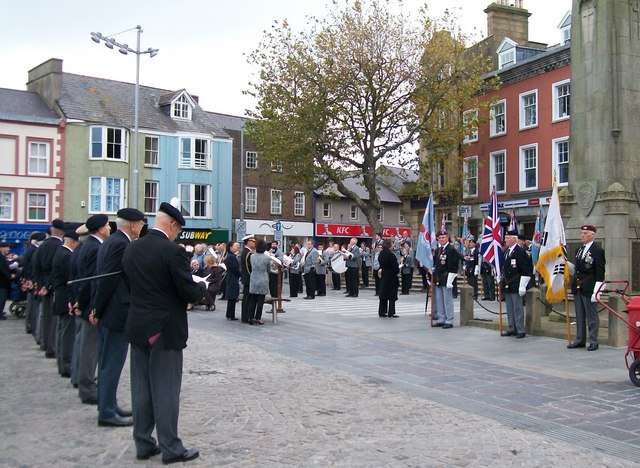
Image Source: © Copyright Eric Jones and licensed for reuse under Creative Commons Licence BY-SA 2.0
Donations keep this site going. If you like what I’m doing here and think this work is important to the independence movement, consider a donation. One-off or monthly; as little or as much as you want. Click the links below, or full details are available here.
How many veterans are there in Wales?
According to the 2021 Census, Wales has a relatively high number of residents who’ve served in the British military – up to 4.5% of the adult population (around 115,000 people). This is higher than both England (3.8% of the adult population)1 and Scotland (3.9%)2.
Of these, 88,000 served in the regular/full-time armed forces, with a further 27,000 serving either exclusively as reservists or as both.
8.1% of all households in Wales had at least one resident who had served in the armed forces, compared to 7% in England.
The veteran community is fairly evenly spread across Wales, averaging around 4-5% of the population in each county. Though the proportion of resident veterans is marginally higher along the north Wales coast, and in Powys, Monmouthshire and Pembrokeshire. It’s also noticeably lower in Cardiff and Newport.
What problems do veterans face in the UK?
In the military, a lot of the basics – housing, utilities, social activities – are provided for you. If you’ve been in the military since leaving school or university and not known any other way of life, moving to civilian life – where you’re on your own, for the most part – can be difficult to adjust to.
Many UK veterans may find that promises made to them when they were recruited – especially what would happen when they leave the armed forces – don’t live up to expectations3.
Also, while there are plenty of military-gained skills that are transferable to civilian life, some are very specific. For example, someone trained exclusively for frontline combat roles may find it more difficult to find a civilian job than someone with technical or leadership skills.
According to Veterans’ NHS Wales4 and Office for National Statistics5:
- Between 600 and 800 veterans are referred to the Veterans NHS Wales service each year. More than half had experienced some sort of trauma caused by deployment to a war zone or on a peacekeeping mission.
- 48% of veterans referred to Veterans’ NHS Wales had experienced childhood trauma of some kind.
- While (as of 2022) the vast majority of veterans lived in owner-occupied housing, 2.3% lived long-term with family or friends, while 0.3% were homeless or sleeping rough.
- More veterans say they are disabled (48.5%) than non-disabled (47.6%). Though this contradicts the 2021 Census, which put the figure at 32.1% of veterans. The ONS figures will have been skewed by a larger number of older people responding.
What are the Welsh & local government roles in supporting veterans?
Defence isn’t devolved. Ultimately, the UK Government and Ministry of Defence (specifically, the Office of Veterans’ Affairs) are responsible for veterans’ welfare.
There is a dedicated Veterans’ Commissioner for Wales under the UK Government’s Office for Veterans’ Affairs.
A lot of campaigning on behalf of veterans, and delivery of support services, is provided by charities such as the Royal British Legion, Help for Heroes, SSAFA and (one of the few Wales-based military charities) Change Step.
As is often the case with certain non-devolved policy areas (such as the prison system), the Welsh Government and local councils often have to provide allied and supporting services to something that’s controlled by the UK Government. These may not come with the necessary policy-making powers or law-making powers, and might not always be funded by the UK Government either.
A lot of this is guided by the Armed Forces Covenant. This is a binding commitment by public authorities to ensure that veterans “face no disadvantage compared to other citizens” in accessing services.
In 2021, it was made a legal requirement for public authorities to properly consider the Covenant when making decisions; in Wales’ case, in devolved policy areas such as health and housing6.
You Might Also Like....
Welsh Government. “UK Armed Forces veterans in Wales, Census 2021.“
Scottish Government (13th June 2024). “Scotland’s Census 2022 – UK Armed Forces veterans”
Nicola Bryan, BBC Wales (21st February 2021) “Census 2021: Veterans ‘need more help for civilian life’“
Veterans NHS Wales (2024). “Annual Report April 2022 – March 2023“
Office of National Statistics (15th December 2023). “Veterans’ Survey 2022, demographic overview and coverage analysis, UK: December 2023“
Armed Forces Act 2021, Section 8
No AI tools were used to draft this post.