Senedd Home
Oggy Bloggy Ogwr
State of Wales
Monday, August 17, 2026
  • About & Contact
    • About State of Wales
    • Comments Policy
    • Complaints Policy
    • Contact
    • Disclaimer
  • Elections Centre
  • The Independence Index
    • The Independence Index (Full)
    • Foreign Policy
      • Relations with the former UK & Ireland
      • Relations with Europe
      • Foreign Policy (General)
      • International Organisations & Law
      • Overseas Aid
    • Defence
      • Defence Policy
      • NATO
      • Armed Forces
      • National Security
      • Civil Defence
    • Rules & Regulations
      • Safety & Standards
      • Intellectual Property
    • Economics & Money
      • Business & Economy
      • Currency
      • Tax & Spending
      • Transport & Infrastructure
    • Society
      • Communities & Housing
      • Culture & Sport
      • Education
      • Health
      • Media & Communications
      • Science & Technology
    • The State
      • Environment & Natural Resources
      • Justice
      • Local Government
  • Support & Donate
No Result
View All Result
  • About & Contact
    • About State of Wales
    • Comments Policy
    • Complaints Policy
    • Contact
    • Disclaimer
  • Elections Centre
  • The Independence Index
    • The Independence Index (Full)
    • Foreign Policy
      • Relations with the former UK & Ireland
      • Relations with Europe
      • Foreign Policy (General)
      • International Organisations & Law
      • Overseas Aid
    • Defence
      • Defence Policy
      • NATO
      • Armed Forces
      • National Security
      • Civil Defence
    • Rules & Regulations
      • Safety & Standards
      • Intellectual Property
    • Economics & Money
      • Business & Economy
      • Currency
      • Tax & Spending
      • Transport & Infrastructure
    • Society
      • Communities & Housing
      • Culture & Sport
      • Education
      • Health
      • Media & Communications
      • Science & Technology
    • The State
      • Environment & Natural Resources
      • Justice
      • Local Government
  • Support & Donate
No Result
View All Result
State of Wales
No Result
View All Result
Home Defence Armed Forces

What would independence mean for war memorials and Remembrance events?

Owen Donovan by Owen Donovan
November 26, 2025
in Armed Forces, Defence
What would independence mean for war memorials and Remembrance events?

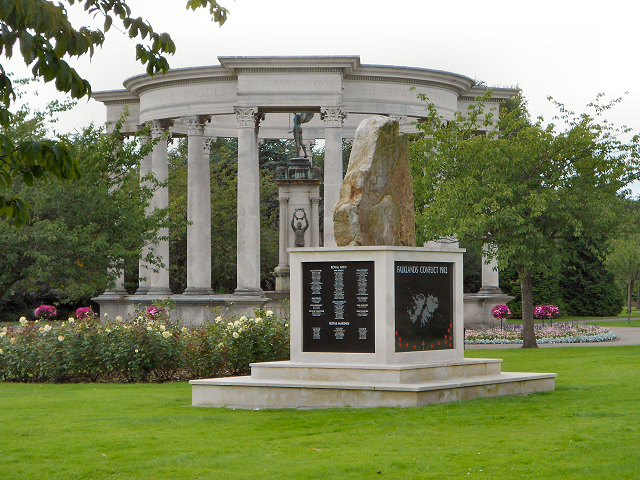
© Copyright David Dixon and licensed for reuse under Creative Commons Licence BY-SA-2.0

Share on FacebookShare on TwitterShare on RedditShare on BlueskyShare by email

Image Source: © Copyright David Dixon and licensed for reuse under Creative Commons Licence BY-SA-2.0

This site is best viewed in landscape mode on smartphones.
Support IndyWales? Support State of Wales!

Donations keep this site going. If you like what I’m doing here and think this work is important to the independence movement, consider a donation. One-off or monthly; as little or as much as you want. Click the links below, or full details are available here.

What Happens Now?

The main annual Remembrance commemoration takes place on Remembrance Sunday (the second Sunday in November), with an additional two-minute silence held on Armistice Day (11th November) if it falls on a different day.

The visible symbol is the poppy, sold under fundraising efforts for the Royal British Legion. White poppies are also sold and worn alongside them as a symbol of peace.

This isn’t a uniquely “British” event. Similar commemorations take place in the rest of the Commonwealth, and poppies are worn in many different countries (though possibly on different days).

Separate from Remembrance events is Armed Forces Day. This is normally held on the last Saturday of June, marking the contribution of serving armed forces personnel.

War memorials include local memorials/cenotaphs. These are usually maintained either by volunteers, the 22 local authorities or town & community councils. Larger memorials are usually maintained by the Commonwealth War Graves Commission.

A “national” memorial garden was opened near Lichfield, England in 2001, while Wales’ main National War Memorial is at Alexandra Gardens in Cardiff city centre.

The Commonwealth War Graves Commission is also responsible for maintaining Commonwealth war graves close to battlefields.

Does This Work for Wales?

Yes. Local war memorials are a devolved responsibility.

There have been proposals to introduce a law at the Senedd to improve how war memorials in Wales are recorded and maintained.

The only matter covered here that is non-devolved is public holidays. In some countries, “Veterans Day” or equivalent (such as Anzac Day in Australia and New Zealand) is often a public holiday.

Bank holidays have been held in the past on major anniversaries marking the end of the Second World War in Europe (VE Day); the last bank holiday was held to mark the 75th anniversary in 2020.

Remembrance & Independence: Pros & Cons

There are no pros and cons as such.

The likelihood is that Remembrance events would be unchanged, as there’s no practical reason to change them (other than to take into account that the UK won’t exist anymore).

The major difference is that, in Wales, the lion’s share of attention would be on the National War Memorial in Cardiff rather than the Whitehall Cenotaph in London (which would become an English national commemoration).

Other than that, poppies would still be sold unless we opted for a different symbol (though the Royal British Legion would have to comply with Welsh charity laws), and all of the major civic commemorations should carry on as normal.

The only downside is that Wales would have to contribute funds to the Commonwealth War Graves Commission when that’s currently paid for by the UK Government on our behalf (more on this later).

What Do Other Countries Do?

Ireland
Denmark
Finland
New Zealand
Ireland

The National Day of Commemoration is held on a Sunday in mid-July each year. The focal point is the Royal Hospital Kilmainham.

The Garden of Remembrance, also in Dublin, was created to mark those who died specifically in the cause of Irish independence.

Denmark

5th September is National Flag Day, which combines commemoration of fallen service members and appreciation of serving members of the Danish military. This includes the laying of wreaths and memorial services.

Finland

Independence Day/Itsenäisyyspäivä (6th December) combines a national celebration of independence from Russian rule, with the commemoration of fallen service personnel – marking the sacrifices made to secure Finnish independence.

So, compared to the independence/national days of other countries, it tends to be more solemn/serious.

New Zealand

Armistice Day (11th November) used to be observed in New Zealand, but ANZAC Day (25th April) has replaced it as the main day of remembrance (as is the case in Australia and the Pacific Islands) and is a public/bank holiday.

Commemorations are similar to Remembrance events in the UK (including the use of the poppy as a symbol of remembrance).
What Options Does Wales Have?

There wouldn’t be any popular support for changing the November Remembrance traditions. As noted, it’s more a Commonwealth tradition than anything that’s particularly or uniquely “British”.

In practical terms, the Royal British Legion (and similar armed forces charities) would need to comply with Welsh charity laws, which would remain the same as in England until the Senedd decides to change them anyway.

One thing we might want to consider is whether we would continue to have an Armed Forces Day and whether it would remain a weekend event, become a public holiday in June, or be combined with an existing summer public holiday (in August).

What's at Stake?

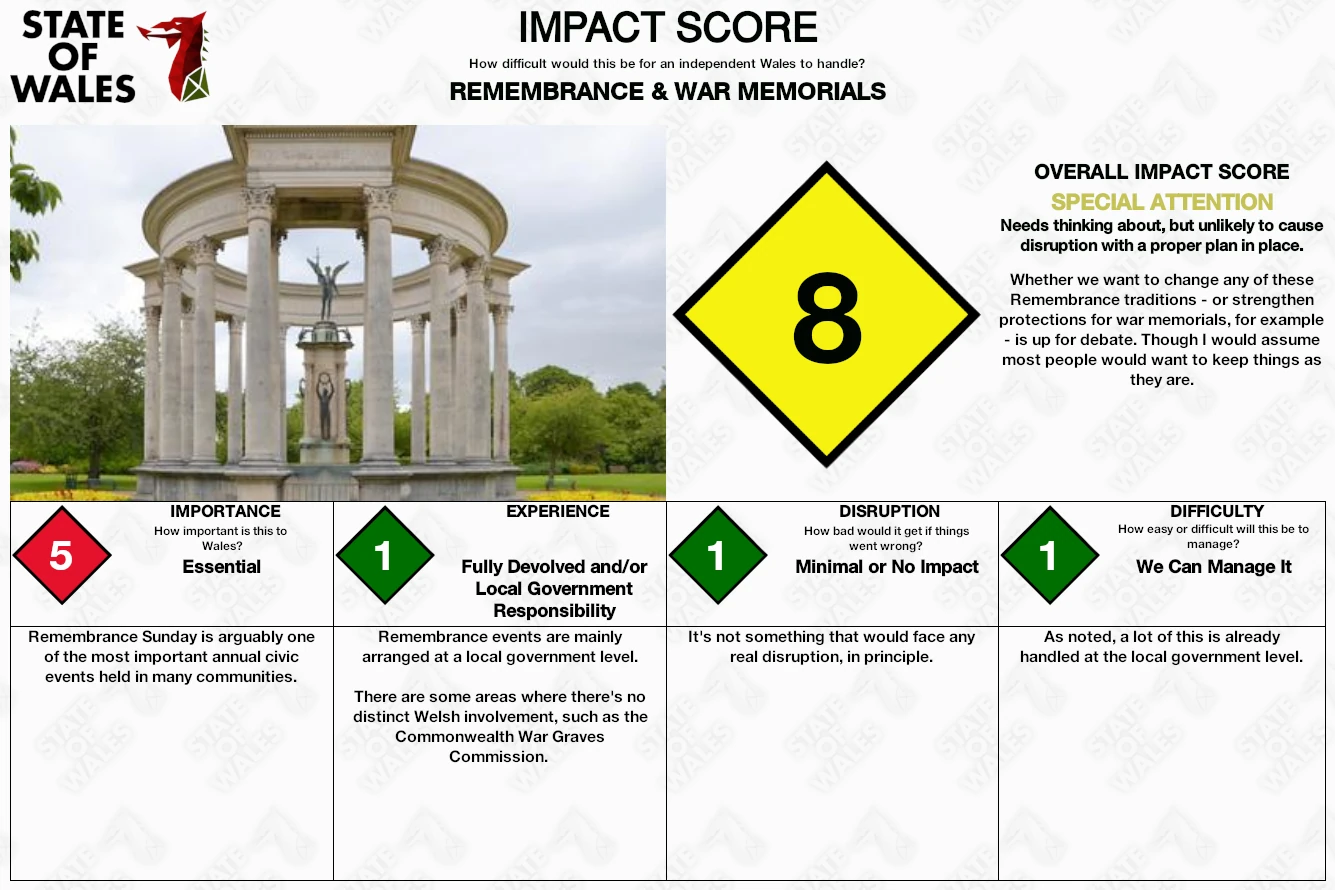
The overall score (out of 20) is the total of the scores for the four mini-categories (out of 5 each).

How Would This Be Run?

Remembrance events are organised and arranged at the local government level. It’s the same case for local war memorials. Some of these will be scheduled monuments or listed buildings.

The Commonwealth War Graves Commission is run by a board of Commissioners, which includes a designated representative from each of the six current member states (UK, Australia, Canada, New Zealand, South Africa, India). This is usually the High Commissioner/Ambassador to the UK (England after independence). 

How Much Will This Cost?

Headline: Indirect costs for Remembrance events; ~£2.5 million from Wales towards the Commonwealth War Graves Commission.

There are indirect costs associated with Remembrance events (road closures, policing, hospitality etc.), but these are normally covered by local government.

The Commonwealth War Graves Commission is separate from the Commonwealth itself (despite the name).

Its budget is around £84 million per year, and the contribution is proportionate to the number of tendered graves for each of the member countries1.

Around 50,000 soldiers from Wales were killed in the two world wars, but it’s unclear how many Commonwealth war graves are “Welsh”. So it’s impossible to work out precisely how much funding Wales would provide to the Commission. If Welsh memorials made up around 3% of the total, you would expect a contribution of around £2.5 million per year.

Would any new taxes need to be introduced? 

No.

Who will pay for this?

Charitable donations and general taxation (all taxpayers).

How Long Would This Take?

Everything is already in place for the most part. There’s no issue unless we want to make radical changes. 

People & Work

Who does this impact?

Remembrance events are organised by local government (including the town & community council tier) and community groups, as well as charities like the Royal British Legion.

The Commonwealth War Graves Commission would, presumably, fall under the remit of whoever we appoint as High Commissioner to England (assuming Wales joins the Commonwealth).

Would any jobs be created or lost?

No job implications, though there are Commonwealth War Graves Commission-maintained graves and memorials in Wales.

You Might Also Like....

How could an independent Wales support veterans and service-leavers?
Armed Forces

How could an independent Wales support veterans and service-leavers?

by Owen Donovan
November 26, 2025
0

...

Read moreDetails
How would an independent Wales buy new military equipment?

How would an independent Wales buy new military equipment?

November 26, 2025
How would a Welsh military recruit & train new personnel?

How would a Welsh military recruit & train new personnel?

November 26, 2025
What could the command structure of a Welsh military look like?

What could the command structure of a Welsh military look like?

November 26, 2025
What are the options for an independent Wales’ military?

What are the options for an independent Wales’ military?

November 26, 2025
Veterans in Wales

Veterans in Wales

November 26, 2025
What would independence mean for existing MoD contracts with Welsh suppliers?

What would independence mean for existing MoD contracts with Welsh suppliers?

November 26, 2025
What defence assets might an independent Wales “inherit” from the UK?

What defence assets might an independent Wales “inherit” from the UK?

November 26, 2025
Military Law & Independence

Military Law & Independence

November 26, 2025
How and when would a Welsh armed forces be deployed?

How and when would a Welsh armed forces be deployed?

September 29, 2025
Would people from Wales serving in the British military have to join a Welsh armed forces?

Would people from Wales serving in the British military have to join a Welsh armed forces?

September 29, 2025
What military threats does Wales need defending from?

What military threats does Wales need defending from?

September 29, 2025
What makes the military unique?

What makes the military unique?

September 29, 2025
Hard Power & Soft Power

Hard Power & Soft Power

June 29, 2025
Load More
    1. Commonwealth War Graves Commission, “Annual Report 2023-24” (p37)

Use of AI

No AI tools were used to draft this post.

Donations Welcome
Tags: Charities & Third SectorCommonwealthDenmarkDF 306FinlandIrelandLocal GovernmentMilitaryNew ZealandPacifismPublic HolidaysReligion & BeliefVeterans Affairs
Previous Post

How could an independent Wales support veterans and service-leavers?

Next Post

Radical Wales: Conscription/National Service

Owen Donovan

Owen Donovan

Archive

Categories

Copyright

Creative Commons Licence

State of Wales by Owen Donovan is licensed under a Creative Commons Attribution-NonCommercial-NoDerivatives 4.0 International License.

Subscribe by Email

Search

No Result
View All Result
No Result
View All Result
  • Go To Senedd Home
  • Go To Oggy Bloggy Ogwr
  • About & Contact
    • About State of Wales
    • Comments Policy
    • Complaints Policy
    • Contact & Subscribe by Email
    • Disclaimer
  • Features
    • After the UK
    • Chinny Reckon
    • Devil’s Advocate
    • How Wales Works
    • Road to Brexit
  • The Independence Index
    • The Independence Index (full)
    • Economics & Money
      • Business & Economy
      • Currency
      • Tax & Spending
      • Transport & Infrastructure
    • Society
      • Communities & Housing
      • Culture & Sport
      • Education
      • Health
      • Media & Communications
      • Science & Technology
    • The State
      • Environment & Natural Resources
      • Justice
      • Local Government
  • Elections Centre
  • Wales FAQ
    • How is Wales funded?
    • How are laws in Wales made?
  • Support & Donate