Senedd Home
Oggy Bloggy Ogwr
State of Wales
Monday, August 10, 2026
  • About & Contact
    • About State of Wales
    • Comments Policy
    • Complaints Policy
    • Contact
    • Disclaimer
  • Elections Centre
  • The Independence Index
    • The Independence Index (Full)
    • Foreign Policy
      • Relations with the former UK & Ireland
      • Relations with Europe
      • Foreign Policy (General)
      • International Organisations & Law
      • Overseas Aid
    • Defence
      • Defence Policy
      • NATO
      • Armed Forces
      • National Security
      • Civil Defence
    • Rules & Regulations
      • Safety & Standards
      • Intellectual Property
    • Economics & Money
      • Business & Economy
      • Currency
      • Tax & Spending
      • Transport & Infrastructure
    • Society
      • Communities & Housing
      • Culture & Sport
      • Education
      • Health
      • Media & Communications
      • Science & Technology
    • The State
      • Environment & Natural Resources
      • Justice
      • Local Government
  • Support & Donate
No Result
View All Result
  • About & Contact
    • About State of Wales
    • Comments Policy
    • Complaints Policy
    • Contact
    • Disclaimer
  • Elections Centre
  • The Independence Index
    • The Independence Index (Full)
    • Foreign Policy
      • Relations with the former UK & Ireland
      • Relations with Europe
      • Foreign Policy (General)
      • International Organisations & Law
      • Overseas Aid
    • Defence
      • Defence Policy
      • NATO
      • Armed Forces
      • National Security
      • Civil Defence
    • Rules & Regulations
      • Safety & Standards
      • Intellectual Property
    • Economics & Money
      • Business & Economy
      • Currency
      • Tax & Spending
      • Transport & Infrastructure
    • Society
      • Communities & Housing
      • Culture & Sport
      • Education
      • Health
      • Media & Communications
      • Science & Technology
    • The State
      • Environment & Natural Resources
      • Justice
      • Local Government
  • Support & Donate
No Result
View All Result
State of Wales
No Result
View All Result
Home Defence

What would be an independent Wales’ policy towards extremism?

The UK currently has the Prevent strategy.

Owen Donovan by Owen Donovan
January 19, 2026
in Defence, National Security
What would be an independent Wales’ policy towards extremism?

BBC Wales

Share on FacebookShare on TwitterShare on RedditShare on BlueskyShare by email

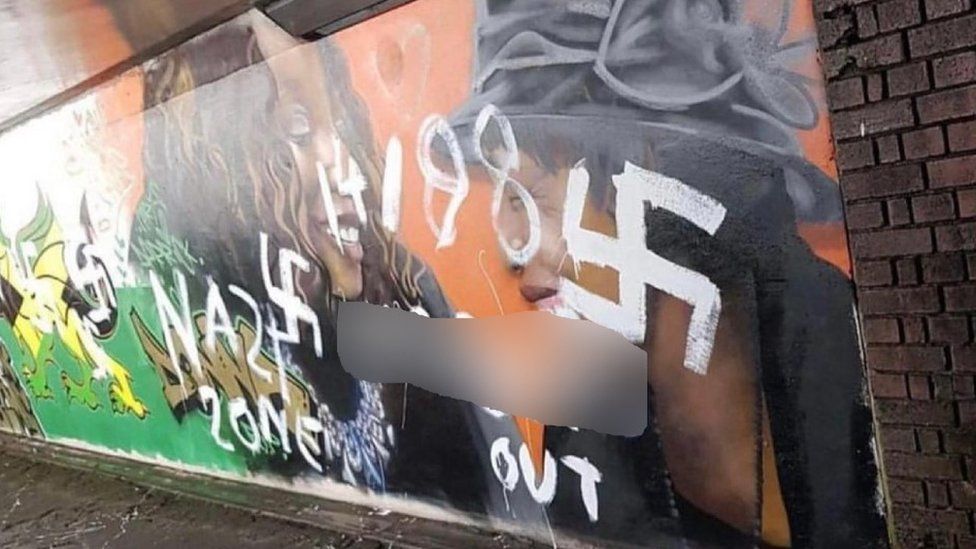
Image Source: BBC Wales

This site is best viewed in landscape mode on smartphones.
Support IndyWales? Support State of Wales!

Donations keep this site going. If you like what I’m doing here and think this work is important to the independence movement, consider a donation. One-off or monthly; as little or as much as you want. Click the links below, or full details are available here.

What Happens Now?

The UK Government’s definition of extremism was updated in 20241.

It includes the “promotion of an ideology, violence, hatred or intolerance”, or a pattern of behaviour, that aims to suppress the rights and freedoms of others and/or seeks to undermine UK democracy.

According to initial evidence forming part of a UK Parliament inquiry2, MI5 has said that the proportion of people under the age of 18 being investigated in the UK for extremism has increased threefold since 2021.

The UK’s main counter-extremism service is Prevent, managed by the UK’s Home Office. People suspected of holding extremist beliefs may be referred to the programme by the authorities. The aim is to intervene/”deprogramme” early (through a programme called “Channel”) to stop the individual moving from holding extremist beliefs to acting on them (such as terrorism).

As of 2024-253, there were just under 400 referrals to Prevent originating from Wales. The vast majority of these involved men, and the biggest single group of concern were the far-right. About 18% of these referrals were deemed suitable enough for the “Channel” intervention programme.

Policy advice around the Prevent programme and the UK Government’s counter-extremism strategy is given by the Commission for Countering Extremism.

Trials relating to terrorism and extremism are not usually held in secret. Organisations deemed to be extremist may be proscribed (banned from receiving public support or funding from within the UK) by the UK Government through regulations.

Does This Work for Wales?

While national security and counter-extremism policy areas are not devolved, the vaguely defined policy area of “community cohesion” is a responsibility of the Welsh Government.

The Prevent referral figures for 2024-25 are broadly in line with the Welsh share of the UK’s population. So there’s nothing to suggest that people in Wales are any more or less likely to be drawn towards extremist beliefs than any other part of the UK.

However, the number of annual Prevent referrals from Wales has increased by over 150% compared to 2015-164, when the overall EnglandandWales trend across the same period has been a decrease.

The number of people referred from Wales is also more than twice the number referred in Scotland5.

The use of the UK Government’s broad powers to proscribe organisations has also been brought into question after the proscription of Palestine Action following a direct action campaign targeting arms sales and UK military support to Israel.

What Would Be the Pros & Cons of Independence?

Pros of Independence
Cons of Independence
Pros of Independence

We would be able to learn best practice on tackling extremism from the rest of the world, instead of having a single “British” solution foisted on us. The Prevent programme has faced criticism both for inaction when identifying threats, and for also having a chilling effect on civil liberties6.

We would be able to define different types of extremism more specifically. This would be different from the “catch all” definitions used by the UK authorities, which could capture strongly-held, but not necessarily extremist, views in the net.

With a smaller population and close working between different public authorities, in principle, it should be easier for Welsh security services to identify potential extremists and intervene earlier because there’s a smaller set of targets.

There would be an opportunity to completely overhaul laws and regulations around intelligence and investigatory powers to better balance civil liberties with national security (which heavily leans towards national security in the case of the UK).

You can argue that Wales is less of a target for foreign interference or terrorism than the major English cities, meaning that we may have to spend less on national security compared to similarly sized countries.

Cons of Independence

Defining “extremism” is controversial. There’s a risk that legitimate dissatisfaction with the status quo, or a strong reaction to inequality or lack of economic opportunities, ends up getting labelled as “extremist”.

There may be too much emphasis on reacting to extremists (“playing whack-a-mole”) instead of addressing the root causes of extremism (underemployment, misinformation, social isolation, mental health issues). Extremism is just as much about faulty logic and poor critical thinking skills as it is about extreme ideology and identity.

There’s a risk that threats wouldn’t be pursued or addressed early enough because of political correctness or because certain threats (far-right, foreign interference, radical misogynists/incels) aren’t deemed as critical or urgent as they should be.

There’s no clear evidence that the relatively close working between different Welsh public authorities (aligned to the concept of the “social partnership”) has been effective within the Prevent framework.

Loosening intelligence and investigative powers for the sake of maintaining personal freedoms would be presented as a security risk and likely opposed by the police and public authorities.

Being able to respond to individual extremist threats may be dependent on intelligence sharing with other countries, which Wales may lose access to immediately upon independence.

What Do Other Countries Do?

Ireland
Denmark
Finland
New Zealand
Ireland

  • Ireland has a recent history of political violence tied to Irish republican and unionist paramilitaries. In the last few years, there’s been a growing far-right and anti-immigrant sentiment as well.
  • Ireland doesn’t appear to have a dedicated counter-extremism programme similar to the UK’s Prevent.
  • Extremism is handled by the police and criminal justice system. There are several specific laws relating to extremism and counter-terrorism, such as the Offences Against the State Acts and Criminal Justice Acts.
  • Ireland’s Special Criminal Court, which meets in closed session, presides over terror-related cases.
Denmark

  • Militant Islamists are considered a primary security threat in Denmark7. Denmark also has a history of far-right, far-left and anarchist movements.
  • The Danish Security Agency (PET) publishes detailed summaries of identified security threats and how they work, including guides for businesses and society.
  • The Danish Government’s Centre for Documentation & Counter Extremism works with local government to intervene and prevent extremism.
  • Intervention is based around mentoring and tailor-made support to address issues in the individual’s personal life8.
  • There’s a publicly available list of sanctioned individuals and organisations blocked from being funded by Danish citizens.
Finland

  • Radical Islamists, the far-right and collaboration between the far-left and Kurdish activists are considered the primary extremist threats in Finland9.
  • The Finnish Government published a new action plan to counter violence and extremism in 202410.
  • Finland’s strategy is focused on prevention.
  • Measures include monitoring and research of radicalisation, improving media literacy & critical thinking skills (to counter disinformation online), recognising the impact of hate speech, greater involvement by clinical psychiatrists and recognising extremism/radicalisation early.
New Zealand

  • Primary extremist threats are decided from a mix of sources, including the police, military, prison service and transport authorities.
  • New Zealand’s strategy is based on early intervention. New policies and protocols were introduced following an inquiry into the 2019 Christchurch terror attack.
  • He Aranga Ake (roughly translates as “Restore/Resurrect”) is New Zealand’s counter-extremism framework and operates similarly to the UK’s Prevent programme. This is led primarily by the New Zealand Police.
  • New Zealand has a list of designated terrorist organisations.
What Options Does Wales Have?

Any counter-extremism programme is likely to be made up of a combination of the following:

A clearer definition of "extremism"
Continue the Prevent programme (or something similar)
Education-based model
Mentor-based deprogramming
Law enforcement approach
A clearer definition of "extremism"

When boiled down to its core, extremism is “advocating, preparing or inciting violence or harassment to promote or support political, philosophical or religious beliefs”.

It shouldn’t include non-violent direct action or holding “politically incorrect” views (which should ideally be protected as free speech). Neither should be jingoistically vague (for example, guff about “upholding Welsh/British values” or such).

Continue the Prevent programme (or something similar)

The focus would be on early intervention and deprogramming. Cases referred to the programme would be escalated or de-escalated depending on “how far gone” someone is (including their potential for violence) and whether the issues can be addressed with or without intervention by public services (i.e. NHS for mental health issues).

Education-based model

This would be similar to some aspects of Finland’s approach. Embedding critical thinking skills and media literacy into the curriculum would ensure younger people aren’t so easily swayed by disinformation. There could be other measures allied to this, such as stronger media regulation.

Mentor-based deprogramming

Counter-extremism efforts would be led by former extremists who have successfully been deprogrammed (I.e. former Islamists and neo-Nazis).

Research undertaken by the Royal United Services Institute in 202011 found that mentorship programmes can be effective when targeted at those most “at risk” of falling prey to extremism. Also, they can be effective when they are locally based and focus on developing life skills.

However, they also concluded that mentorship can be stigmatising and lead to unintended consequences (i.e. over-confidence, a sense of preferential treatment, and a sense of disappointment/betrayal if programmes fall short of expectations).

Law enforcement approach

There would be no formal programme for prevention. Instead, extremists of all kinds would be prosecuted and handled by the criminal justice system. This would be similar to Ireland, but Ireland has a much longer/more damaging history of home-grown terrorism and organised crime than Wales.

This may be the most straightforward approach: an extremist breaks anti-extremism laws, and they get prosecuted. The risk is that you end up keeping extremists cycling in and out of institutions (and maintaining their influence through a sense of mistreatment) instead of addressing the root causes.

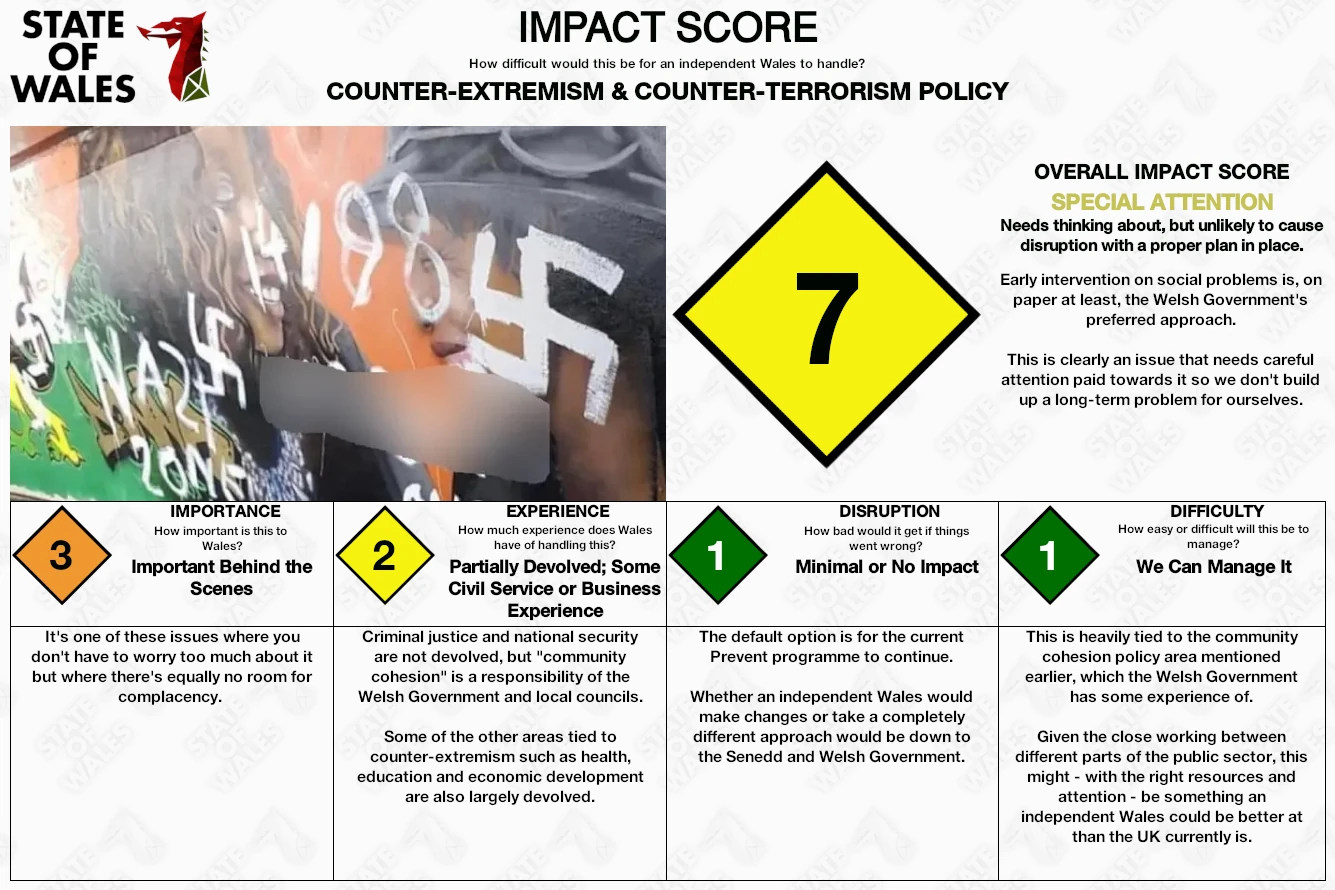
What's at Stake?

The overall score (out of 20) is the total of the scores for the four mini-categories (out of 5 each).

How Would This Be Run?

The Minister in charge of national security is likely to be a Welsh equivalent of the Home Secretary/Interior Minister. There would be heavy input from the First/Prime Minister, as well as the Welsh equivalents of Foreign Secretary and Defence Secretary.

The policy towards extremism would likely be discussed and set by a Cabinet-level committee – whether that’s a stand-alone National Security Committee or a combined Defence & National Security Committee.

How Much Will This Cost?

Headline: A proportional (5%) Welsh share of Prevent spending for 2024-25 works out at around £1.45 million per year12.

We may decide to spend more or less on this depending on which model we want to pursue. Some measures – such as intensive mentoring, public information campaigns and altering the school curriculum – would be more expensive than others.

Would any new taxes need to be introduced?

No.

Who will pay for this? 

All taxpayers (general taxation).

How Long Would This Take?

If we decide to maintain Prevent in some way, then it would be in place automatically upon independence. The UK’s counter-terrorism and counter-extremism laws and regulations would also be in place (unless the Senedd decides to change them).

Drafting new counter-extremism laws in the Senedd would likely take the best part of a year (if not a bit longer if it needs to go through a full consultation process).

Legal definitions around free/protected speech, treason and extremism could also be included in a written Welsh Constitution.

People & Work

Who does this impact?

Anyone susceptible to extremism. At the moment, the evidence points towards young men and the under-employed.

Would any jobs be created or lost?

here are unlikely to be any significant job implications one way or another. Though you would expect some form of counter-extremism team working either within the Welsh Government or within a Welsh security agency.

You Might Also Like....

Would an independent Wales share security intelligence with other countries?
Defence

Would an independent Wales share security intelligence with other countries?

by Owen Donovan
January 19, 2026
0

...

Read moreDetails
Would an independent Wales have its own security service?

Would an independent Wales have its own security service?

January 19, 2026
What would be an independent Wales’ national security policy?

What would be an independent Wales’ national security policy?

January 19, 2026
Extremism in Wales

Extremism in Wales

January 19, 2026
The Security Services

The Security Services

January 19, 2026
What civil emergencies would an independent Wales need to prepare for?

What civil emergencies would an independent Wales need to prepare for?

January 19, 2026
What would Welsh independence mean for defence and national security in the rest of Britain?

What would Welsh independence mean for defence and national security in the rest of Britain?

September 29, 2025
Would people from Wales serving in the British military have to join a Welsh armed forces?

Would people from Wales serving in the British military have to join a Welsh armed forces?

September 29, 2025
What military threats does Wales need defending from?

What military threats does Wales need defending from?

September 29, 2025
What makes the military unique?

What makes the military unique?

September 29, 2025
Hard Power & Soft Power

Hard Power & Soft Power

June 29, 2025
Load More
    1. UK Government, Ministry of Housing, Communities & Local Government (14th March 2024). “New definition of extremism (2024)“

    2. UK Parliament, House of Commons, Home Affairs Committee (14th May 2025). “New inquiry: Combatting New Forms of Extremism“.

    3. UK Government, Home Office (6th November 2025). “Individuals referred to and supported through the Prevent Programme, April 2024 to March 2025 (Table 7)”

    4. UK Government, Home Office (6th November 2025). “Individuals referred to and supported through the Prevent Programme, April 2023 to March 2024 (Table 7)”

    5. Matthew Fulton, STV News (6th November 2025). “Record number of young Scots referred to counter-terrorism scheme“

    6. Dominic Casciani, BBC News (8th February 2023). “Prevent counter-terror scheme lambasted in review“

    7. PET (Danish National Security & Intelligence Service). “Threats to Denmark: Terrorism & Extremism“

    8. Danish Centre for Documentation & Counter Extremism. “Interventions“

    9. Supo (Finnish Intelligence & Security Agency). “Counter-terrorism“.

    10. Government of Finland, Ministry of the Interior (11th July 2024). “National Action Plan for the Prevention and Combating of Violent Radicalisation and Extremism”

    11. E, Winterbottom. Royal United Services Institute (September 2020). “How effective are mentorship interventions?“

    12. UK House of Commons, Written Question (28th October 2025). “Counter-terrorism: Civil Society“

Use of AI

No AI tools were used to draft this post.

Donations Welcome
Tags: Civil LibertiesCourt System & JudiciaryDemocracyDenmarkDF 403ExtremismFinlandIrelandMental HealthNew ZealandPolicing & Law EnforcementRace & RacismReligion & BeliefTerrorismWelsh Government
Previous Post

Would an independent Wales have its own security service?

Next Post

Would an independent Wales share security intelligence with other countries?

Owen Donovan

Owen Donovan

Archive

Categories

Copyright

Creative Commons Licence

State of Wales by Owen Donovan is licensed under a Creative Commons Attribution-NonCommercial-NoDerivatives 4.0 International License.

Subscribe by Email

Search

No Result
View All Result
No Result
View All Result
  • Go To Senedd Home
  • Go To Oggy Bloggy Ogwr
  • About & Contact
    • About State of Wales
    • Comments Policy
    • Complaints Policy
    • Contact & Subscribe by Email
    • Disclaimer
  • Features
    • After the UK
    • Chinny Reckon
    • Devil’s Advocate
    • How Wales Works
    • Road to Brexit
  • The Independence Index
    • The Independence Index (full)
    • Economics & Money
      • Business & Economy
      • Currency
      • Tax & Spending
      • Transport & Infrastructure
    • Society
      • Communities & Housing
      • Culture & Sport
      • Education
      • Health
      • Media & Communications
      • Science & Technology
    • The State
      • Environment & Natural Resources
      • Justice
      • Local Government
  • Elections Centre
  • Wales FAQ
    • How is Wales funded?
    • How are laws in Wales made?
  • Support & Donate