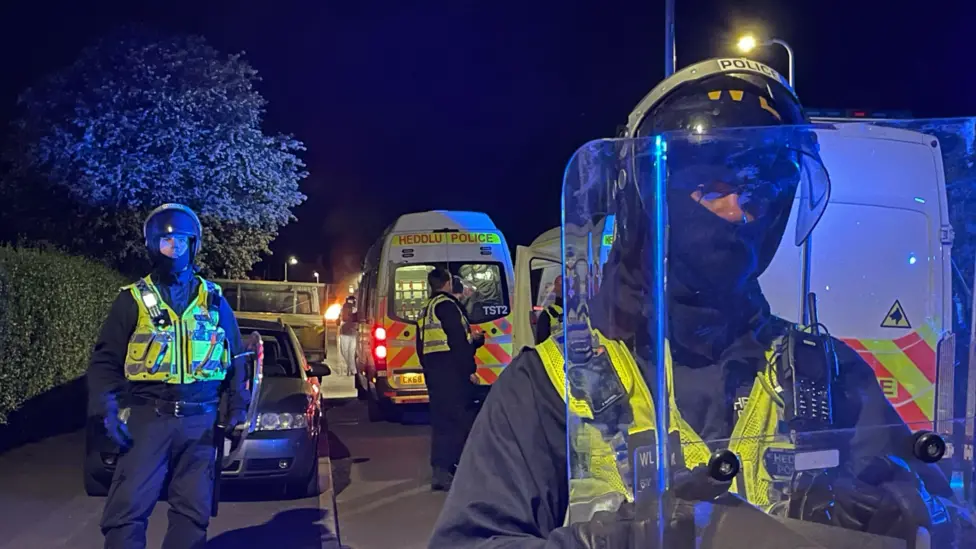
Image Source: South Wales Police via BBC Wales
Donations keep this site going. If you like what I’m doing here and think this work is important to the independence movement, consider a donation. One-off or monthly; as little or as much as you want. Click the links below, or full details are available here.
What Happens Now?
Emergency powers are not devolved.
The Civil Contingencies Act 2004 gives the UK Government the power to pass emergency regulations, effectively “by decree” (Orders-in-Council)1.
These regulations can only be issued in response to an emergency as defined in the Act.
These emergency regulations can enforce a range of measures. However, they can’t be used to introduce conscription, ban strikes, amend emergency powers themselves or create new serious criminal offences.
Emergency regulations are also time-limited. They only last for 30 days unless the UK Parliament votes to extend them. Due to this, the Civil Contingencies Act wasn’t used during the COVID-19 pandemic. Instead, a pandemic-specific emergency law, the Coronavirus Act 2020, was passed (which was approved by the Senedd).
The Senedd can pass “emergency laws” in devolved policy areas, but this is more a matter of law-making procedure than in response to a civil emergency. This may be done if, for example, there’s a loophole that needs urgent closure.
The most recent example of this is the Mental Health Tribunal for Wales Act 2026. This was passed as an emergency law so that sitting members would not be barred from serving on the tribunal because they were no longer practising psychiatrists.
Does This Work for Wales?
Technically, no – as emergency powers aren’t devolved.
The UK doesn’t have a written constitution, so the authority to pass emergency powers comes from a mix of laws, such as the Civil Contingencies Act and older laws (like the Public Health Act 1984).
In practice, the Welsh Government has a lead/strategic role in responding to civil emergencies in Wales. Particularly, civil emergencies in devolved policy areas. That would include things like health, transport and rural affairs.
If the UK were involved in a war, for example, the UK Parliament would be responsible for passing any emergency laws or regulations that affect Wales. This is what happened in the build-up to both world wars and would’ve been expected to happen in the “transition to war” ahead of an expected attack on the UK during the Cold War.
Independence & Emergency Powers: Pros & Cons
It’s a procedural matter, so there are no pros or cons as such.
One of the main issues here would be the approach: whether emergency powers would be in a written Constitution or left to the law.
Also, the scope: what kind of powers, who can use them (i.e. should local government leaders be able to declare an emergency), why they would be used and, most importantly of all, the limits on their use.
What Do Other Countries Do?
![]()
The Irish Constitution grants the Irish Government emergency powers during wartime or rebellion2. A “state of emergency” can only be cancelled by a resolution in both houses of the Irish Parliament.
Most of the current emergency powers are addressed in the Offences Against the State Acts, which were introduced to deal with, in the main, extremism, domestic terrorism and organised crime.
![]()
The Danish monarch has the constitutional power to draft emergency laws, subject to them being approved by the Danish Parliament3.
The Constitutional Act of Denmark outlines the emergency procedure to pass certain laws (similar to the Senedd procedure for emergency Bills mentioned earlier).
![]()
The Finnish Parliament passed the Emergency Powers Act in 2011.
The Government of Finland has the power to declare a state of emergency, subject to approval from the President of Finland. The definition of an emergency includes wartime and any threat to life or property.
Emergency powers can remain in force for a maximum of 6 months, though the Finnish Parliament can change the emergency decree – including the length of time it remains in force for (a minimum of a week).
![]()
Emergency powers are addressed in the Civil Defence Emergency Management Act 2002, which is similar (but not identical) to the UK’s Civil Contingencies Act. The declaration of a state of emergency automatically triggers several relevant powers that can be used by public officials (i.e., the power of entry, mandatory evacuation, requisitioning of property)
Government ministers and local government leaders have the power to declare a state of emergency at a local, regional or national level4. In the event of a national emergency, the New Zealand Parliament needs to meet within one week.
States of emergency at the local, regional or national level can only be renewed for a week at a time. This is carried out by the relevant minister or local government leader.
New Zealand’s Parliament is set to debate an Emergency Management Bill before the end of its current term (November 2026). This will replace the existing Civil Defence Act.
What Options Does Wales Have?
This is the default option. The existing laws and regulations would continue to apply after independence because of the common law system.
The Senedd could amend the existing Act after independence to address any weaknesses in the existing system.
This could include the status of volunteer groups, the different types of responders, specific instances in which emergency powers can be used and additional measures around emergency warning systems.
A “rip it up and start again” approach, learning from the best international examples.
This would be more permanent and difficult to change, making it less flexible but also (in principle) protecting it from being abused.
It would mean that the language would need to be very precise, and the interpretation of how the emergency powers would be used would need to be drafted by a Welsh supreme/constitutional court alongside the constitution itself.
What's at Stake?
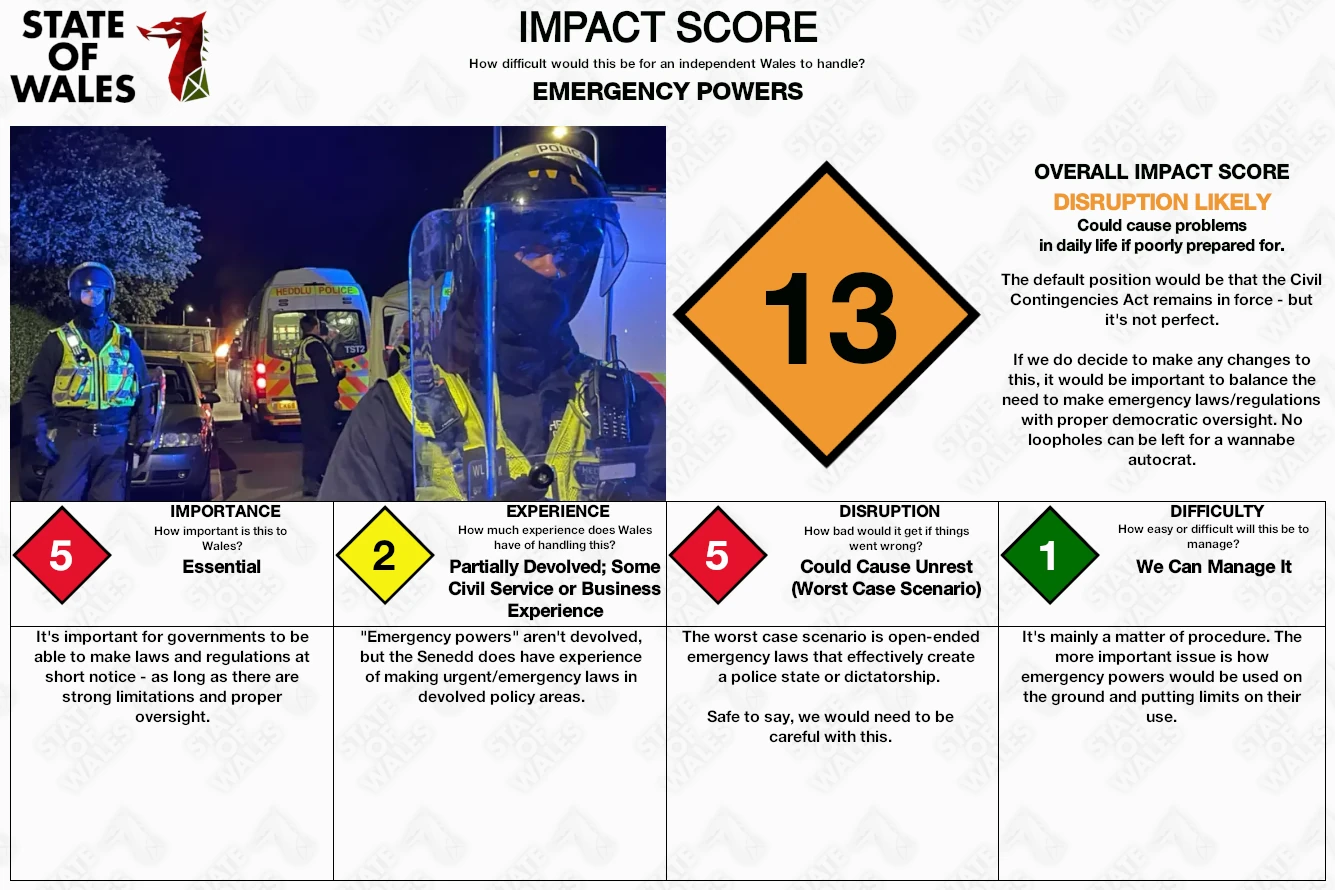
The overall score (out of 20) is the total of the scores for the four mini-categories (out of 5 each).
How Would This Be Run?
This is a matter of procedure at heart, so “how” it would be run is less important than the “who” and the “why”. That was covered in the options bit further up.
How Much Will This Cost?
Headline: No direct cost implications.
The cost of responding to emergencies would come out of related budgets (local government, health, fire service, police and defence). The Welsh Government would need to provide extra funding as and when needed.
There would be arguments for and against setting up a ringfenced national Disaster Relief Fund or equivalent. This could be used to provide immediate emergency funding to householders and businesses affected by a natural or man-made disaster. The closest thing we have to date is the Welsh Government’s Discretionary Assistance Fund.
Would any new taxes need to be introduced?
No.
Who will pay for this?
No direct cost implications. Though you would expect a compensation scheme to be set up to cover the cost of confiscating or commandeering property or equipment during an emergency.
Any extra duties placed on local government and the emergency services (through changing emergency power laws) would need to be paid for as well, but it’s hard to estimate precise costs.
How Long Would This Take?
The default option is that the Civil Contingencies Act continues to work as it does currently – so it’s already in place.
Drafting a new emergency management/emergency powers law may take the best part of a year, and could only happen after independence (as the necessary powers are not devolved).
Including emergency powers in a written Welsh Constitution would take however long it takes, depending on how we decide to write a constitution in the first place. The constitution will be looked at separately.
People & Work
Technically, everyone. It crosses both civil defence and civil liberties matters. You only have to look at what’s happening in the United States as of 2026 to see how this can be abused when power is placed into the wrong hands.
There are unlikely to be any job implications one way or another.
You Might Also Like....
Civil Contingencies Act 2004, Part 2.
Constitution of Ireland, Article 28, Subsection 3.3.
Constitutional Act of Denmark, Chapter II, Section 23.
Civil Defence Emergency Management Act, Section 25.
No AI tools were used to draft this post.