


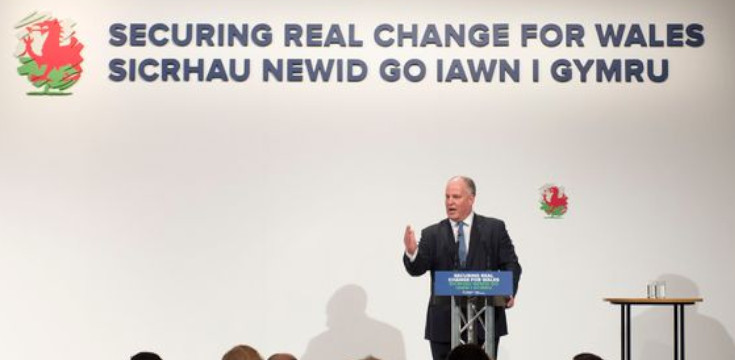
(Title Image: Wales Online)
Next in my look at the state of the parties before the election, it’s the turn of the Conservatives.

Five Key Events of the Fifth Senedd
The Tories avoid a split after the Brexit referendum – One of the most remarkable developments post-Brexit is that far from descending into self-destructive arguments over Europe (which plagued the party since the 1980s), the Conservatives presented a fairly united front in Wales.
There were Senedd Tory members who didn’t like the idea of Brexit and backed Remain, but they could get-out-of-jail by saying they were reluctantly taking a cue from the electorate to “Get Brexit Done”. They didn’t have to justify their change in position. That may well have been down to the Brexiteer Andrew RT Davies being group leader at the time too.
Any deviation from this has been relatively low-key and the Conservatives in the Senedd have largely backed Brexit throughout (if not the details), which arguably made their lives a lot easier compared to Labour who for a long time couldn’t make their minds up on how to react to the referendum result.
Leadership Shenanigans (in Cardiff and London) – One of the UK’s biggest strengths is the ability to elect people into high office who should be nowhere near government yet continue as a functioning society. The UK has endured six years of Italian-style governance that’s rendered it a global laughing stock, started to threaten the UK’s very existence as a nation-state and was only halted in its tracks by a global health disaster (with the worse person imaginable responsible for dealing with it). The Conservative ability to destroy everything around them yet still use that to their advantage is second-to-none.
Boris Johnson, Theresa May and David Cameron will all likely be judged by history to be amongst the UK’s worst-ever (and maybe even amongst the last) prime ministers for different reasons: David Cameron’s hubris, Theresa May’s handling of Brexit negotiations and Boris Johnson being a clown who doesn’t believe in anything and can’t be believed.
The Tory leadership crisis wasn’t just confined to the UK stage. We had our own mini-crisis in the Senedd when, following ill-judged comments on mass job losses, Andrew RT Davies was forced to stand down as leader.
While Paul Davies won the subsequent low-key leadership election, there was always a nagging feeling that Andrew RT Davies was pulling the strings behind the scenes with the help of allies in key positions within the Welsh branch’s backroom administration. Towards the end of 2020, Paul Davies was forced to stand down himself after two and a half years as leader for reportedly breaching coronavirus regulations. It seemed awfully convenient timing.
2019 UK General Election – The snap UK General Election produced one of the Conservative’s best ever results in a Welsh election. This was largely brought about by bubbling anger at the snail’s pace by which Brexit was being implemented, taken advantage of by simple messaging from a populist leader. The result was the ultimate and final defeat of Remain, putting an end to talk of a second referendum or a soft Brexit.
The Conservatives finally made inroads into parts of in Wales that had always been in sight but slightly out of reach – particularly in the north-east which has now become part of the Anglo-Welsh “Red Wall”. There are still a few “no-go” areas for the Conservatives in Wales, but the 2019 result makes the field of play a bit bigger in 2021 and all future elections than it otherwise would have been.
“Business-first” approach to the Covid-19 pandemic – During the pandemic, all governments have had to carefully balance public health with economic considerations. Business – particularly customer-facing businesses – couldn’t continue as usual with employees and customers having to stay away, but the Conservatives in Wales have certainly supported tipping the scales more in favour of the economy and businesses than the health of the public.
There are a large number of people annoyed that they can’t do the things they were able to do in 2019 (whose frustrations the Tories and others want to exploit). While that presents a USP for them as a soft anti-lockdown party, it also suggests they’re willing to put profits and balance sheets (particularly the tourism and hospitality sectors) above people.
The Purge of the Moderates & tilt towards devoscepticism – Many of the calmer, “traditional Welsh conservative” voices on the Tory benches in the Senedd are either standing down, have been deselected or are in positions that make re-election difficult if not impossible. We all know about the questions asked on prospective candidates’ support (or not) for devolution so they don’t get caught out in the future in the same way they were on Brexit.
The Tories also have to contend with more threats (in number rather than strength, as I touch on shortly) from the British right in the form of UKIP, Reform UK and Abolish the Assembly. So politically, it makes sense for the Conservatives to position themselves as a devolutionist party which still gives enough nudges and winks towards those who would be quite happy to return to direct rule. Paul Davies was fairly subtle about it, placing blame more on how Wales was run than Wales running itself. Andrew RT Davies isn’t that subtle, neither are some of the potential next generation of Tory MSs.
The likes of Nick Bourne and David Melding have gone to great lengths to make the Conservatives fit devolution (rather than the other way around) and it’s brought them a great deal of success over the last 20 years. Undoing that may not necessarily lead to a decline in support, given populism is about what you’re against – in this case devolution itself – not what you’re for.
That said, while Brexit was supposed to be the ultimate victory of the Anglo-Welsh right (some may argue a reversal of devolution would be too), in the longer-term it could end up costing them everything; I can’t think of a better way to shift attitudes within the Labour party further towards independence than the Tories tilting more towards devoscepticism – and no significant constitutional change in Wales can happen without Labour support.
Key Strengths

“Welsh conservatism” is a thing. People are still willing to vote for them in big numbers and they’ve arguably had more electoral success since devolution than Plaid Cymru. Far too many people ignore the centre-right tradition in Wales. The Welsh are a small-c conservative people. Where there are differences, they exist between the Social Darwinist, populist conservatism of England (which is currently the dominant force within the Conservative party in Wales, but hasn’t always been) and the more community-focused “Big Society” paternalistic conservatism I would argue Wales has a longer-standing tradition of (best demonstrated by our large and influential Charity/Third Sector).
Quite a few constituencies look winnable. The target list for the Conservatives (which I come back to later) is likely to be fairly long given their successes in 2019. There’s probably only one Tory-held constituency under any serious threat and that’s Aberconwy (which has traditionally been a three-way marginal anyway). The north-east looks particularly promising.
They have little natural opposition on their own turf. The Conservatives are the Welsh centre-right. While, as mentioned earlier, they’ll face more of a challenge on the regional lists this year from the likes of Abolish the Assembly, they don’t face the same scale of challenge Labour does from Plaid Cymru (and the Greens and Lib Dems). The Tories are prominent and mainstream enough that Abolish may simply attract protest voters (much as UKIP in 2016) without taking away any core Tory voters. The Conservatives are also likely to (and need to) attract back a lot of 2016’s UKIP voters and 2019’s Brexit Party voters given that Brexit is done and dusted.
They’ve made inroads in some areas due to Labour complacency on demographic changes. This is particularly true along the M4 corridor and in the north-east. Labour in Wales have a knack for staying on the right side of public opinion, but local government austerity and high year-on-year council tax increases have seen suburban and more affluent areas – where property prices and, subsequently, council tax bills are relatively high – start to turn against Labour.
There is some evidence that a Labour-Conservative shift starts around age 40 – prime home-owner with a young family territory. People in general (ignore the party faithful/true believers) may start thinking more about keeping what they have instead of trying to change the world, which is why support for independence tends to dip around the same age bracket too. Most housing developments across Wales since the 1990s cater to this demographic. The Conservatives realise this, Labour doesn’t.
Key Challenges

They might have peaked too early in the polls. While it’s true the only poll that matters is the one on May 6th, until recently the Tories fell back from their peak during the first few months of 2020 (when they looked on the verge of making a significant breakthrough). There will be several reasons why this has happened including the unpopularity of the UK Government, a more strident and offputting “flagshagging” Anglo-British nationalism, the Dominic Cummings incident (which seems to have been a major turning point in attitudes towards Boris Johnson’s handling of the pandemic) and the relatively positive view of the Welsh Government’s Covid-19 response.
They lack self-awareness. Conservative discourse in Wales has taken a nose-dive over the last two to three years. What started as (somewhat justified) righteous indignation at the inability of Remain parties in the Senedd to accept the Brexit referendum result turned into a general sense of getting thicker and angrier over nothing.
The loss of the likes of David Melding, Suzy Davies, Nick Ramsay and Angela Burns will significantly hollow out their parliamentary ability. They’re at risk of being left with a new generation of cranks and headbangers. You see some of the stuff coming from the direction of the Conservatives and think they must be sleeper agents for YesCymru. The Union isn’t in imminent danger – and I say that as one of the hardcore “nats” – but the Tories have talked themselves into a corner and may even be out of touch with popular opinion on devolution (which generally supports more powers short of independence). While “muscular Unionism” will give them a short-term boost, it’s a dangerous combination for themselves and everyone else because I’m not convinced they’re capable of controlling it.
They picked the wrong Davies in 2018. Paul Davies’ tenure as group leader in the Senedd turned out to be a quiet disaster. He had a low media profile (and didn’t seem to pick up any additional publicity despite being Leader of the Opposition during the pandemic), occasionally picked the wrong targets to criticise during the peak of the Covid-19 pandemic (“Cruel Five-Mile Rule”), has overseen the near-complete undoing of Nick Bourne’s work reconciling the Tories with devolution and ended up having to stand down in embarrassing circumstances. That doesn’t mean Suzy Davies would have had an easy time of it either, but the last two-and-a-bit years seems to have been wasted.
They’re returning to a “Nasty Party” stereotype and are developing a woman problem. With a few exceptions – Natasha Asghar stands a reasonable chance of becoming the first woman of colour Senedd member – the selections for the 2021 election have significantly favoured men. The regional lists are generally a bit of a sausage fest and fewer women Tories are standing in “winnable” constituencies than Labour or Plaid Cymru. Returning to type as a party for middle-to-senior-aged Daily Mail-reading men and posh boy policy wonks might be a comfort blanket in a time of uncertainty (and a reaction to the woke culture war), but it looks bad given the effort they’ve put in to try and make themselves more palatable.

They might be polling down from their early 2020 peak, but the Tories are still – on average – doing better than their 2016 result in both constituency and regional vote shares.
As mentioned, seats in the north-east and along the M4 corridor look promising, as does Brecon & Radnor. They arguably have the largest selection of potential targets constituencies of any party standing this year – at least 12 on top of the constituencies they already hold.
They look set to remain the largest opposition party after the election. As they’ve got their heart set on not working with anyone and stand little to no chance of winning the 26+ seats needed to form a government of their own, that has to be the realistic height of their ambitions.
At the very least they’ll want to ensure a blocking Unionist/devosceptic vote in the Senedd to rule out moves on electoral reform and increasing the size of the Senedd (which requires a two-thirds majority vote). A combined 21-22 Tory, Abolish/Reform UK/UKIP members would achieve that aim.
What would be a good result?
This time last year, anything less than 18-20 seats would’ve been an underperformance.
While recent polls have suggested they could reach those sorts of numbers, a target of 15-18 seats is realistic and better reflects the general trend over the last year. There’ll be an expectation of making constituency gains, regardless.

