


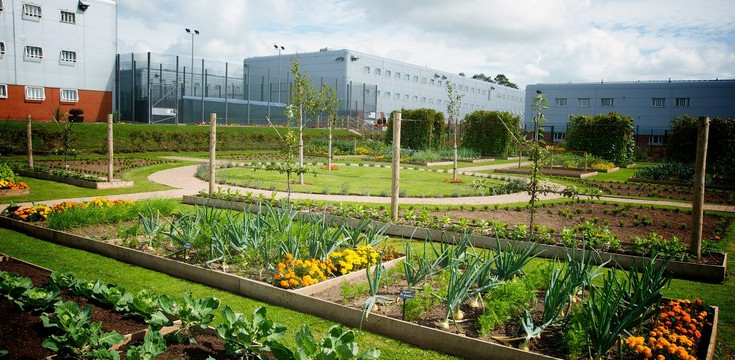
The final post in this “Welsh Justice System” series focuses on the least comfortable element – prisons and prisoners – with the death penalty debate thrown in at the end for good measure.
Not everything relating to penal policy will be covered otherwise this would be twice the length and I’ve done enough already.
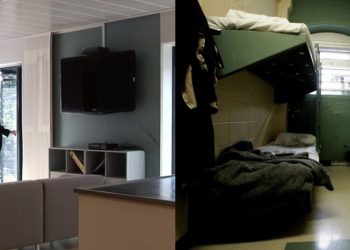

Currently, prisoners (adult men) are divided into four security categories:

Women prisoners have three categories: Restricted, Closed and Open (analogous to Category A, B/C and D respectively). The security category will determine which prison someone is sent to and what the regime will be like.
There are also secure hospitals (Broadmoor Hospital, Ashworth Hospital) that aren’t counted as prisons even if they have prison-like conditions.
There are no high-secure psychiatric units in Wales. There are several medium-secure units – some of which are operated privately, some by health boards – such as Glanrhyd Hospital’s Caswell Clinic in Bridgend and Ty Llywelyn in Llanfairfechan.

The best measure of capacity is Certified Normal Accommodation – the number of prisoners that can be held whilst ensuring “decent standards of accommodation”. What these figures show is that as things stand Welsh prisons (except Berwyn) are holding too many inmates to be considered uncrowded, but not enough to be deemed significantly overcrowded. This will naturally vary from year to year, but there are other signs of problems too.
In 2020 – just as the Covid-19 pandemic was peaking – Wales Governance Centre research revealed that 60% of prisoners were sharing cells. At only two prisons – Parc and Prescoed – were fewer than half doing so.

There are no rules against cell sharing (as long as there’s the capacity to do so), but high levels of cell sharing suggest pressure in terms of population to some extent.
Cost & Management of Prisons
In 2019-20, overall expenditure on prisons in Wales stood at £195.2million1. The most “expensive” prison by overall expenditure by some way is Bridgend’s Parc Prison, with an expenditure of £77.3million. It’s likely that when at full capacity Berwyn will be at or near the same level. However, both prisons have lower cost-per-place rates than others in Wales.
Parc Prison is one of the few privately-run prisons in EnglandandWales, being built under an £82million PFI contract with the UK Government and managed by G4S with a contract value of £266million (1997 prices; 2022 price is £515.8million)2. The prison estate was due to transfer to public ownership in 2021, though G4S continue to operate the prison as of 2022.
All other prisons in Wales are owned and operated by HM Prisons & Probation Service (Part XV), which has an all-Wales Directorate.
On the ground, prisoners and prisons are managed by prison officers. There are no formal entry qualifications and the entry-level training course only lasts 12-weeks. Other prison-related roles require more extensive training or professional qualifications such as healthcare staff, forensic psychologists and prison governors (which is increasingly becoming a graduate entry role).
At the end of 2021, there were 1,511 prison service workers employed in Wales3. Based on EnglandandWales average, roughly 70% of those (~1,060) are likely to be prison officers of varying grades with the rest being administration, support and non-operational staff like chaplains and healthcare workers. So the ratio of prison officers to inmates in Wales is likely to be around 1 officer for every 5 inmates.
The Prison System & The Thomas Commission
The Thomas Commission concluded4 that Welsh prisons were producing variable outcomes when it came to prison safety – particularly at Berwyn due to its size.
The Commission also considered the rise in self-harm in prisons to be “completely unacceptable”, suggesting the prison system in Wales was no longer fit for purpose.

While you would’ve thought the Commission would have criticised the lack of a women’s prison facility (or similar) in Wales, they saw it as an opportunity to consider alternatives. A women’s residential centre has been earmarked for Wales (the original shortlisted sites were Bridgend and Porthcawl) but there’s been no progress on this since. However, there was praise from the Commission for some of the projects to reduce reoffending or redirect women away from prison.
Most of the Commission’s recommendations were related to offender management and rehabilitation – including more intensive community sentencing to limit the number of new prison inmakes – which was the focus of Part XV.
How many Welsh prisoners are in England and vice versa?
As Wales has no Category A facility or women’s prisons, all Category A inmates and women prisoners serve their sentences in English prisons. In 2019, Wales Governance Centre research5 states there were 32 Category A prisoners from Wales and around 270 women prisoners (more recent estimates suggest the number of Welsh women prisoners has fallen to around 218 – Question 4).
Additionally, the Wales Governance Centre said that one third (34%) of all prisoners from Wales were serving sentences in English prisons.
This is similar to the proportion of prisoners from England being held in Wales. In 2019, 1,619 prisoners in Wales were from England (just under 35% of all prison inmates in Wales during that year). In the early days of HMP Berwyn’s operation, up to 70% of inmates were from outside Wales.
It’s seemingly very difficult to tell where inmates committed their crimes and where they were convicted. There are also no figures, as far as I can tell, about the number of Welsh patients at high-secure psychiatric hospitals in England either.
I don’t think there’s an argument against the principle that a Welsh inmate should serve out their sentence in England if they committed a crime there and vice versa.
However, the figures suggest cross-border flow for the sake of it or because space is available (particularly at Berwyn), not because of local demand. All of this could play a part in slightly inflating Wales’ imprisonment rate (Part XIV) and results in inmates being sent further away from home than they need to be.
1: UK Home Office, Prison & Probation Performance Statistics, (October 2020). Cost per prison place and prisoner by individual prison (2019-2020).
2: National Audit Office, (October 1997). The PFI Contracts for Bridgend and Fazakerly Prisons, p1. Available at:https://webarchive.nationalarchives.gov.uk/ukgwa/20170207054802/https://www.nao.org.uk/pubsarchive/wp-content/uploads/sites/14/2018/11/The-PFI-Contracts-for-Bridgend-and-Fazakerley-Prisons.pdf
3: UK Ministry of Justice, Her Majesty’s Prison and Probation Service workforce quarterly, (February 2022). Table 1: HMPPS Staff in post by HQ & Area Services. Available at: https://www.gov.uk/government/statistics/her-majestys-prison-and-probation-service-workforce-quarterly-december-2021
4: Commission on Justice in Wales, (October 2019). Justice in Wales for the People of Wales, p224-232. Available at: https://gov.wales/sites/default/files/publications/2019-10/Justice%20Commission%20ENG%20DIGITAL_2.pdf
5: Dr Robert Jones, Cardiff University (September 2020). Prison, Probation & Sentencing in Wales: A Factfile, p22-24.

