


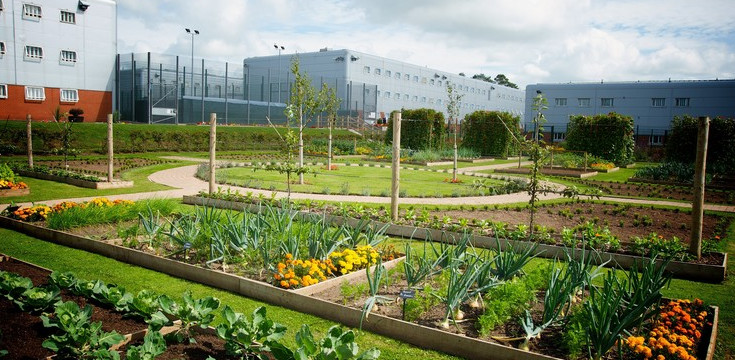
The final post in this “Welsh Justice System” series focuses on the least comfortable element – prisons and prisoners – with the death penalty debate thrown in at the end for good measure.
Not everything relating to penal policy will be covered otherwise this would be twice the length and I’ve done enough already.

Regular inspections of prisons and other penal facilities is a requirement of the Optional Protocol to the UN Convention Against Torture (OPCAT).
How are prison standards assessed now?
As things stand, responsibility for maintaining standards in prisons (in EnglandandWales) lies with HM Inspectorate of Prisons. Scotland and Northern Ireland have separate systems (as criminal justice is devolved).
The Chief Inspector is appointed by the UK Government but operates independently.
As for inspections, they’re usually unannounced and last for two weeks (usually every five years for adult prisons), focusing on four key areas: safety, respect, “purposeful activity” (I assume this means education, work and training) as well as rehabilitation/release planning. The Inspectorate is also responsible for inspecting custody suites, stockades/military prisons, Young Offenders Institutes (Part XV) and immigration detention centres.
Its operating budget in 2020-21 was £4.8million, with an income of £5.2million. Most of the inspectorate’s income comes from the relevant government departments (UK Ministry of Justice & Home Office) and agencies (Probation Service, Border Force)8.
— How could prisons be monitored after independence?
In terms of the overall focus of prison inspections, I doubt they need to fundamentally change.
We could perhaps be a bit more specific in what areas to monitor (i.e. instead of “safety”, it becomes specific assessments of accommodation/living conditions, staff-inmate relations, prevention of escape, sanitation & hygiene). That might give a clearer picture of where prisons need to improve and where they’re going right.
The criteria could be changed or weighted differently based on the prison itself. A lower-security prison may be weighted more for rehabilitation, while a higher-security prison will have a greater focus on safety.
It may also be worth cutting the amount of time between inspections of adult prisons from five years to three or four years.
As for the options themselves, they might include:
- No formal inspection regime – Renders everything written above null and void. Under this option, Wales would have to opt against signing and ratifying the UN OPCAT. This would be highly unusual and would make Wales one of the few nations in Europe alongside Russia, Latvia and Belarus to do so. Even if there were no formal inspection regime, there would still be informal ones – such as from civil society, academia and the charity sector.
- The Current Model: An independent prisons inspectorate – Replication of the HM Inspectorate of Prisons at the Welsh level. Given the small number of prisons and similar facilities in Wales at the moment (unless we adopt some of the changes mentioned earlier), it’s likely to be a very small team indeed paid on an inspection-by-inspection basis. It’s probably the most cost-effective option. The Scottish prison inspectorate budget was £950,000 in 2020-219, so you would expect an equivalent budget for Wales to be in the £500-600,000 mark.
- The Northern Irish Model: A single criminal justice inspectorate – Northern Ireland has a single inspectorate for the entire criminal justice system; policing, youth justice, prisons, probation. That would have an attraction in cutting down the number of agencies/bureaucracy involved and it might suit Wales due to the low number of prisons or prison-like facilities. Bigger doesn’t necessarily mean better of course and there’s a risk that a single inspectorate might seem too distant or not as focused as specialist inspectorates made up of small teams. Criminal Justice Inspection Northern Ireland employed 12 people in 2020-21, with a budget of £1.13million10. An equivalent Welsh budget might be up to £2million but that would cover multiple services.
- Hand responsibility to a civilian review board (Part VIII) – Civilian review boards, perhaps the same one as mentioned for the police, would place control over prison and prison-like facility accountability with the public. There would be an opportunity to over-represent certain communities that have particular issues with the justice system as a whole. Any civilian review board system would need to have serious teeth to prevent them from being blocked by the prison service from investigating matters referred to them. They would need some way to refer investigations higher up if needed too – probably to the courts or the Welsh Government – if they believe prison services aren’t being cooperative.
8: HM Inspectorate of Prisons, (July 2021). Annual Report 2020-21, p101-102. Available at: https://assets.publishing.service.gov.uk/government/uploads/system/uploads/attachment_data/file/1003082/hmip-annual-report-accounts-2020-21.pdf
9: HM Inspectorate of Prisons for Scotland, (November 2021). Annual Report 2020-21, p37. Available at: https://www.prisonsinspectoratescotland.gov.uk/sites/default/files/publication_files/HM%20Chief%20Inspectors%20Annual%20Report%202021-22%20r.pdf
10: Criminal Justice Inspection Northern Ireland, (July 2021). Annual Report 2020-21, p35. Available at: https://www.cjini.org/getattachment/640af4bd-5284-4e76-90ee-7003a7ddf88b/CJI-Annual-Report-and-Accounts-2020-2021.aspx

