


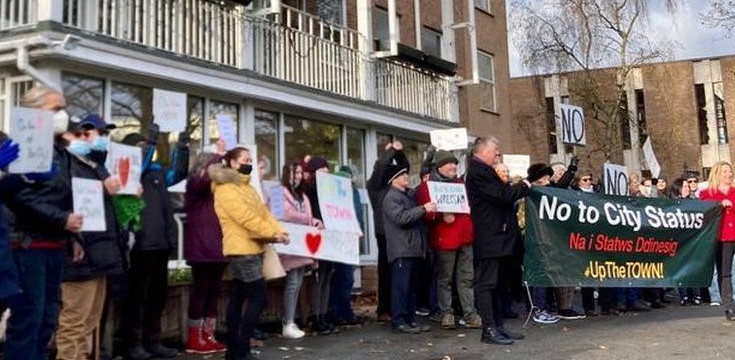
This is a re-write of a piece from a few years ago and something a bit more gentle to round off the series on local government & independence: city status.
Right, it’s not the most important thing in the world – but in the UK it’s just another one of those odd things that doesn’t make much sense.
Though given the furore around Wrexham’s (ultimately successful) bid for city status in 2022, it’s clearly important to many people.
No. Essentially, it’s just a title.
There are no special rights granted to cities in the UK – the only exception perhaps being the City of London (which has a load of unique quirks).
Wrexham Council’s city bid supporting documents (pdf) listed the benefits of city status as including:
- An increased sense of pride amongst residents (though this is subjective and there’s no supporting evidence).
- A general sense of city status elevating the settlement, attracting greater attention and economic focus, as well as providing a platform for international promotion and a stronger brand.
- The ability to attract projects as a city that might not otherwise be considered for a town (again, debatable).
The local authority will have the right to call itself a “City Council” or “City & County Council” and the (ceremonial) Mayor in a city usually holds the title “Lord Mayor”.
As mentioned earlier, cities are often higher up the hierarchy of settlements and tend to be considered (psychologically) “more important” than towns and villages. Cities usually become a focal point for a regional/sub-regional economy and key public services.
Wales has a few towns that are de facto cities because of their sub-regional importance, as well as many de jure cities that are only classed as such through historical flukes.
Post-independence, we could have a more rational system for designating cities that doesn’t rely on religious architecture or royal prerogatives but on geographical realities.

