


Last week, the Senedd (Members & Elections) Bill was tabled.
It comes after the best part of 20 years of consultations, commissions, backroom talks and committees to get to a point where the Senedd will finally be considered to be (so-called) “fit for purpose”.


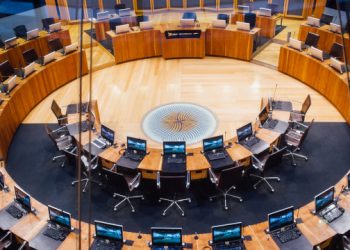
I don’t cover the Senedd that often anymore (if ever), but this is a “constitutional” matter with a broader impact on democracy. It’s also a far more significant electoral reform than those passed in the previous term.
As for my own opinions, the whole thing is yet another wasted opportunity – but there are some positives. A few tweaks as the Bill goes through the law-making process would take it something closer to acceptable, even good.
The proposed voting system
Unfortunately, the Bill sticks with a closed-listed system to elect MSs.
The big plus point is that it’s easy to understand. You get one vote (for a party) and MSs are elected in order based on how the party decides to place them and how many votes the party receives in the constituency. So while the overall result ought to be proportional, the parties ultimately decide who represents your area.
That’s worse than the system we have now because we have some control over the individual elected to represent our constituency. There’s an element of peril to it because it’s easier to lose a seat under first-past-the-post. Meanwhile, we might vote for a different party on the regional list based on policies we like.
This wouldn’t be a problem under single transferable vote (STV) because you can vote for as many candidates as there are seats in order of preference. So you can vote for an individual candidate and a party at the same time. The MSs behind this Bill have decided that we’re too stupid to count from 1-6. It’s worth reminding everyone that STV had majority support in the public consultation on Senedd reform.
Far from being “a strengthening of democracy” this seems like a backwards step. Keeping the mix of first-past-the-post constituencies and regional list members is preferable to what’s on the table.
The impact on smaller parties and Independents
Under the proposed system, the bar needing to be hit for a smaller party or Independent candidate to be elected is much higher than under the current system or STV.
Some of the smaller parties which have celebrated the Senedd’s expansion – Greens, I’m looking at you – are acting like (using a suitably apt analogy) turkeys voting for Christmas.
6 member constituencies using D’Hondt makes it far less likely that the Greens will make a significant Senedd breakthrough in 2026 because they’ll probably need to get 10-15% of the vote to win a single seat.
If Labour performs as they usually do (edit:) in most constituencies (40-50% of the vote), they’ll probably pick up those 5th and 6th seats; not the Greens, not Independents, and probably not other smaller parties like the Lib Dems, Reform UK, Propel, Abolish etc. either.
A different formula could be used to calculate the number of seats each party/group wins (known as the Sainte-Laguë method). It increases the number by which the total votes are divided, potentially benefiting smaller parties.
However, it’s telling that the explanatory memorandum states:
“In some countries, the Sainte-Laguë method has been modified to reduce the risk of political fragmentation, which could result from smaller parties benefitting from the method…Hyper-proportionality in turn could give rise to circumstances where smaller parties had a disproportionate voice, and thereby influence upon government formulation and policy.”
So a stitch-up by Labour, Tories and Plaid Cymru because somehow smaller parties and Independent candidates are less legitimate?
STV doesn’t have this problem.
No more by-elections
Under the proposed system, if a member resigns or dies in office their vacant seat would pass to the next person on their closed constituency list. In principle, there’s nothing wrong with this and it would save the cost of holding an election. It’s happened a few times on the Senedd regional lists.
But what if the member resigned in disgrace or was disqualified (i.e. imprisoned)? In those circumstances, should their party be let off the hook for possibly failing to act? Likewise, wouldn’t it be nice for the successor to get an endorsement from their electorate?
Protest votes are no less legitimate than “informed” votes and the option of giving parties a slap across the face mid-term ought to be a key tenet of democracy.
STV doesn’t have this problem.
Lifting the cap on the number of ministers
Why? Nobody asked for this as far as I recall.
We’ve been told the whole point of this law is to improve scrutiny of the government, not to increase the size of the government itself. The 2017 review recommended an increase from 12 ministers to 14 – which seems proportionate.
The Bill proposes an increase to 17 ministers and possibly up to 19 “if there’s devolution of further powers”. Assuming Labour continues to run minority governments, you’ll be looking at close to half of the ruling party being on the government payroll – which isn’t much different to how things are now.

