


Last week, the Senedd (Members & Elections) Bill was tabled.
It comes after the best part of 20 years of consultations, commissions, backroom talks and committees to get to a point where the Senedd will finally be considered to be (so-called) “fit for purpose”.


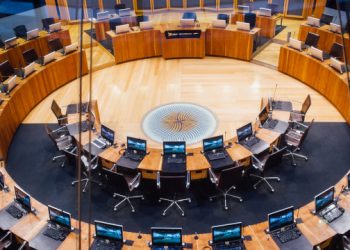
I don’t cover the Senedd that often anymore (if ever), but this is a “constitutional” matter with a broader impact on democracy. It’s also a far more significant electoral reform than those passed in the previous term.
As for my own opinions, the whole thing is yet another wasted opportunity – but there are some positives. A few tweaks as the Bill goes through the law-making process would take it something closer to acceptable, even good.
Primary elections (as an alternative to open-list)
The common sense way to address this is to adopt Single Transferable Vote (STV).
In the absence of common sense, at least allow us to publicly scrutinise the order on the party lists before the election and give sitting and prospective members the duty to properly defend their records.
This shouldn’t be a free-for-all and voting in primaries ought to be restricted to party members and affiliates, but it ought to be done formally via a secret ballot to a clear set of election rules.
In principle, any registered member of a party in good standing and who meets the eligibility rules should be able to run in a primary – meaning no selection/shortlisting committees.
It’s not a perfect solution, but it might make closed lists/D’Hondt more palatable knowing they’re a true reflection of the party membership’s views.
New rules on swapping parties/”crossing the floor” during term time
This was a problem during the Fifth Senedd with some MSs swapping parties multiple times. It doesn’t seem to have been addressed at all in the Bill.
It still has to be allowed, but MSs shouldn’t be able to take the piss.
For example, members could only be allowed to change political group/affiliation once during a term, could only join another party if that party is already a recognised group, or could only be allowed to become a non-affiliated Independent if leaving a party (or sit as an Independent for a minimum period before being able to join another party/group).
Associated amendments to the Local Government & Elections Act
Anything deemed “good enough” for the Senedd ought to apply to local government too. That includes introducing a wholly proportional voting system (in this case the D’Hondt method), returning to four-year terms etc.
Term limits for Senedd Members & office holders
The United States has strict term limits, but this is easier to apply there because executive roles are separated from lawmakers. It’s a bit more difficult in a parliamentary system where the government and lawmakers are all members of the same parliament.
All politicians have a natural shelf life of 10-12 years and being an elected member (at all levels) ought to be seen as a temporary role, not a career.
While the absence of term limits allows politicians to build up experience (particularly at the ministerial level), “time serving” on the backbenches leads to stagnation and complacency. It also prevents the election of fresh blood with new perspectives.
For argument’s sake, MSs could only be allowed to serve for a maximum of four terms, whether consecutive or staggered. To ensure some level of policy continuity/stability, members who’ve spent at least three-quarters of a term (3 years) in a government/ministerial role, won’t have that term count towards the limit.
Additionally, MSs should only be allowed to serve as a Llywydd, Senedd Commissioner or committee chair for a single term.
The Llywydd should formally sit as an Independent
While in practice this happens anyway, there’s a clear conflict of interest if the presiding officer (Llywydd) remains an active member of a party or party group.
They would still need to stand for election on a party ticket (because it’ll be next to impossible for an Independent candidate to be elected under the proposed system), but they shouldn’t be allowed to remain in a party or party group the moment they’re elected to the position of Llywydd.
A new standards regime for Senedd members
This could include things like transferring responsibility for investigating Ministerial Code breaches to the Standards Commissioner and the option of disqualifying people from office for serious or persistent standards breaches.
Something similar to the 14 calendar day suspension rule in the UK Parliament – which forces a recall petition – couldn’t be applied in Wales under the new electoral system because there would be no by-elections.

