Senedd Home
Oggy Bloggy Ogwr
State of Wales
Sunday, August 9, 2026
  • About & Contact
    • About State of Wales
    • Comments Policy
    • Complaints Policy
    • Contact
    • Disclaimer
  • Elections Centre
  • The Independence Index
    • The Independence Index (Full)
    • Foreign Policy
      • Relations with the former UK & Ireland
      • Relations with Europe
      • Foreign Policy (General)
      • International Organisations & Law
      • Overseas Aid
    • Defence
      • Defence Policy
      • NATO
      • Armed Forces
      • National Security
      • Civil Defence
    • Rules & Regulations
      • Safety & Standards
      • Intellectual Property
    • Economics & Money
      • Business & Economy
      • Currency
      • Tax & Spending
      • Transport & Infrastructure
    • Society
      • Communities & Housing
      • Culture & Sport
      • Education
      • Health
      • Media & Communications
      • Science & Technology
    • The State
      • Environment & Natural Resources
      • Justice
      • Local Government
  • Support & Donate
No Result
View All Result
  • About & Contact
    • About State of Wales
    • Comments Policy
    • Complaints Policy
    • Contact
    • Disclaimer
  • Elections Centre
  • The Independence Index
    • The Independence Index (Full)
    • Foreign Policy
      • Relations with the former UK & Ireland
      • Relations with Europe
      • Foreign Policy (General)
      • International Organisations & Law
      • Overseas Aid
    • Defence
      • Defence Policy
      • NATO
      • Armed Forces
      • National Security
      • Civil Defence
    • Rules & Regulations
      • Safety & Standards
      • Intellectual Property
    • Economics & Money
      • Business & Economy
      • Currency
      • Tax & Spending
      • Transport & Infrastructure
    • Society
      • Communities & Housing
      • Culture & Sport
      • Education
      • Health
      • Media & Communications
      • Science & Technology
    • The State
      • Environment & Natural Resources
      • Justice
      • Local Government
  • Support & Donate
No Result
View All Result
State of Wales
No Result
View All Result
Home Foreign Policy

How many embassies would an independent Wales have?

Owen Donovan by Owen Donovan
June 30, 2025
in Foreign Policy, Foreign Policy (General)
How many embassies would an independent Wales have?
Share on FacebookShare on TwitterShare on RedditShare on BlueskyShare by email

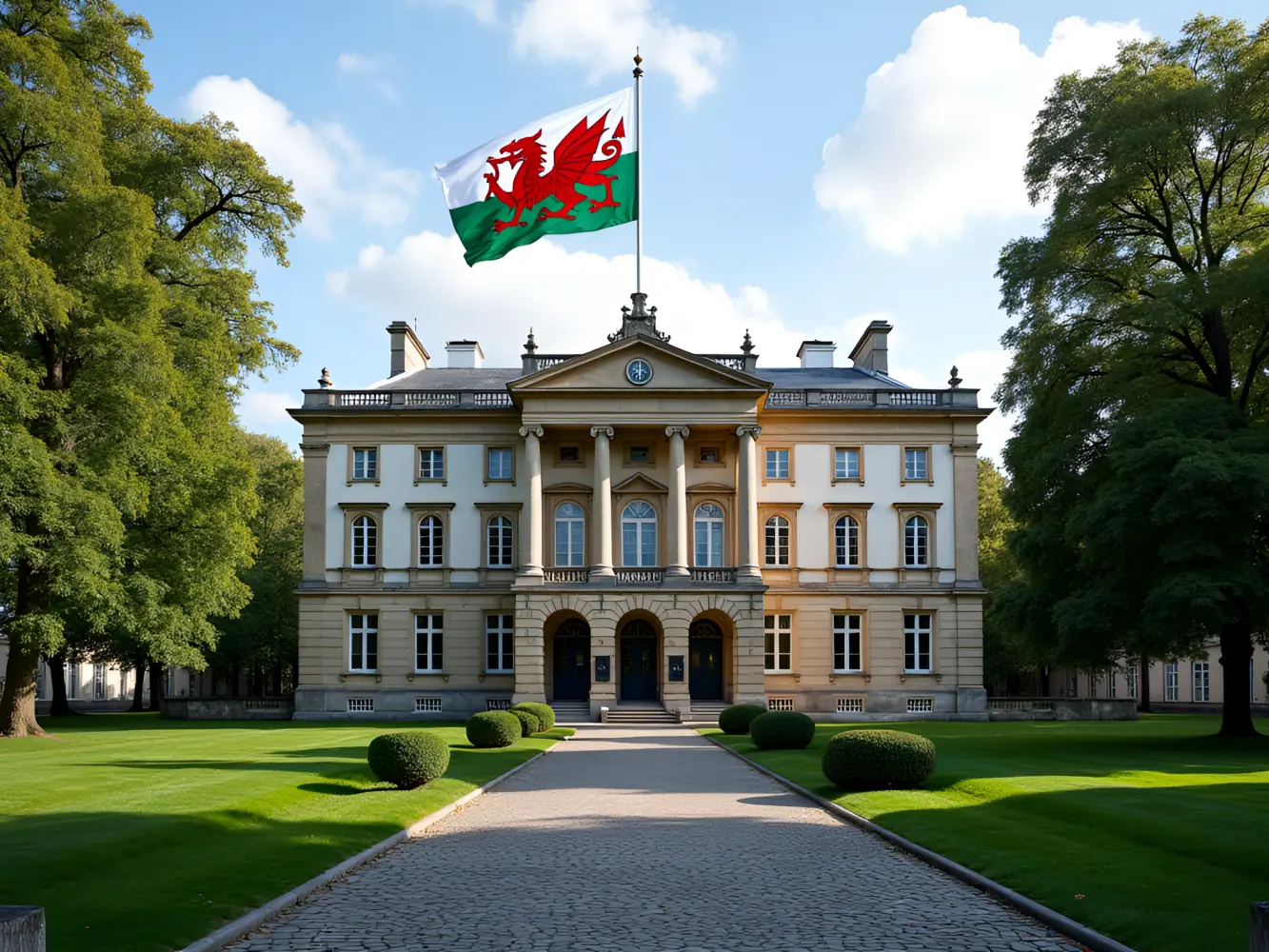
Image Source: AI generated, scroll to the bottom for details

This site is best viewed in landscape mode on smartphones.
Support IndyWales? Support State of Wales!

Donations keep this site going. If you like what I’m doing here and think this work is important to the independence movement, consider a donation. One-off or monthly; as little or as much as you want. Click the links below, or full details are available here.

What Happens Now?

The UK Government’s Foreign, Commonwealth & Development Office (FCDO) manages the UK’s network of embassies, high commissions and consulates.

As of April 20251, the UK’s overseas network consisted of:

  • 120 embassies or embassy offices.
  • 57 high commissions*, deputy high commissions or high commission offices.
  • 53 consulates.
  • 41 other offices (governors of overseas territories, trade offices, honorary consulates etc.).
  • 11 delegations to international organisations (i.e. United Nations, NATO, European Union).

Embassies and high commissions are a base for the UK’s diplomatic staff. They’re usually responsible for maintaining formal diplomatic relations with the country they’re based in.

Consulates are satellite offices that provide certain services, such as trade promotion or helping tourists.

As of 2025, the Welsh Government has a network of 20 international offices (they can’t be called embassies or consulates). Most of these are located in countries that are important for trade or promotion; five offices are in the US and there are three each in China and India, for example. Some of these are co-located with FCDO offices.

These offices were a network formed as part of the International Business Wales agency – set up to boost foreign trade and investment. The agency was brought “in-house” to the Welsh Government in 20102.

*Embassies with Commonwealth countries are normally called high commissions. Deputy high commissions are a bit like a consulate in Commonwealth countries.

Does This Work for Wales?

In terms of breadth and reach: yes. In terms of supporting Welsh interests abroad: no.

There are very few places in the world that don’t have a FCDO presence. A lot of this will be a legacy of the British Empire, when the UK was a genuine global power.

However, the UK is the face of Wales abroad – good and bad. When it comes to promoting Welsh interests abroad this network clearly doesn’t work to our advantage. If it did, the Welsh and Scottish governments wouldn’t have felt the need to set up overseas offices.

A Welsh Diplomatic Mission Network: Pros & Cons

Pros of Independence
Cons of Independence
Pros of Independence

Wales would have a permanent base in other countries. There would be less controversy about the cost or necessity of them (in the same way nobody complains about the cost or necessity of UK embassies and high commissions).

Embassies would provide office space for Welsh agencies (current or future) involved in foreign aid, trade/investment and defence/national security. Embassies are protected spaces under international law.

There’s an opportunity – where practical to do so – to share embassy space and costs with other countries (much like the Nordic embassies/Felleshus3 in Berlin).

We would be able to do a lot more in terms of attracting investment and building up international ties with full diplomatic relations with other countries. We wouldn’t be limited in what we can or can’t do (or offer).

The establishment of a Welsh diplomatic service (or equivalent) would create lucrative posts abroad that wouldn’t normally be available to people living in Wales.

It would make teaching foreign languages at school and university more important (to train future diplomats).

Cons of Independence

Wales would likely no longer have access to the UK’s (pretty extensive) embassy and consular network; we would have to start from scratch and that could take years.

Embassies are a focus for protests and terrorist attacks and often require high levels of security.

We might not have a choice in where a Welsh embassy, consulate or high commission is to be located.

There would be a cost involved in setting up a diplomatic mission – though this will vary from country from country and will depend on factors like the number of staff posted there and the range of services offered.

The idea of a permanent embassy in a single building in a single country may be outdated. Different models can be considered such as mobile regional teams (suggested in 2014 by the Welsh Centre for Public Policy).

As much as we would pay closer attention to the behaviour of other countries, they would be paying closer attention to us. Embassies in Wales could be used as a station for foreign intelligence officers (known as “diplomatic cover”).

What Do Other Countries Do?

Ireland
New Zealand
Denmark
Iceland
Estonia
Ireland

By my count: 72 embassies, 28 consulates or representative offices, and 6 permanent missions with international organisations.

New Zealand

By my count, around 148 embassies, high commissions and permanent missions in total.


Denmark

As of 2024: 68 embassies, 28 consulates, trade offices and embassy offices, and 6 permanent missions to international organisations.


Iceland


18 embassies, 3 consulates, 5 permanent missions to international organisations. Some of these embassies double up as embassies to other countries (i.e. Iceland’s UK embassy also covers Malta and Ireland).


Estonia

37 embassies, 12 consulates and 4 permanent missions/representations.


What Options Does Wales Have?

Where we put Welsh diplomatic missions, and how many of them there would be, depends on several factors.

Where do we need an embassy or consulate?
How would they work?
What would they do?
Where do we need an embassy or consulate?
The Welsh Centre for Public Policy (WCPP) looked at this is 2014 – though this focused on the Welsh Government’s overseas offices4.

  • The amount of trade and investment between Wales and the host country.
  • “Closeness” to where key decisions are made (it’s why many countries have consulates in California and New York City in the case of the US.
  • The cost of maintaining an office – whether stand-alone or co-located in another office.
  • The networking skills of staff.
  • How risky the host country is.

That was focused on devolution and trade. With independence, we would also have to consider:

  • Whether we have formal diplomatic relations with the host country.
  • How “good” relations are between Wales and the host country.
  • The number of Welsh tourists visiting each year (who might need consular help).
  • Closeness to the Welsh diaspora and Welsh “ex-pats”/émigrés.
How would they work?


Traditionally, embassies and consulates are either built from scratch, located in a suitable office or even located in a home (which doubles up as an ambassadorial residence). This is usually done under a contract with the host nation’s government.

Diplomatic missions are protected by treaty5. That treaty also sets out how diplomatic missions work, so it’s standardised across the world, though individual countries may set their own specific rules (as part of a diplomatic code or protocol).

An embassy or high commission would have an appointed ambassador or high commissioner appointed. They would have full diplomatic immunity.

Consulates would likely focus solely on helping Welsh tourists and businesses and would be run by a Consul-General – possibly as a one-person post in some cases.

A separate WCPP report6 suggested that improvements to digital communications mean that Wales wouldn’t necessarily need a physical presence in a country to promote our interests. A very good web portal and marketing strategy might be enough.

The report also suggested that “roving teams of specialist marketing personnel” could be deployed and called in as and when needed (i.e. for a trade fair).

What would they do?
  • Ensure Wales has good ties with foreign governments and heads of state.
  • “Soft intelligence” – networking, filtering out rumours, following up leads and updating the Welsh Government on major political and economic events in the host country.
  • Support Welsh foreign policy objectives.
  • Provide consular services to Welsh citizens and businesses abroad (emergency passports, visas, legal disputes, registering births and deaths abroad).
  • Trade and investment promotion.
  • Building links with Welsh people living abroad.
  • Cultural exchange.
  • Tourism promotion.
  • Provide a local base for Welsh international development programmes.
  • Process asylum and visa applications.

Next, potential shortlists for diplomatic mission locations.

Option One: Do Minimum (45-47 stand alone diplomatic missions)
Option Two: Mix of stand-alone and "super embassies" (37 diplomatic missions)
Option Three: Do Maximum (~70 diplomatic missions)
Consulates (~25-35)
Option One: Do Minimum (45-47 stand alone diplomatic missions)

Great Britain & Ireland (3 or 4): England, Scotland, Ireland (possibly Northern Ireland too).

G20 countries that Wales does a lot of trade with7 (14): Australia, Canada, Saudi Arabia, United States, India, South Africa, Turkey, Brazil, France, Germany, Italy, China, Japan, South Korea.

Major European economies and trade partners (7): Spain, Portugal, Poland, Switzerland, Netherlands, Belgium, Sweden.

A selection of Commonwealth countries not included on other lists (9): Cyprus, Malta, New Zealand, Singapore, Malaysia, Pakistan, Bangladesh, Sri Lanka, Nigeria.

Other major global economies or trade partners (at least 13): Palestine*, UAE, Qatar, Morocco, Egypt, Ukraine, Philippines, Mexico, Argentina, Colombia, Russia, Vietnam, Israel.

*Subject to full recognition as an independent state.

Option Two: Mix of stand-alone and "super embassies" (37 diplomatic missions)

Standalone (22)

Great Britain & Ireland (3 or 4): England, Scotland, Ireland (possibly Northern Ireland too).

G20 countries that Wales does a lot of trade with7 (12): Australia, Canada, Saudi Arabia, United States, India, Turkey, France, Germany, Italy, China, Japan, South Korea.

Major European economies and trade partners (5): Spain, Portugal, Switzerland, Netherlands, Belgium.

European Commonwealth countries (2): Malta, Cyprus.

Regional “Super Embassies” (at least 15)

Europe (4): Poland or Czechia (Central & Eastern Europe), Greece (Balkans); Denmark or Norway or Sweden (Nordic Countries), Finland (Baltic States)

Africa (4): Ghana or Nigeria (West Africa/ECOWAS), Morocco or Tunisia (Maghreb Region), South Africa (Southern Africa/SADC); Rwanda, Uganda or Kenya (East Africa/EAC)

Asia (3): UAE or Qatar (Middle East), Singapore (ASEAN), Kazakhstan (Central Asia & Caucasus)

Pacific Islands (1): New Zealand

Americas (3): Brazil or Argentina (South America), Mexico (Central America), Jamaica (Caribbean Region/CARICOM)

Option Three: Do Maximum (~70 diplomatic missions)

Great Britain & Ireland (3 or 4): England, Scotland, Ireland (possibly Northern Ireland too).

G20 countries that Wales does a lot of trade with7 (14): Australia, Canada, Saudi Arabia, United States, India, South Africa, Turkey, Brazil, France, Germany, Italy, China, Japan, South Korea.

European countries that (i) Wales does a lot of trade with, (ii) have a large ex-pat community in Wales, (iii) host major international organisations, (iv) are likely to be visited by large numbers of Welsh tourists (23): Spain, Portugal, Greece, Austria, Czechia, Slovakia, Poland, Romania, Luxembourg, Switzerland, Netherlands, Belgium, Cyprus, Malta, Hungary, Norway, Finland, Sweden, Iceland, Lithuania, Latvia, Estonia, Holy See.

Commonwealth countries (i) with a population similar to or greater than Wales, (ii) have a sizable community living in Wales or cultural ties to Wales (at least 14): Jamaica, New Zealand, Singapore, Sierra Leone, Rwanda, Zambia, Sri Lanka, Ghana, Malaysia, Uganda, Kenya, Bangladesh, Pakistan, Nigeria (possibly others too).

Other major global economies or trade partners (at least 17): Palestine*, UAE, Qatar, Jordan, Oman, Morocco, Egypt, Ukraine, Philippines, Mexico, Argentina, Colombia, Russia, Indonesia, Thailand, Vietnam, Israel.

*Subject to recognition as an independent state.

Consulates (~25-35)

Wales would probably seek to open consulates in economically important city regions, other stateless nations we have ties with (assuming they don’t become independent before us) and parts of the world that are popular tourist destinations for Welsh people.

This might include:

Europe: Gibraltar, Spain (Canary Islands, Costa del Sol, Balearic Islands, Catalonia, Basque Country, Galicia), Portugal (Algarve), Eastern Mediterranean, including Greece, Turkey (3 or 4), France (Brittany).
Africa & Asia: Somaliland, Palestine, Taiwan, India (Mumbai, Kerala, Bengaluru), China (Shanghai, Hong Kong, Chongqing).
Americas: Canada (Quebec, Toronto, Vancouver), US (New York, California, Chicago, Florida).

Also, between 4-6 permanent missions with major international organisations. The exact number will be dependent on whether Wales joins NATO and/or the EU.

What's at Stake?

The overall score (out of 20) is the total of the scores for the four mini-categories (out of 5 each).

How Would This Be Run?

Whoever is in charge of foreign policy in an independent Wales would be responsible for running a Welsh diplomatic service.

That includes providing corporate services, accommodation and security to embassies, high commissions and consulates.

Some of this would be done jointly with the host country. Or we could – ironically – contract some corporate support services out to FCDO Services. They already work with the Canadian and Australian governments on things like the transport of diplomatic bags (“King’s Messenger Service”).

The recruitment and appointment of diplomats will be looked at separately. 

How Much Will This Cost?

Headline: Between a third and a half of the budget for a Welsh foreign office.

Wales’ population-based share (5%) of UK Foreign and Commonwealth Office spending (combined revenue and capital) on “operating costs, frontline diplomacy and overseas network” was just over £90 million in 2025-268. This would be roughly a third of the budget of a Welsh foreign office if we wanted to match Ireland’s spending.

Each of the Welsh Government’s existing overseas offices (which could be considered a consulate) costs £235,000 per year to run on average9.

Wales might be able to save significant sums of money by sharing embassy space and costs with other countries. There’s also the opportunity to do things differently to keep costs down, such as multi-country/regional embassies or secure online consular services.

The exact cost of running an embassy, high commission or consulate will vary from country to country (rent prices, energy, staff/pay, accommodation costs) and would probably play a part in deciding where Wales opens one.

Some of the costs would be partially offset by income from embassies, high commissions and consulates opened in Wales.

Would any new taxes need to be introduced? 

No, though the Welsh Government would set fees for providing consular services.

Who will pay for this?

General taxation (all taxpayers), apart from consular fees.

How Long Would This Take?

It would happen gradually as and when we are recognised by other countries and start formal diplomatic relations with them.

People & Work

Who does this impact?

Technically everyone resident in Wales. It would be most relevant to politicians, the civil service, businesses based in Wales that do a lot of trade abroad and Welsh tourists.

Would any jobs be created or lost?

The number of people working at each embassy, high commission or consulate would depend on how close relations are between Wales and the host country, the number of Welsh tourists and our foreign policy goals.

So an embassy or high commission in the US, England, Japan or the major EU economies would probably have more posts than a Welsh embassy or high commission in Africa or Southeast Asia.

If the average number of people working at an embassy or high commission was 6-8 and the number working at a consulate was 3-4, then it works out at anything between 480 and 700 posts abroad. That’s based on the potential options for diplomatic mission locations mentioned earlier.

The number of staff at permanent missions would vary and would depend on things like whether Wales joins the EU (permanent missions to the EU often have 50-100 people involved).

You Might Also Like....

Would an independent Wales join the Commonwealth?
Foreign Policy

Would an independent Wales join the Commonwealth?

by Owen Donovan
July 29, 2025
0

...

Read moreDetails
Would an independent Wales join the United Nations and other international organisations?

Would an independent Wales join the United Nations and other international organisations?

July 29, 2025
The Commonwealth

The Commonwealth

July 26, 2025
How would Welsh diplomats be selected and recruited?

How would Welsh diplomats be selected and recruited?

June 30, 2025
How would you get help abroad – as a tourist or business traveller – after independence?

How would you get help abroad – as a tourist or business traveller – after independence?

June 30, 2025
What would a Welsh foreign policy look like after independence?

What would a Welsh foreign policy look like after independence?

June 30, 2025
Hard Power & Soft Power

Hard Power & Soft Power

June 29, 2025
Load More
  1. UK Government, Foreign, Commonwealth & Development Office (April 2025). “List of Foreign, Commonwealth & Development Office posts abroad”.

  2. Prof. DJ Evans (17th July 2010). “Closing overseas investment body is ‘own goal’ for Wales”.

  3. Nordische Botschaften, “The Nordic Embassies in Berlin”.

  4. Welsh Centre for Public Policy (October 2014). “Decisions, Decisions: How should the Welsh Government decide where to locate its overseas offices”.

  5. Vienna Convention on Diplomatic Relations (1961).

  6. Welsh Centre for Public Policy (October 2014). “Punching our Weight? International Comparisons of the Location and Staffing of Overseas Offices”.

  7. StatsWales (2023). “Value of Welsh exports by quarter and destination (£m)”

  8. UK Government, Foreign, Commonwealth & Development Office (16th May 2025). “FCDO Main Estimate Memorandum 2025”.

  9. BBC Wales (26th February 2025). “Shut offices abroad to save cash, Tories say”. Annual quoted running cost of £4.7 million divided by 20 offices (£235,000 mean average).

Use of AI

The title image was generated using ComfyUI and the FLUX1 model.

Donations Welcome
Tags: Civil ServiceDenmarkDiplomacyEstoniaFP 303IcelandInternational DevelopmentInternational LawInternational OrganisationsIrelandNew ZealandTradeTreatiesWelsh Government
Previous Post

What would a Welsh foreign office look like?

Next Post

How would you get help abroad – as a tourist or business traveller – after independence?

Owen Donovan

Owen Donovan

Archive

Categories

Copyright

Creative Commons Licence

State of Wales by Owen Donovan is licensed under a Creative Commons Attribution-NonCommercial-NoDerivatives 4.0 International License.

Subscribe by Email

Search

No Result
View All Result
No Result
View All Result
  • Go To Senedd Home
  • Go To Oggy Bloggy Ogwr
  • About & Contact
    • About State of Wales
    • Comments Policy
    • Complaints Policy
    • Contact & Subscribe by Email
    • Disclaimer
  • Features
    • After the UK
    • Chinny Reckon
    • Devil’s Advocate
    • How Wales Works
    • Road to Brexit
  • The Independence Index
    • The Independence Index (full)
    • Economics & Money
      • Business & Economy
      • Currency
      • Tax & Spending
      • Transport & Infrastructure
    • Society
      • Communities & Housing
      • Culture & Sport
      • Education
      • Health
      • Media & Communications
      • Science & Technology
    • The State
      • Environment & Natural Resources
      • Justice
      • Local Government
  • Elections Centre
  • Wales FAQ
    • How is Wales funded?
    • How are laws in Wales made?
  • Support & Donate