Image Source: PNG Arts
Donations keep this site going. If you like what I’m doing here and think this work is important to the independence movement, consider a donation. One-off or monthly; as little or as much as you want. Click the links below, or full details are available here.
What Happens Now?
In broad terms, intellectual property (IP is a legal claim of ownership over rights relating to creative works. This can take several forms:
- Patents – Legally protect an invention, its design and functions. Patent owners can take legal steps to prevent anyone else from copying what’s outlined in the patent itself. It applies mainly to things with industrial uses.
- Trade marks – A legally protected “sign/brand” for a company or product, assuring consumers that the product is what it says it is and from who it says it’s from. Uses the symbols ™ and ®
- Registered designs – IP protection for how a product “looks”.
- Copyright – Legal ownership over “original creative works” (books, plays, TV programmes, music, etc.). It means they can’t be reproduced without permission from the copyright owner(s), depending on the terms and conditions under which it was produced/published. Copyright doesn’t have to be registered, as it’s automatic, simply by using the © symbol and a date.
The Intellectual Property Office (IPO), also called the Patent Office, is the UK agency responsible for registering and managing intellectual property rights. They are headquartered in Newport, having relocated from London in the 1990s. In 2024-25, the IPO employed just under 1,700 staff and had annual revenues of £161.5 million1.
Does This Work for Wales?
It’s debatable.
As a service, there are no obvious issues. As noted, the IPO is (at least on paper) a significant UK Government employer in Wales, much like the Office for National Statistics and DVLA.
All global economies are grappling with Artificial Intelligence (AI) and the impact it’s already having on creative industries and other types of intellectual property. Wales is no different.
IP is particularly important to universities and businesses, as it sends out a positive message about innovation. While research undertaken by Welsh universities is often undertaken to a high standard, or is even world-leading2, income from IP is low3.
What Would Be the Pros & Cons of Independence?
If we were to set up a new IP agency, it would create a small number of highly skilled graduate roles (patent law, senior managers). These jobs would be guaranteed in Wales and could be moved outside the country.
Having more local control of IP may make it easier to build closer working ties with Wales-based businesses and universities. This may help boost the number of patent applications and other forms of copyright. In the longer term, this may generate more income.
It may make it quicker and easier to take action on emerging threats to IP or IP law, such as “copyright trolling” and issues around AI.
A Welsh IP agency is likely to be smaller and, proportionally, cost less to run than the UK equivalent.
The IPO has a certain level of trust built up over decades – within the UK and internationally – which may be hard for a Welsh equivalent to match (at least in the short term).
Much like the Office for National Statistics, while an independent Wales may have a need for its own statistics authority, it’s unlikely to employ anywhere near as many people as the IPO currently does in Newport.
What Do Other Countries Do?
![]()
The Intellectual Property Office of Ireland is the national IP agency and has the same roles and responsibilities as the IPO in the UK. In 2024, it raised just over €10.5 million in revenues (£9.1 million) and employed 46 staff4.
Adjacent to this is Ireland’s Copyright Licensing Agency. This agency supports the creative industries to protect IP. They act as a central representative agency to issue licences for the use of their work by schools, colleges and businesses.
![]()
The Danish Patent and Trademark Office is the national IP agency. It performs a similar function to the UK’s IPO. It employs 200 people as of 20265.
![]()
Finland’s national IP agency is the Finnish Patent and Registration Office (PRH). It performs a similar function to the UK’s IPO. As of 2024, it employed 434 people and generated €68.4 million (£59.3 million) in revenues6.
![]()
The Intellectual Property Office of New Zealand is….you guessed it. Similar role to the UK’s IPO. The only major difference is that it’s seemingly run directly by New Zealand’s Ministry for Business, Innovation and Employment. Most other examples are quangos or semi-independent agencies.
What Options Does Wales Have?
It seems as though the international gold standard option is to have a stand-alone national IP agency. Such an agency would be responsible for copyright, trademarks, designs and patent protection.
What's at Stake?
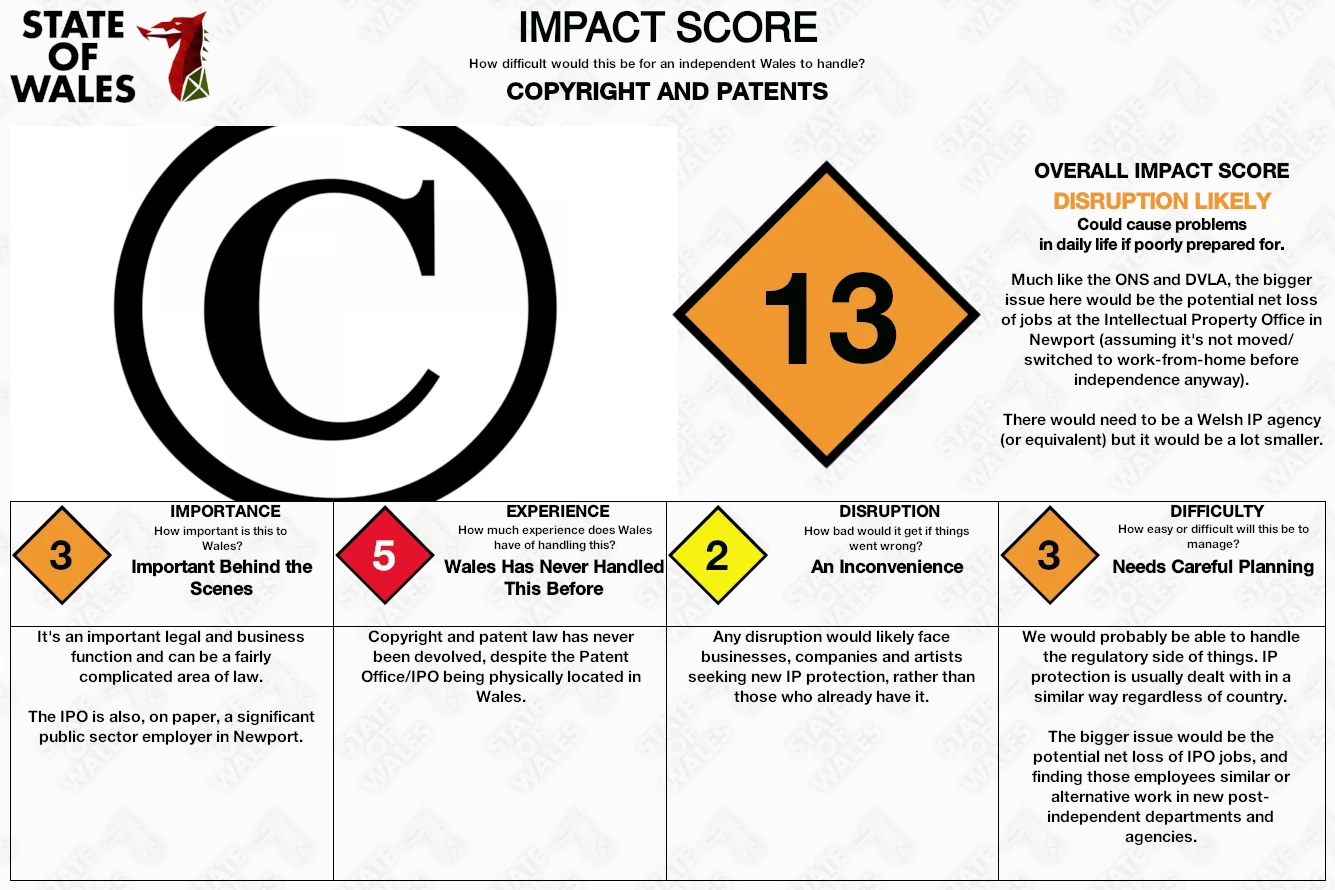
The overall score (out of 20) is the total of the scores for the four mini-categories (out of 5 each).
How Would This Be Run?
The only question here is whether a Welsh IP agency is run directly by the Welsh Government, or as an arms-length body. Either way, they would presumably be accountable to the Welsh Government minister responsible for business/the economy.
How Much Will This Cost?
IP agencies usually finance themselves through fees. Any shortfall in annual operating costs would be made up by a Welsh Government grant. Similarly, any operating surplus could be returned to the Welsh Government.
Would any new taxes need to be introduced?
No.
Who will pay for this?
Income would be generated through application fees.
How Long Would This Take?
The relevant existing copyright laws – Registered Designs Act, Patents Act, Copyright, Designs and Patents Act and Trade Marks Act – would remain in force because of the common law system. It would be up to the Senedd whether those laws need to change or not.
So the law and rules wouldn’t change, only the responsibility for registration and enforcement, which would switch from the UK Government to the Welsh Government.
People & Work
Anyone working in an industry or sector where intellectual property is important. This would include the creative arts, publishing, media, higher education, R&D in manufacturing, as well as marketing and the legal profession.
Many businesses – of all kinds – would need to (or want to) protect their trade marks or product line names as well.
There could be a significant job impact on Wales as the Intellectual Property Office is headquartered in Newport.
Based on the international examples mentioned earlier, a Welsh IP agency would likely employ at most 200 people. That could lead to a net loss of anything up to 1,500 jobs.
However, there would be similar jobs created elsewhere that currently don’t exist in Wales. For example, agencies related to national standards and consumer protection.
You Might Also Like....
- UK Intellectual Property Office, “Annual Report 2024-25”.
- Business Live (12th May 2022). “The verdict on the quality of research at Welsh universities”
- Nation.Cymru (25th April 2025).”Earning more money from patents would halt university cutbacks, says lawyer”
- Intellectual Property Office of Ireland. “Annual Report 2024”.
- Danish Patent and Trademark Office.
No AI tools were used to draft this post.